
“My Daughter Just Turned Nine and Already Has Breast Buds. Is That Normal?”
“My son is thirteen and hasn’t really hit his growth spurt yet. Should I be worried?”
These two questions sit on opposite ends of the same concern. One parent is watching their child develop faster than expected. The other is waiting for a growth surge that hasn’t arrived. Both are trying to understand the same thing: where exactly is my child in their growth journey, and how much time is left?
Most parents know the word “puberty.” Far fewer understand how to read it. And almost none have been told this: certain signs visible at home can tell you whether your child’s growth window is just opening, fully underway, or beginning to close. You just need to know what to look for.
That is what this post is about.
Why Families Across the U.S. Trust I Grow Clinic
| Credential | Detail |
|---|---|
| Children guided | Nearly 3,000 with precision growth strategies |
| Treatment retention | 95% rate, reflecting exceptional outcomes and family trust |
| Approach | Meticulous 1:1 personalized management using AI-driven bone age analysis |
| Medical Director | Board Certified by the American Board of Physical Medicine and Rehabilitation (ABPMR) |
| Experience | 20+ years specializing in Pediatric Growth and Developmental PM&R |
| Reputation | 5-Star Google Rating with numerous testimonials |
| Telehealth | Available in CA, NY, WA, FL, and TX |
What Are the Tanner Stages, and Why Do They Matter for Height?
In 1969, a British pediatrician named James Tanner systematically documented the physical stages of puberty for the first time. What he described, now known as the Tanner Stages or Sexual Maturity Ratings, is a five-stage framework that tracks the progression of physical development from prepuberty to full sexual maturity.
Most parents encounter Tanner Stages as a list of physical changes. What they are less often told is that these stages are directly connected to the growth plates, the bone age, and the remaining growth window for height gain. Reading Tanner Stages correctly gives you a real-time read on where your child’s growth clock actually stands.
The Five Tanner Stages: What Each One Means for Height
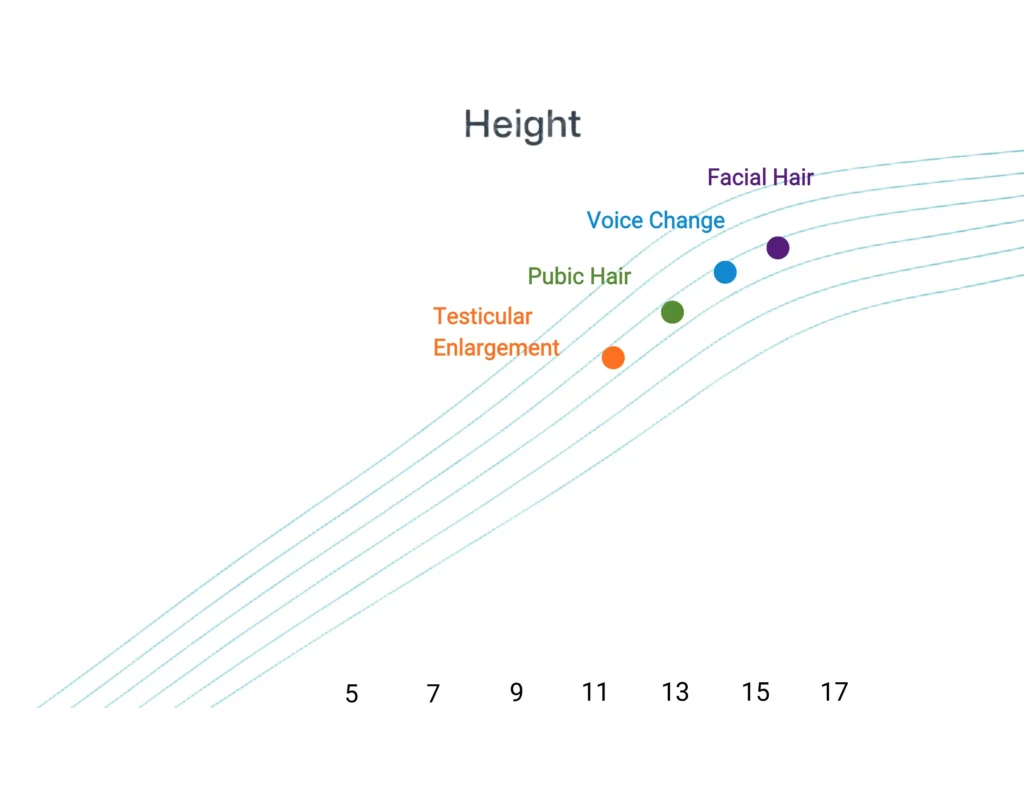
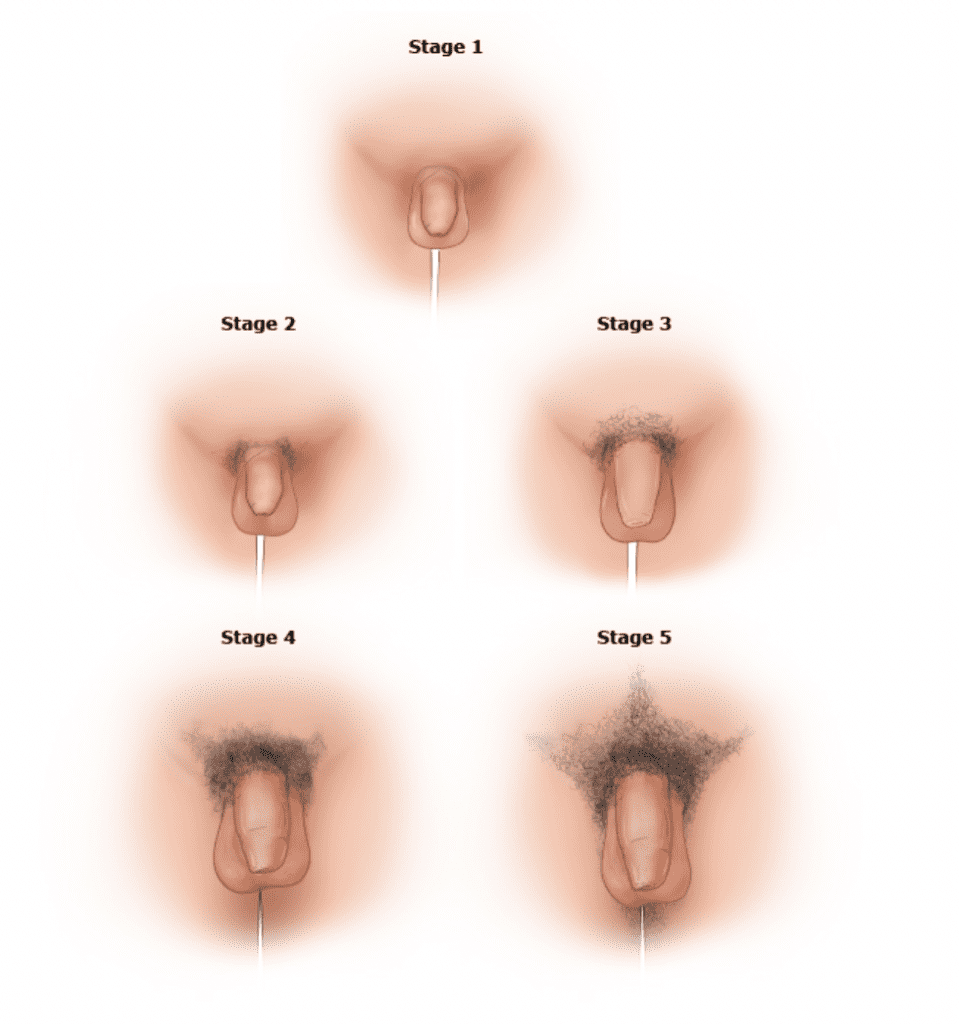
Boys: Tanner Stages and Height Growth
| Stage | Key Signs | What It Means for Height |
| Stage 1 Pre-puberty | No visible changes. Testicular enlargement begins quietly. Check every 6 months. | Growth is steady at about 2 inches per year. This is the widest open window. Establish your height tracking baseline now. |
| Stage 2 The Starting Signal | Testicles continue to enlarge, approaching adult size. The scrotal skin becomes darker and thinner. | The growth spurt will begin in 6 months to a year. |
| Stage 3 Growth Spurt Underway | Pubic hair darker and curlier. Penis lengthening. Voice cracking. Muscle growth. | Peak height gain of 3 to 4 inches per year. Growth plates are working at maximum capacity. |
| Stage 4 Slowing Down | Voice deepens permanently. Facial and underarm hair appear. | Growth is still occurring but decelerating. Facial hair signals the long bone plates are approaching closure. |
| Stage 5 Growth Complete | Facial/armpit hair fills in. Pubic hair reaches inner thighs. | Long bone growth plates have closed. Still growing in spine/pelvis but very slowly. |
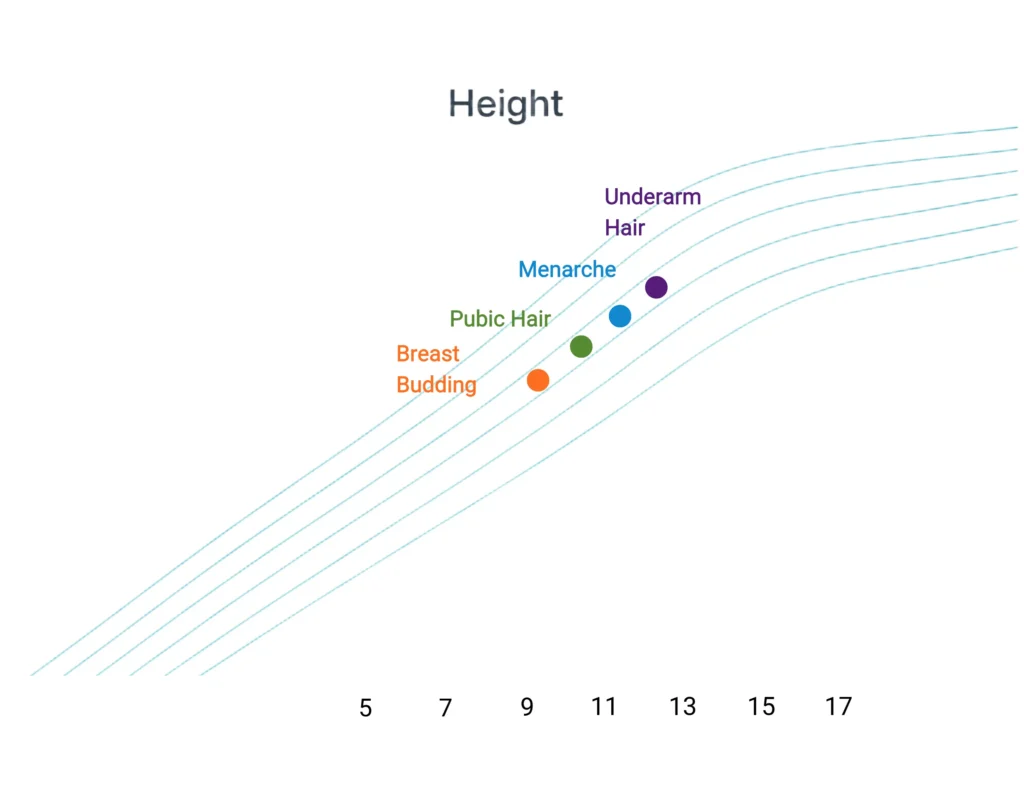
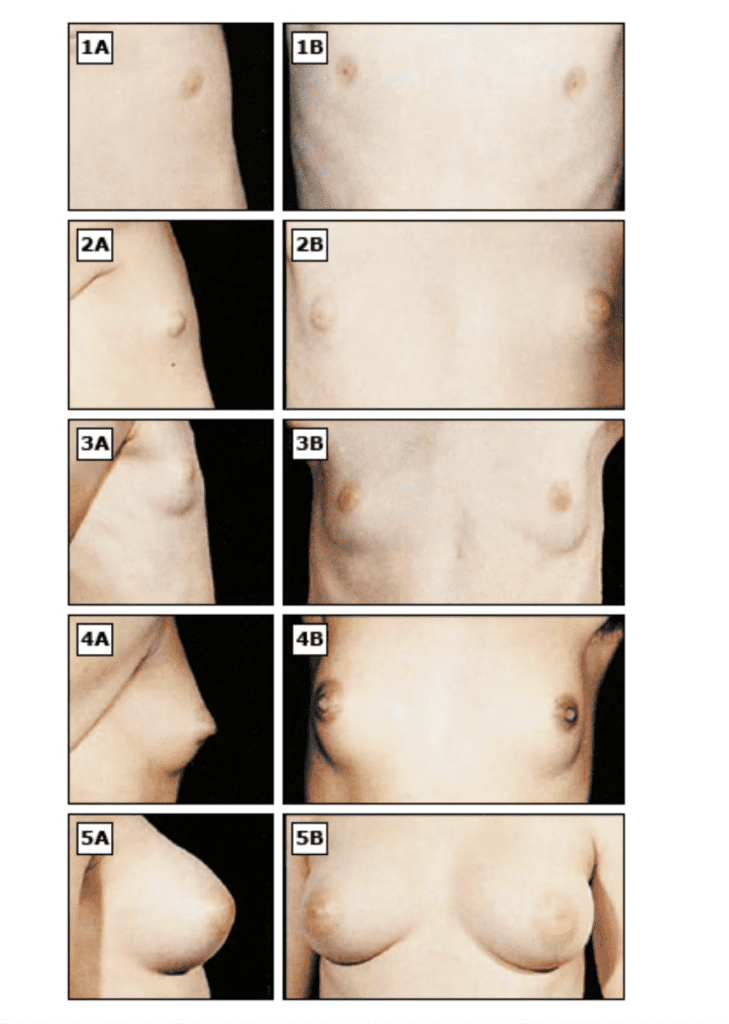
Girls: Breast Tanner Stages
| Stage | Key Signs | What It Means for Height |
| Stage 1 Pre-puberty | No breast tissue. | Baseline. Growth steady at about 2 inches per year. |
| Stage 2 The Starting Signal | Breast budding appears. Pubic area is still stage 1. | Growth spurt begins about 1 year later. |
| Stage 3 Growth Spurt Underway | Breasts continue growing. Pubic Tanner Stage 2 begins around this time. | Growth spurt is underway. Peak height gain is starting. |
| Stage 4 Slowing Down | Breasts fuller. Pubic Tanner stage 3-4 | Growth slowing. Menarche usually begins here. Most girls grow 1 to 2 inches in the 1 to 1.5 years following menarche. |
| Stage 5 Growth Complete | Adult breast size. | Long bone growth plates have closed. Still growing in spine/pelvis but very slowly. |
The One Sign You Can Monitor at Home
Before getting into the stages, there is one practical piece of information worth knowing first.
For both boys and girls, the appearance of pubic hair is often the easiest sign to notice at home, and it frequently aligns with the beginning of the growth spurt. It is not a perfect marker, and timing varies between individuals, especially in children with naturally heavier body hair due to ethnicity or genetics. But for most children, it is a useful starting signal that the growth window has opened.
How to Monitor Your Child’s Growth Window Without a Doctor Visit
You do not need a bone age X-ray, a blood test, or a clinic appointment to start understanding your child’s growth window. Two simple habits, done consistently, can give you a meaningful picture.
- Watch for pubic hair. For both boys and girls, initial pubic hair appearance generally signals that the growth spurt has begun or is about to begin. Note the date when you first notice it. This becomes your starting point.
- Measure height monthly, at the same time of day. Start this before puberty if possible, to establish a baseline growth rate. Once the growth spurt begins, you will notice a clear change. In boys, the monthly gain can suddenly double compared to the months before. In girls, the increase is typically around 1.5 times the baseline rate. This shift in growth velocity, combined with the appearance of pubic hair, gives you a strong, practical signal that the growth window is open and actively running.

Once the growth spurt begins, it typically lasts about two years. The first year tends to bring the most dramatic height gain. The second year, growth begins to taper as the long bone growth plates start to close. Consistent monthly measurement is what lets you track this arc in real time.
One thing worth knowing during this period: as the body grows faster, bone age advances faster too. The gap between a child’s chronological age and their bone age widens during the growth spurt, and this is completely normal. It happens in every child going through puberty. We mention this because parents who visit our clinic after their child has already gone through the growth spurt are often surprised to see how far ahead the bone age is. But it is simply what puberty does to the skeleton and everyone eventually goes through it.
The Bone Age Clock Behind the Stages
Understanding Tanner Stages becomes even more precise when you layer in bone age. Here is the general timeline based on our clinical experience, noting that individual variation exists:
For boys:
- Bone age 12.5 to 13 years: growth spurt begins
- Bone age in the early 14’s: the first year of the growth spurt is complete, the fastest phase has passed
- Bone age 15 years: fingertip growth plates (the very first one to close in the body) close, growth velocity drops by roughly 40 to 50 percent
- Bone age late 15 to 16 years: growth spurt ends, long bone plates approaching closure
- Bone age 17 years: long bone growth plates are closed
For girls:
- Bone age 10.5 to 11 years: growth spurt begins
- Pubic hair appearance, typically about one year before menarche: growth spurt is underway
- Menarche: growth continues but velocity begins to decline, corresponding to bone age approximately 12.5 to 13 years (individual variance)
- 1 to 1.5 years after menarche: long bone growth plates are nearly closed and the growth spurt ends
This is why two children at the same chronological age can be at completely different points in their growth journey. A 13-year-old boy with a bone age of 11 has a meaningfully different outlook than a 13-year-old boy with a bone age of 15.
🔍 To understand how bone age differs from your child’s actual age, read: Bone Age vs. Chronological Age: Is Your Child’s Biological Clock Ticking Too Fast?
When to Seek a Professional Evaluation
Monthly height tracking and pubic hair monitoring are powerful tools for parents. But there are moments when that data points toward the need for a clinical assessment.
Consider a bone age evaluation if:
- Breast budding appears before age 8 in girls, or testicular enlargement before age 9 in boys
🔍 To learn when early puberty requires medical attention, read: Early Puberty Treatment: When to Start?(coming soon)
- Your child’s growth spurt started significantly earlier than their peers
- Growth during the spurt seems underwhelming: monthly gains that were doubling have suddenly returned to the pre-spurt baseline
- Your gut tells you the growth window is closing and you want clarity before it does
A simple hand X-ray, analyzed with AI-driven precision at I Grow Clinic, can tell you exactly where the growth plates stand and how much potential remains. This is not guesswork. It is a data point that changes the conversation from “wait and see” to “here is exactly where we are.”
🔍 To understand how to assess how much growth time is actually remaining, read: How Do You Know If Growth Plates Are Closed? 3 Key Signs Parents Often Miss
A Note to Parents Who Are Watching and Wondering
Many parents in our clinic tell us the same thing: “I had a feeling something was happening, but I didn’t know what to look for.” Now you do.
The Tanner Stages are not just a checklist of physical changes. They are a timeline, and each stage is a hint about where your child’s growth window stands and how much time is realistically left. You do not need to be a medical provider to read these signs. You need a height measure, a calendar, and the knowledge of what you are looking for.
Growth hormone therapy is most effective when the long bone growth plates are still open and active. Once they have closed, no intervention changes that. This is why the families who benefit most from our care are the ones who came in while the window was still open.
If you are tracking your child and something in the data makes you want a clearer picture, that instinct is worth acting on.
🔍 To understand how puberty suppression affects height growth, read: Do Puberty Blockers Stop Height Growth? (Coming soon)
Don’t let the clock run out on guesswork.
Schedule your precision growth consultation today.
FAQ: What Parents Ask Most About Tanner Stages and Height
1. Can I tell which Tanner Stage my child is in without a doctor visit?
To a meaningful degree, yes. Pubic hair onset and the change in monthly height velocity are the two most practical home markers. A physician can confirm staging more precisely, and a bone age study adds a layer of accuracy that home monitoring cannot, but you can still learn a great deal from consistent tracking at home.
2. My daughter got her period at 11. How much more will she grow?
On average, girls grow 1 to 2 inches in the 1 to 1.5 years following menarche. However, menarche alone does not determine the exact amount of remaining growth. Bone age and height velocity at the time of menarche are more reliable predictors. Some girls grow more, some less.
3. My son has pubic hair but his voice hasn’t changed yet. Where is he in the growth spurt?
Early pubic hair generally marks the beginning of the growth spurt. Voice change comes later, closer to the peak. If his voice has not yet changed, he is likely still in the most active phase. Keep measuring monthly.
4. Is early puberty always a problem?
Not automatically. It depends on the child. Early puberty becomes a concern when a child is already shorter than their peers and enters puberty early. When puberty arrives early, bone age begins advancing faster than chronological age, which shortens the overall growth window. If the child is already on the shorter side, this means they may end up at an even lower height percentile than where they are now. That is when early intervention matters.
On the other hand, if a child is already tall, early puberty is often less of a concern. In fact, many tall children naturally have a bone age that runs ahead of their chronological age. For them, an advanced bone age is simply part of who they are, not a warning sign.
5. My son is 15 and still growing steadily. Does he need an evaluation?
If he is growing steadily and you know roughly where he is in his puberty progression, you may not need an immediate evaluation. But if you want to know precisely how much time remains, a bone age study gives you that answer. Many families find that a single evaluation at this age provides the exact clarity they need to decide whether to continue watching or take action.