

The Question Every Parent Asks: “My son just turned sixteen — will he keep growing?”
A mother once asked me in my clinic:
“My son is sixteen, still shorter than his friends. But boys usually grow later, right?”
It’s one of the most common questions I hear.
At the same time, I see many 15–17-year-old boys who come to my clinic for a growth plate evaluation — and far more often than parents expect, I have to explain that their long-bone growth plates are already closing or even closed, meaning the main phase of height growth has ended. In those moments, I often see deep heartbreak in the parents — some even tear up — and it makes me wish we had met just a little earlier. The topic of height and growth plate closure can be quite sensitive for teenage boys. Because of that, I usually ask the parents to come in first to review the results and talk about how to share them with the child. Before the child comes in, we discuss the best way to help him understand the results with reassurance and care. That’s why I felt this post was needed: so that parents can recognize the signs of puberty, understand when the growth spurt happens, and notice when growth is slowing. When families understand these signs early, they can make wiser and more timely decisions to support their child’s development.
Yes, boys usually finish growing later than girls, and some “late bloomers” continue into their later teens.
But not all boys grow later, and for many, the major height increase ends around age 16, depending on when puberty began. In this post, I’ll explain how boys’ growth patterns typically unfold — what determines the timing of their height changes and how parents can recognize whether their son’s growth window is still open.
I’m Dr. Choi, a board-certified physical medicine and rehabilitation physician with over 20 years of clinical experience in medicine. Since founding my clinic in 2021, I’ve helped more than 3,000 children through their growth journeys — with one guiding goal: helping each child reach their own healthy height potential safely and responsibly.
When Does Puberty Start in Boys? The First Sign Most Parents Miss
For boys, puberty generally starts a bit later compared to girls — usually between ages 11 and 13.
And the very first sign often goes unnoticed: a gradual increase in testicular size.
Even when everything else — the face, the voice, the body proportions — still looks completely childlike, the testicles may already be growing quietly beneath the surface. Because most parents don’t intentionally monitor for it, the gradual increase in testicular size often goes unnoticed.
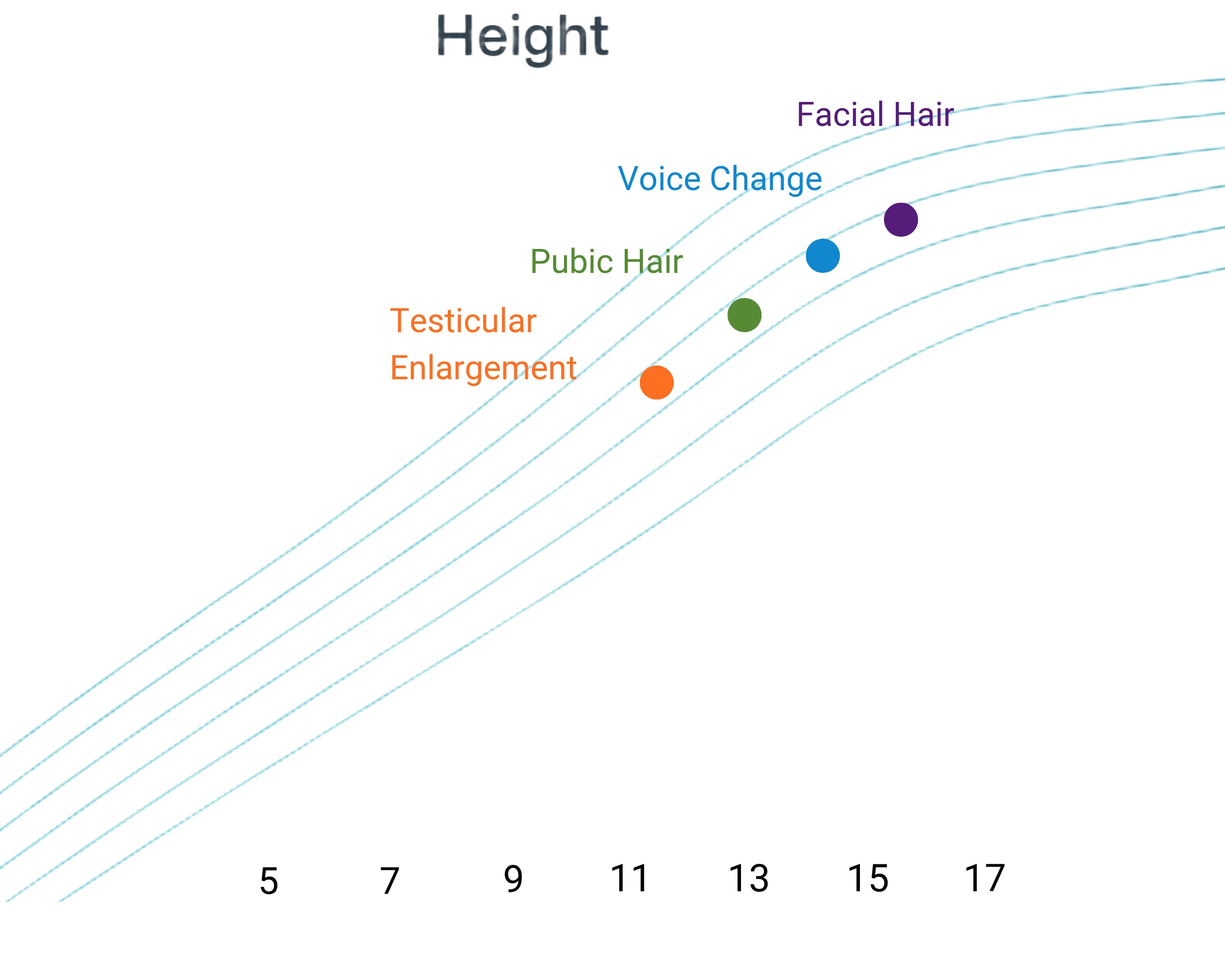
About a year later, pubic hair begins to appear, marking the start of visible puberty and often coinciding with the main growth spurt. What most parents think of as “puberty” — things like a deeper voice, facial hair, and muscle development — are signs of late puberty, not the beginning. These actually appear about a year after the main growth surge has already started. By the time a boy’s voice changes or he begins to shave, his fastest height-gaining phase has likely already passed in most cases.
Is My Son in His Growth Spurt Right Now?

Most boys reach their fastest height gain between ages 13 and 15. During this period, they can grow 3–4 inches (8–10 cm) per year — sometimes more, depending on genetics and timing.
Parents often notice:
- Pants that suddenly become too short
- Needing a larger shoe size sooner than expected
- A growth chart line that rises more steeply than before
This stage doesn’t last forever. By the following year, growth naturally slows down as the growth plates begin to mature and prepare to close.
Typical pattern:
- Year 1: Rapid growth acceleration
- Year 2: Gradual slowdown as growth plates begin closing
Not every boy experiences a dramatic surge — for some, growth happens more gradually, and that’s entirely normal too.
How Do I Know If My Son’s Growth Plates Are Closing?
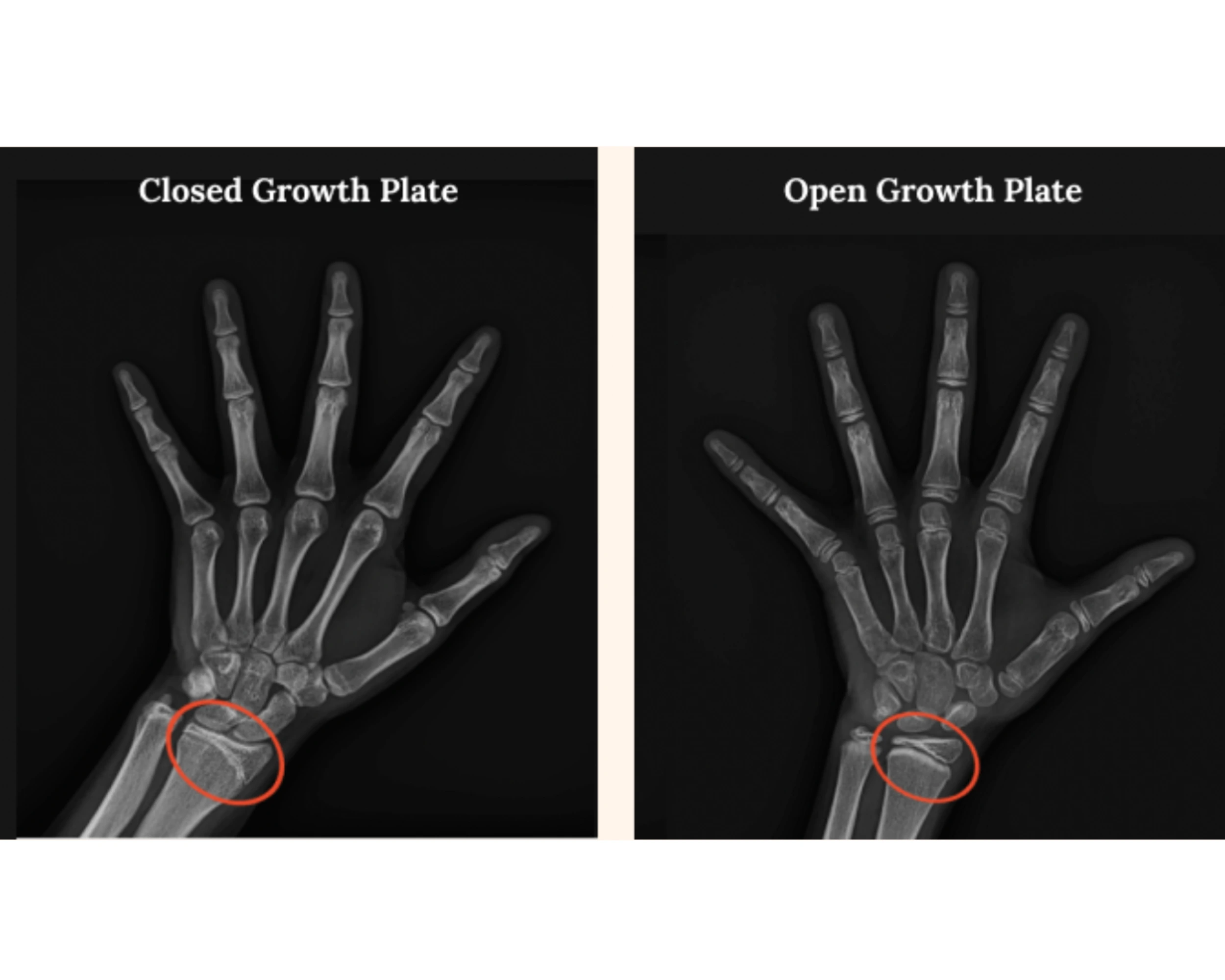
Inside every long bone are growth plates — thin layers of cartilage where new bone is formed. During puberty, these plates are highly active, responding to growth hormone and testosterone.
After about two years of rapid growth, they start to harden and fuse, marking the end of major height increases.
For most boys:
- Leg bone growth plates begin to close around age 16.
- Spine and pelvis plates may remain open a little longer, allowing for an additional 1 inch (2–3 cm) of slow, gradual growth.
In a minority of boys — those whose puberty starts later — the growth spurt can still be underway after 16; however, in most boys the main phase of rapid height gain has stopped by age 16.
The only way to know which group your son is in is a growth plate evaluation, which reads bone maturity from a single hand X-ray and shows how much growth window is left.
What Parents Can Monitor at Home
You don’t need special tests to start understanding your child’s growth.
Here are some practical things to track and notice:
- Height pattern
Record your child’s height every 3–4 months. If his annual growth slows to less than 2 inches (5 cm) before age 16, his growth window may be closing. - Puberty signs
Body hair growth patterns can vary depending on genetics — some boys naturally have more or less body hair than others.
But generally:- Pubic hair beginning of growth spurt
- Voice change peak growth
- Facial hair nearing the end
- After the growth spurt
Keep measuring for another 1-2 years. Small but steady gains from the spine and pelvis can continue even after leg growth slows. - Bone-age evaluation
If puberty seems early, delayed, or growth is slower than expected, a physician can check bone age with a simple hand X-ray to estimate how much potential remains. - Healthy habits that support height growth
- Try to go to sleep before 10 p.m. whenever possible
- Eat balanced, protein- and calcium-rich meals
- Encourage daily physical activity and outdoor play
- Limit excess sugar and processed snacks
- Help your teen manage stress and screen time



These are not minor lifestyle tips — they directly support the body’s hormonal rhythm that influences height development.
Will My 16 Year Old Son Grow Taller? When to Seek a Physician’s Input
It may be time to consult a physician if:
- Puberty starts much earlier or later than peers
- Growth slows significantly between ages 13 and 16
- Height percentile is dropping steadily despite good sleep and nutrition
- You want to understand more precisely how much growth potential remains
A growth evaluation with height tracking and bone-age assessment can clarify whether your child is still in an active growth phase or nearing completion.
If the window is still open, growth hormone treatment for children is one option a specialist can walk you through.
Not sure how much growth window your son has left? One visit gives you a clear answer.
Real Case: A 16-Year-Old at the Turning Point
A 16-year-old boy came to my clinic concerned that he hadn’t grown much since the previous year. At 15, he had grown nearly 3.5 inches (about 9 cm) — a typical sign that his main growth spurt had already taken place. But by 16, his height gain had slowed noticeably.
A growth plate evaluation showed that his long-bone plates were starting to close, but they were still partially open — enough to allow a meaningful period of remaining growth. With close observation and strong attention to sleep, nutrition, and daily habits, he was able to make the most of his remaining window — gaining nearly 3 more inches (about 7 cm) over the next year.
Not every boy at this stage will grow that much; results depend on timing, bone age, and genetics. But this case reminds us that recognizing where a child is on the growth timeline matters most — because once the window closes, no amount of effort can reopen it.
Parents’ Most Common Questions (FAQ)
Will my son grow taller after 16?
Some do — especially those who hit puberty later. But for most boys, leg bone growth slows sharply by 16, with only about 2–3 cm of growth left from the spine and pelvis.- How can I tell if my son is still growing?
Look at both height velocity and puberty signs. Pubic hair marks the beginning, voice change marks the peak, and facial hair usually signals the end — though every boy’s pace is unique. - When should I consider a bone-age test?
If growth slows early, puberty timing seems off, or you’re unsure whether growth plates are closing, bone-age imaging can offer helpful clarity. - My son’s body hair developed early, but he’s not growing fast. Is that normal?
It can be. Hair patterns don’t always match growth timing. That’s why regular height tracking is more reliable than appearance alone. - Can lifestyle habits still make a difference at this age?
Absolutely. Consistent sleep before 10 p.m., nutritious meals with protein and calcium, and daily activity all support remaining growth potential.
Final Reflection: Growth Has Its Own Rhythm
Many parents worry about their child’s height — but rather than worrying vaguely, it’s more important to understand when growth happens and how it unfolds.
Growth doesn’t follow a fixed calendar; it follows each child’s unique timing. Recognizing whether a child is still in the growth spurt, approaching it, or just past it helps families make informed decisions about how to support that period effectively.
As physicians, we can’t change a child’s genetics, but we can help parents and teens identify their growth phase early — and make the most of that precious time through healthy habits, accurate tracking, timely evaluation, and when appropriate, medically supervised growth hormone treatment.
Growth timing is different for every boy. Let our team look at where yours stands.