
“My daughter just turned 9 and she already needs a bra. Her friends still look like little kids. Is something wrong, or am I overreacting?”
“My son is only 11 and his voice is starting to crack. I thought boys didn’t go through puberty until their teens. Are we running out of time for him to grow?”
“Our pediatrician told us to watch and wait. But watch for what, exactly? Nobody tells you what you are actually supposed to be looking for.”
If any of those words sound familiar, you are not overreacting. You are paying attention. And the fact that you noticed something feels “off” about your child’s timing compared to their peers is worth taking seriously, not dismissing.
There is a particular kind of worry that comes with early puberty, and it is different from the usual parenting anxieties. It is not vague. It is specific. You are watching your child’s body move ahead of schedule, and you cannot shake the feeling that time is already running out.
That instinct deserves a real answer, not just reassurance.
Hello, I am Sunjo Chung, FNP at I Grow Clinic. We have guided nearly 4,000 children through their growth journeys. We work with families across the United States, both from our clinic in Fullerton, California, and through specialized telehealth services in CA, NY, WA, FL, and TX.
What I hear from parents who come to us is almost always the same: they noticed something, brought it up with their doctor, and were told not to worry. But they still came to us. Because the worry did not go away. I want to give you something more useful than reassurance. I want to give you clarity.
| Why Families Trust I Grow Clinic | |
| Successfully guided nearly 4,000 children with precision growth strategies | 95% treatment retention rate, reflecting exceptional clinical outcomes and family trust |
| Meticulous 1:1 personalized management based on each child’s unique growth potential and AI-driven bone age analysis | Medical Director is Board Certified by the American Board of Physical Medicine and Rehabilitation (ABPMR) |
| Clinical team with over 20 years of experience specializing in Pediatric Growth and Developmental PM&R | 5-Star Google Rating with numerous testimonials highlighting commitment to professional excellence and compassionate, family-centered care |
In this post, I will walk you through how to tell whether your child’s puberty is truly early and what it means for their adult height. I will also share the specific warning signs that tell you the growth window is beginning to narrow. By the end, you will know exactly what to watch for, and you will know when it is time to move past monitoring and get a real answer.
How to Tell If Your Child’s Puberty Is Actually Starting Too Early
The first thing most parents want to know is whether what they are seeing is actually early, or whether their child is simply on the earlier end of a wide normal range. This is a fair and important question, because puberty does have a genuine range of normal timing, and not every child who develops ahead of friends is experiencing a medical concern.

Here is the framework clinicians use. In girls, puberty is generally considered to be starting on the early side when breast development begins before age 8, when pubic hair appears before age 8 or 9, or when a first menstrual period arrives before age 10. In boys, the threshold is testicular enlargement before age 9. When development begins before those ages, it falls into a category clinicians call precocious puberty, a term that simply means puberty has arrived earlier than expected for that child’s biological stage.
What most parents do not realize is that in boys, testicular enlargement often begins before any visible changes appear. By the time a boy’s voice is cracking or his first facial hair is appearing, he has often already been in puberty for a year or more. The same pattern applies in girls: breast budding, not a first period, is the actual starting point, and it often precedes menstruation by two years.
This is why the Tanner staging system is the clinical tool that matters here. Tanner staging breaks puberty into five numbered stages based on physical development markers, ranging from prepubertal (Tanner 1) through fully mature (Tanner 5). A child who appears to be in Tanner Stage 2 or 3 at age 7 or 8 is on a meaningfully different timeline than a child who reaches those same stages at 10 or 11.
🔍 To understand how Tanner stage and bone age relate to each other, and what that means for your child’s remaining height potential, read our detailed guide: Tanner Stages of Puberty.
The bottom line: if breast development in your daughter is appearing before age 8, or if you are noticing what seems like testicular growth in your son before age 9, paired with rapid height gain or body odor, that is worth a professional evaluation rather than a “watch and see” approach.
What Early Puberty Really Means for Your Child’s Adult Height
This is the part most parents don’t fully understand, and it is the most important piece of information in this entire post. So let me be as clear as I can.
The child who is tallest in the third-grade class is not always going to be a tall adult. In fact, that child is sometimes at greater risk of ending up shorter than their genetic potential would suggest. And the reason is bone age.
Every child has two ages: their chronological age, which is the number of birthdays they have celebrated, and their bone age, which is the biological age of their skeletal system based on how mature their growth plates actually are. These two ages are not always the same. In a child with early puberty, bone age often runs significantly ahead of chronological age. A 9-year-old girl with early puberty may have a bone age of 11 or 12.
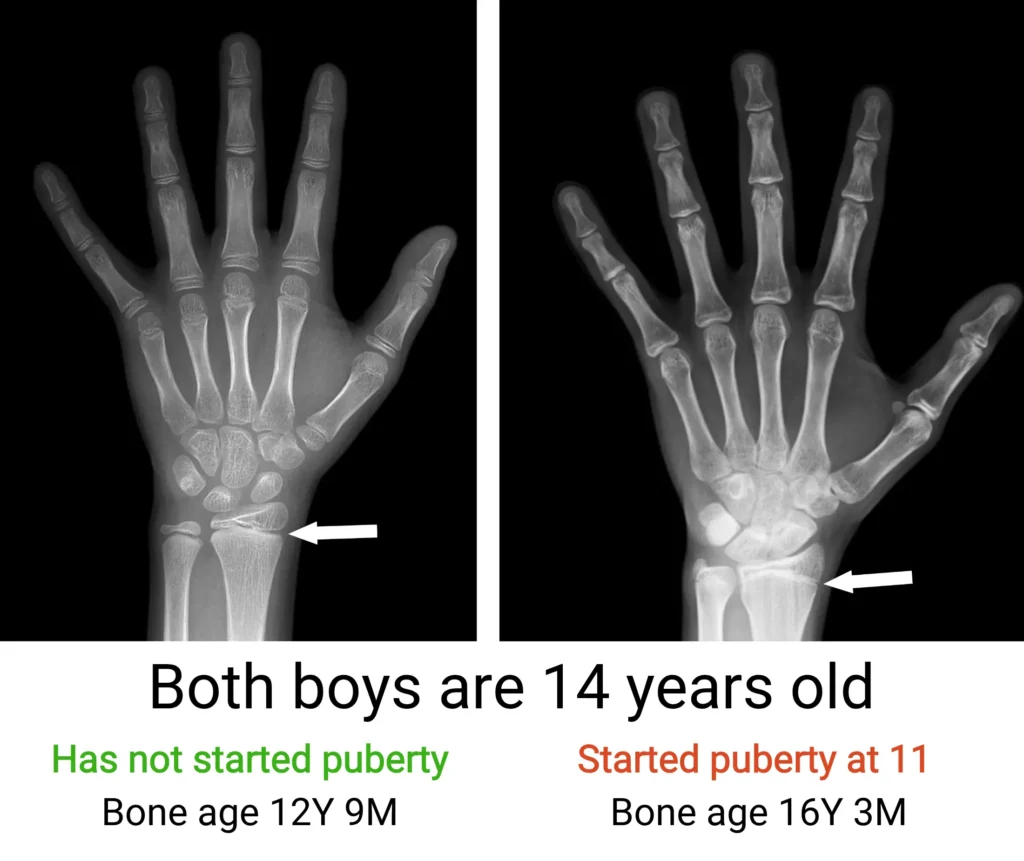
Why does that matter? Because growth plates, the thin layers of cartilage at the ends of long bones where new bone is formed, close when bone age reaches its endpoint, not when the calendar age does. When puberty hormones arrive early, they accelerate bone maturation. The growth plates start closing ahead of schedule. A boy who entered puberty at age 10 or 11 may have fully fused growth plates by age 14 or 15, while their peers continue growing until 17.
This is what we call the Tall Child Paradox. The child who seems to be growing so impressively fast right now may actually be burning through their growth window at an accelerated rate. The early spurt looks like great growth. What it actually represents, in many cases, is a compressed timeline that ends sooner than it should.
🔍 For a deeper look at how growth plate closure works and what the typical timelines look like by age and sex, see our full guide: What Age Do Growth Plates Close?
This is why bone age measurement is such an important diagnostic tool. Chronological age tells you how old your child is. Bone age tells you how much time they actually have left to grow.
🔍 For a full explanation of this concept, Bone Age vs. Chronological Age walks through exactly how these two ages diverge and what it means for your child’s final height potential.
When “Wait and See” Is Not Enough and What a Real Evaluation Looks Like
“Wait and see” is a reasonable clinical recommendation in specific situations. If a child’s puberty timing is on the early edge of normal and bone maturation is not accelerating rapidly, monitoring without intervention is often the right call. There is no benefit to treating something that is not causing harm.
But “wait and see” without measurement is a different thing entirely. Waiting while measuring gives you data. Waiting while assuming gives you false reassurance. The distinction matters enormously when the question on the table is how much of your child’s growth window is still open.
Here is what a meaningful evaluation actually includes:
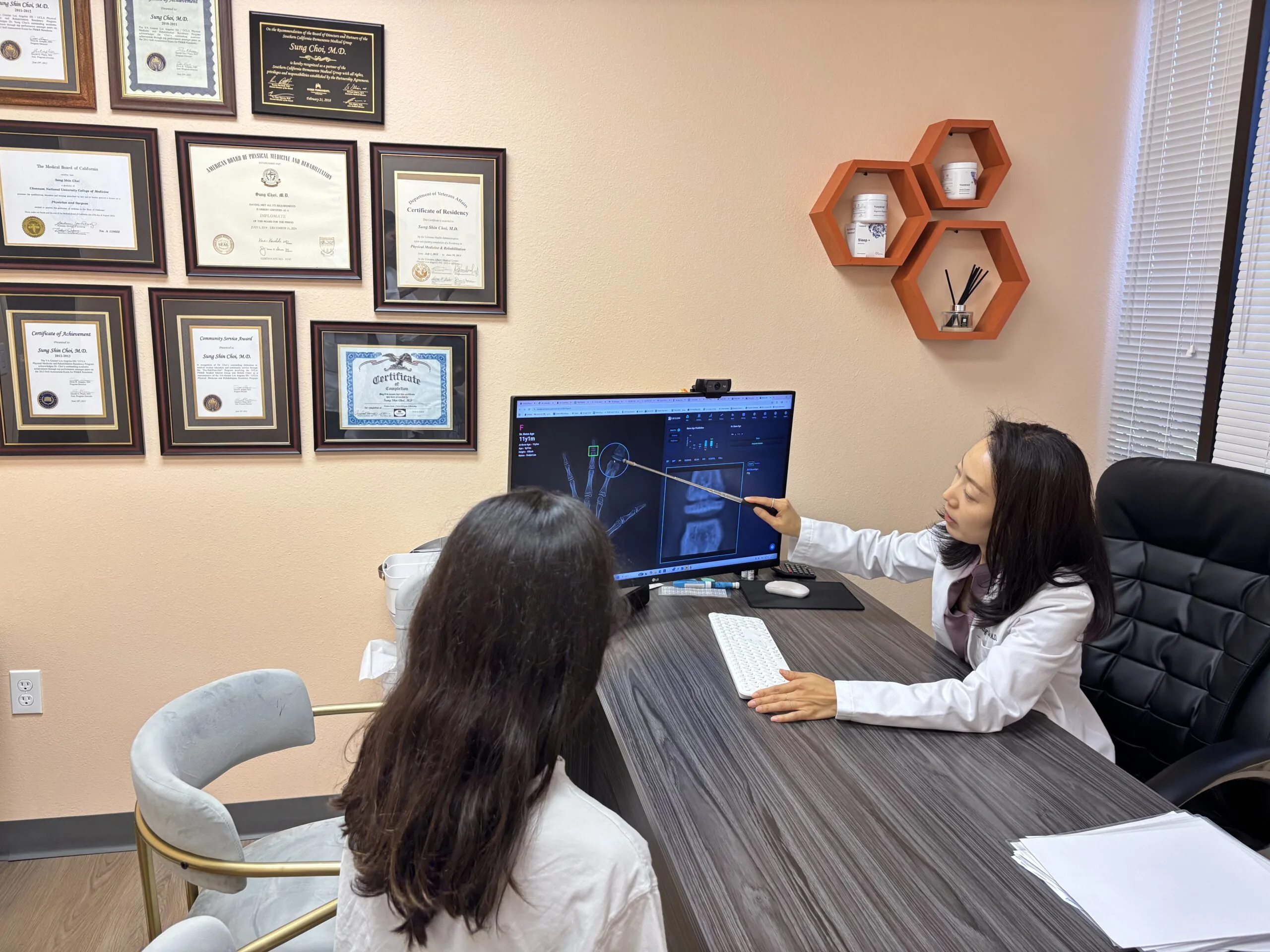
- A bone age study. This is a simple, quick, low-dose X-ray of the left hand and wrist. The hand contains dozens of small bones and growth plates that mature in a very predictable sequence. A trained clinician can use that single X-ray to determine the biological age of your child’s entire skeletal system, giving a reliable picture of how much growth window remains.
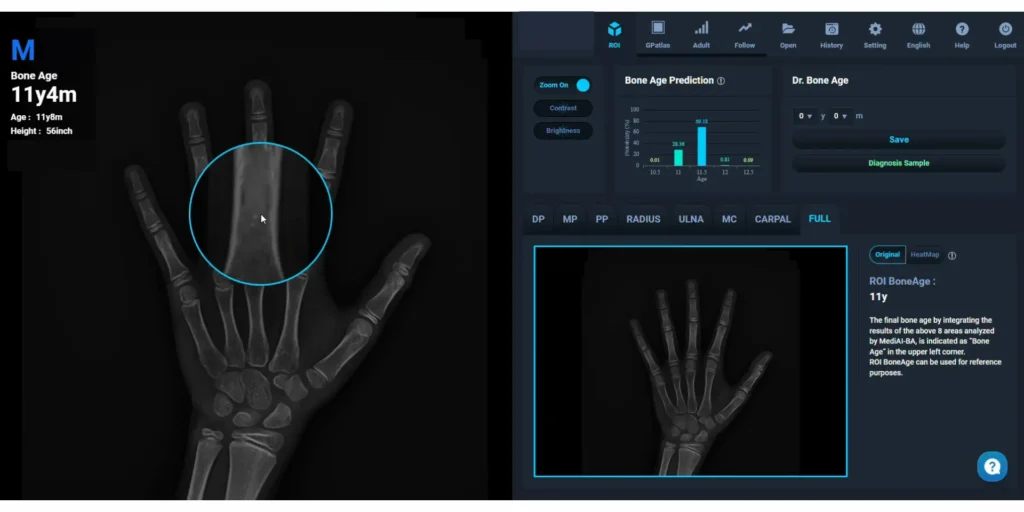
- AI-enhanced bone age analysis. At I Grow Clinic, we take bone age evaluation further with AI-driven analysis that compares your child’s skeletal maturity against thousands of data points with a level of precision that standard visual interpretation cannot match. This allows us to calculate remaining height potential and provide a reliable estimate of final adult height, giving families a data-driven picture rather than a general impression.
- Height velocity tracking. A single height measurement tells you where your child is today. Height velocity tells us where they actually are in their growth journey, and where they are headed. Whether they are just entering the growth spurt, in the middle of it, or approaching the end, the rate of growth over time reveals what a single measurement cannot.
- Pubertal staging in clinical context. Tanner staging done by a clinician gives a complete picture of where your child is in the puberty timeline. Interpreted alongside bone age and height velocity data, it also shows how quickly they are moving through it.
The families who find our approach most valuable are often ones who have already had a pediatrician visit, been told their child’s development is within normal range, and still feel uncertain because no one explained what the bone age is, whether the growth window is still meaningfully open, or how their child’s puberty timing is likely to affect their adult height. Those are answerable questions. They require measurement, not reassurance.
A Note from Sunjo
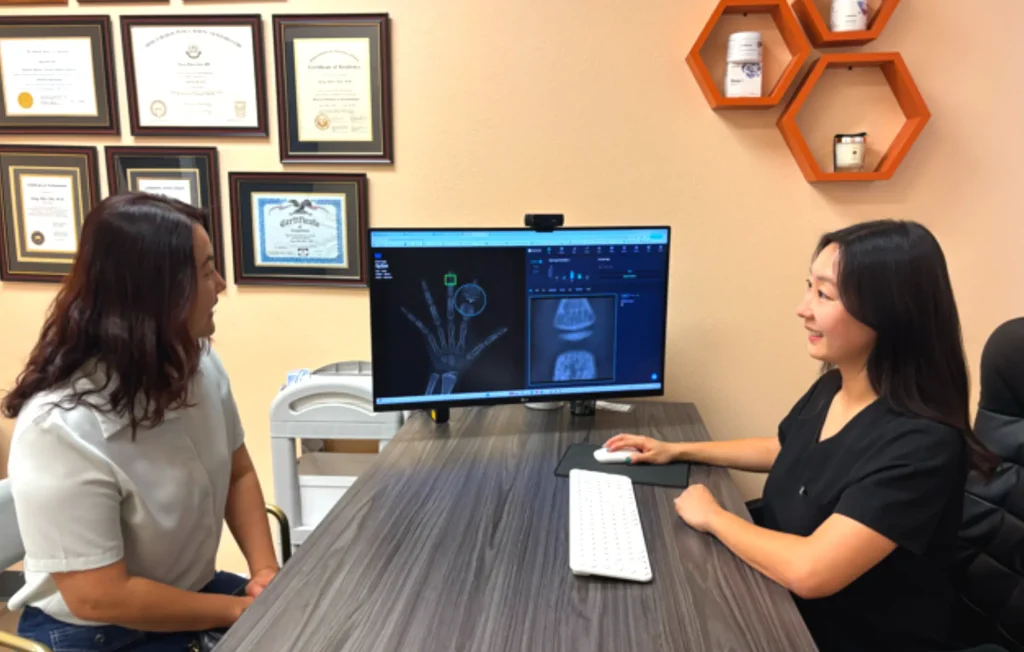
I want to say something directly to the parents who are reading this. If your gut has been telling you something is happening too fast, and you have not yet felt heard, this is for you.
The worry you are carrying is not overprotectiveness. Height and physical development are tied to confidence, social experience, and self-image in ways that follow children into adulthood. When a child moves through puberty while their peers are still in childhood, the experience can feel isolating and disorienting, even when the child does not have words for it yet.
I have sat across from families who came to us when their child was 13 or 14, only to discover that the main growth window had already closed. In those moments, I see it in the parents’ faces before I even finish explaining. Some tear up. Some go quiet. And I always find myself thinking the same thing: if we had met just one or two years earlier, this conversation would have looked so different. That feeling never gets easier, no matter how many times I have been in that room. What I want for every family reading this is the chance to have a different kind of conversation, one where the window is still open and the answer can still change the outcome.
You do not have to have a diagnosis in hand to request a growth evaluation. You do not have to wait until the concern feels undeniable. If what you are observing makes you wonder, that is reason enough to look at the science together.
Your Next Step: Get the Clarity Your Child Deserves
At I Grow Clinic, every evaluation is built around one guiding question: how much of this child’s growth window is still open, and what is the best way to protect it? Every protocol is built on AI-driven bone age analysis and 1:1 personalization, because no two children are on the same timeline, and no family should be treated as if they are.
Because our care is concierge and genuinely individualized, our new patient capacity each week is limited. If you have been wondering whether the timing is right to schedule an evaluation, the honest answer is: the earlier the evaluation, the more options the data gives us.
Whether you are in Southern California or joining us via telehealth from New York, Texas, Washington, or Florida, we are here to give your family the data-driven clarity you came looking for.
🔍 To understand why we built this clinic around the belief that every family deserves honest answers while the window is still open, read: Why I Started a Growth Hormone Clinic.
Frequently Asked Questions
1. At what age should I start to worry about early puberty in my daughter?
Breast budding before age 8 or a first period before age 10 falls into the range clinicians classify as precocious puberty and warrants a professional evaluation. But you do not have to meet that exact threshold to benefit from one. If your daughter is already shorter than her peers and you are noticing early signs of puberty, that combination is reason enough to check her bone age. Knowing her bone age tells you how much of the growth window is still open and gives you a reliable estimate of her final adult height. The earlier you have that data, the more options you have.
2. My son is 11 and already has pubic hair and body odor. Is his puberty starting too early?
In boys, testicular enlargement before age 9 is the clinical threshold for precocious puberty. Pubic hair typically appears as the testicles approach adult size, so seeing it at 11 is on the earlier side and worth paying attention to. What matters more than the age is how fast puberty is progressing. If your son is already on the shorter side compared to his peers, early puberty is worth taking seriously. Puberty hormones accelerate bone maturation, which compresses the growth window. A bone age evaluation can tell you exactly how much time he has left to grow and what his final height is likely to be. That is information worth having while the window is still open.
3. Can early puberty actually make my child shorter as an adult?
Yes, and this is one of the most important and least-discussed consequences of precocious puberty. When puberty hormones arrive early, bone age accelerates ahead of their actual age. Growth plates may fuse as early as age 12 or 13 in boys well before the child has used their full genetic height potential. A child who was the tallest in their third-grade class may stop growing while their peers continue, ending up below their predicted adult height. This is why measuring bone age, not just tracking height, is the right way to assess what is actually happening.
4. What is the difference between seeing a pediatrician and seeing a growth specialist for early puberty?
A general pediatrician can identify that puberty is occurring earlier than expected and refer to a specialist if needed. A growth specialist evaluates early puberty specifically through the lens of bone maturation and height potential, asking not just “is this early?” but “how is this affecting the growth window, and what can be done about it?” At I Grow Clinic, we use AI-enhanced bone age analysis alongside clinical assessment to give families a complete, personalized picture of their child’s remaining growth potential.
5. What lifestyle changes can support healthy growth if my child is entering puberty early?
While lifestyle habits cannot reverse early puberty, they can support the body in making the most of the growth window that remains. Consistent sleep before 10 p.m. supports the natural growth hormone pulses that happen during deep nighttime sleep. Protein and calcium-rich meals provide the raw materials for bone formation. Daily physical activity promotes bone density and overall development. Limiting excess sugar and managing stress reduce factors that can interfere with healthy hormonal balance. These are meaningful supports, not substitutes for a clinical evaluation if the signs of early puberty are present.