

“His IGF-1 Looks Low. Should I Be Worried?”
“The lab report says his IGF-1 is in the low range for his age. Does that mean he has a growth hormone problem?”
“Her IGF-1 came back high. Does that mean she is growing well?”
These are some of the most common questions I hear from parents after a blood panel. They have done exactly what any concerned, research-driven parent would do: they Googled the normal range, compared the number on the report, and immediately felt alarmed or relieved. The problem is, that comparison may be telling you the wrong story entirely.

Meet Jenny Diep, FNP at I Grow Clinic
I am Jenny Diep, FNP at I Grow Clinic. We are a concierge growth clinic based in Fullerton, California, serving families across CA, NY, TX, WA, and FL through in-person and telehealth consultations. Our team has guided nearly 3,000 children through their unique growth journeys.
Why Families Trust I Grow Clinic
| Credential | Detail |
|---|---|
| Children guided | Nearly 3,000 with precision growth strategies |
| Treatment retention | 95% rate, reflecting exceptional outcomes and family trust |
| Approach | Meticulous 1:1 personalized management using AI-driven bone age analysis |
| Medical Director | Board Certified by the American Board of Physical Medicine and Rehabilitation (ABPMR) |
| Experience | 20+ years specializing in Pediatric Growth and Developmental PM&R |
| Reputation | 5-Star Google Rating with numerous testimonials |
| Telehealth | Available in CA, NY, WA, FL, and TX |
What Is IGF-1, and Why Does It Matter for Height?
IGF-1, or Insulin-like Growth Factor 1, is a hormone produced primarily by the liver in response to growth hormone (GH). Think of it this way: growth hormone is the signal sent from the brain, and IGF-1 is what actually does the work at the tissue level, stimulating bone growth and cell production.
Because GH levels spike and drop throughout the day depending on sleep, meals, and activity, a single GH blood draw is not reliable. IGF-1, by contrast, stays relatively stable in the bloodstream. That stability makes it a useful and practical marker for tracking a child’s growth hormone activity over time.
🔍 For more on how growth hormone and bone maturity work together, read our guide: Bone Age vs. Chronological Age: Is Your Child’s Biological Clock Ticking Too Fast?
A Note on IGF-1 Testing: Screening vs. Stimulation
The IGF-1 test we are referring to throughout this blog is a simple blood draw, used as a screening tool. It is straightforward, requires no special preparation, and gives us a stable snapshot of your child’s growth hormone activity.
This is different from a stimulation test, which is a separate and more involved procedure. A stimulation test is typically ordered only when IGF-1 levels are critically low and there is strong clinical suspicion of growth hormone deficiency. During this test, a substance is injected to stimulate the pituitary gland, and growth hormone levels in the blood are then measured at intervals to see how the body responds. It is used to confirm a diagnosis of growth hormone deficiency, not as a routine screening step.
For most families who come to us after seeing their child’s IGF-1 result on a routine panel, we are working with that simple screening number, and as this blog explains, context is everything.
The Problem with the Lab’s Reference Range
Here is where most parents run into confusion, and understandably so.
When a lab processes your child’s blood sample, it generates a reference range based on age. A 12-year-old boy’s result gets compared to a reference range built for all 12-year-old boys. That sounds reasonable, until you realize one critical fact: the lab has no idea where your child is in puberty.
And that changes everything.
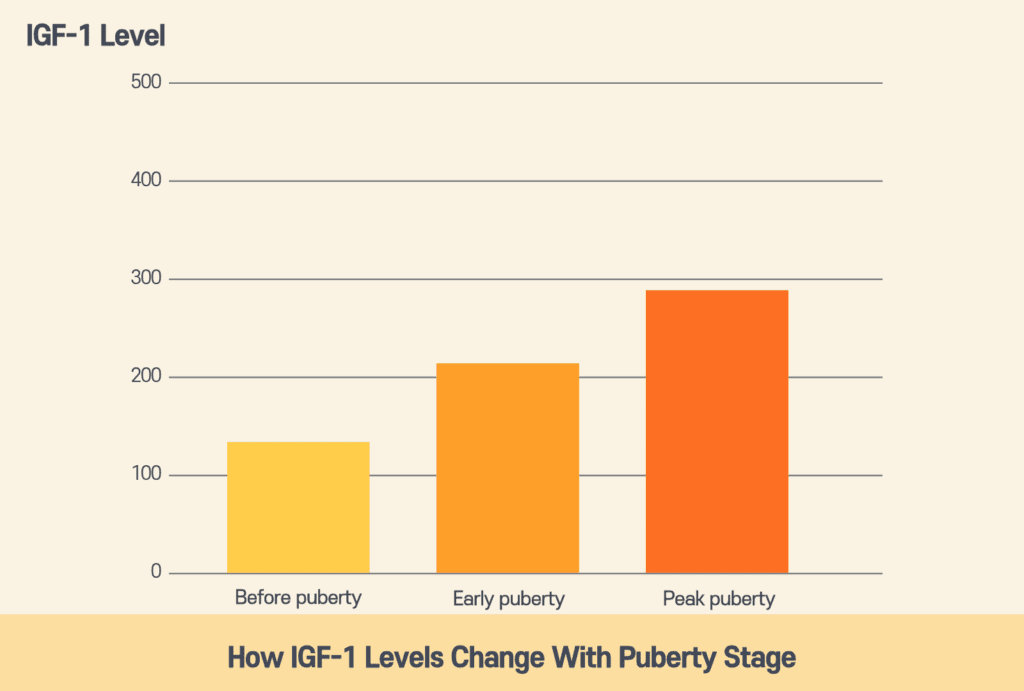
IGF-1 levels do rise gradually as a child gets older, but once puberty begins, levels can nearly double in a relatively short period. That dramatic surge means the single biggest factor driving your child’s IGF-1 is not how old they are, but when their puberty started. Before puberty begins, IGF-1 levels are naturally lower, typically in the range of 90 to 150. As puberty gets underway, the body’s production of sex hormones sends IGF-1 climbing. Levels commonly rise above 200 as the growth spurt begins and continue rising through the peak of puberty.
Because lab facilities cannot know each child’s individual puberty status, they are forced to build a wide reference range that attempts to cover all possibilities for a given age. The result is a range so broad that it can make a perfectly healthy child appear worryingly low or surprisingly high, depending entirely on when their puberty clock started.
Two Children, Two Very Different Stories
The Late Bloomer at 14
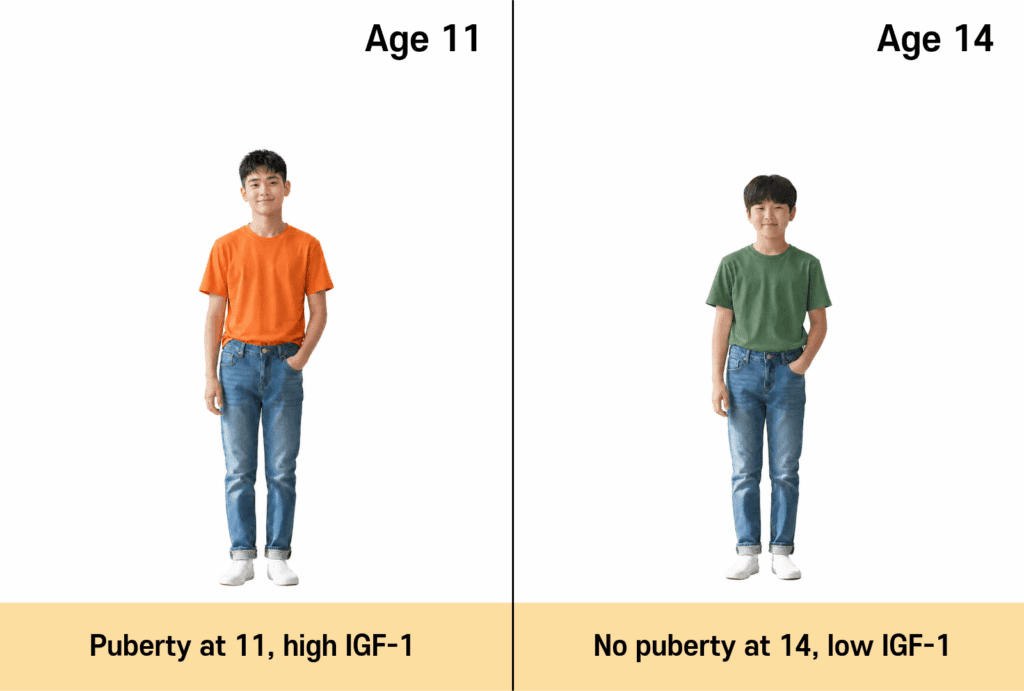
A 14-year-old boy has an IGF-1 of 150. His lab report flags this as low for his age group. His parents are alarmed.
But here is what the lab report cannot see: this boy has not yet entered puberty. He is a late bloomer, and his body simply has not yet sent the hormonal signal to ramp up IGF-1 production. A level of 150 is completely appropriate for his actual biological stage. He is not deficient. His growth window is likely still wide open.
🔍 To understand how to assess how much growth time is actually remaining, read: How Do You Know If Growth Plates Are Closed?
The Early Maturer at 11
An 11-year-old boy has an IGF-1 of 250. Next to the lab’s reference range for his age, this looks perfectly healthy. His parents breathe a sigh of relief.
But again, the lab report is missing context. This boy has entered puberty earlier than most of his peers. His IGF-1 is elevated not because he is growing exceptionally well, but because his puberty hormones have already kicked into gear. That early surge will produce a growth spurt, yes. But it also means his growth plates are maturing faster than expected, and his window for height gain may close significantly earlier than his friends. A high IGF-1 in this case is not a reassurance. It may actually be an early signal that puberty is arriving ahead of schedule. When you see this, it is worth looking at the bigger picture: other puberty signs, bone age, and growth velocity all need to be considered together to get a true sense of how much growth window remains.
So What Does IGF-1 Actually Tell Us?
IGF-1 is a valuable piece of the puzzle, but it must always be read in the context of where a child is in their puberty journey. At I Grow Clinic, we never look at IGF-1 in isolation. We consider it alongside:
Bone age. A hand X-ray tells us the true biological maturity of the skeleton, independent of what the calendar says. This is often the single most clarifying piece of information we can add to an IGF-1 result.
🔍 To learn more about how bone age reveals your child’s true growth timeline, read: Bone Age vs. Chronological Age: Is Your Child’s Biological Clock Ticking Too Fast?
Puberty stage. Where is the child in their development? Have they started? Are they at the peak? Are they nearing the end? This context transforms how we interpret any number on a lab report.
🔍 To understand how puberty timing affects your son’s growth window, read: Do Boys Really Keep Growing So Late? What Science Says
Actual growth rate. This is, honestly, the most important indicator of all. How many inches has this child grown in the past six months? In the past year? Real, measured height velocity tells us more about what is happening inside the growth plates than any single blood test can.
IGF-1 and Growth Hormone Dosing: Not the Whole Story
Parents sometimes assume that if their child is receiving growth hormone support, the IGF-1 level will be the primary number we watch to decide whether the dose is working. IGF-1 is indeed one of the markers we monitor for safety, and we always keep it within the appropriate range. But it is not the most important measure of whether the plan is succeeding.
The most important question is simpler and more direct: Is your child actually growing?
A child who is growing steadily at a healthy rate is responding well, regardless of where the IGF-1 sits within the normal window. A child whose growth rate has stalled needs a closer look, even if the IGF-1 appears adequate. IGF-1 gives us a starting point, but what ultimately tells us whether the plan is working is simple: is your child growing?
The Heart of It
I know what it feels like to open a lab report and see your child’s number sitting below the reference range. The worry is immediate and real. You are not overreacting. You are paying attention, and that is exactly what your child needs.
What I want you to know is this: a single IGF-1 number, without context, is an incomplete sentence. It cannot tell you whether your child is deficient, thriving, maturing early, or simply developing on their own timeline. What it can do, when read alongside bone age, puberty stage, and growth velocity, is give us a far more honest and complete picture of where your child stands and how much time remains to act.
That is the conversation we are here to have with you. Every child’s story is different, and every number deserves to be understood in full.
Ready for Clarity?
Whether you are in Southern California or connecting with us via telehealth from New York, Texas, Washington, or Florida, we can review your child’s IGF-1 results alongside a bone age study and a full growth evaluation. Do not let a lab range tell you a story without all the facts.
FAQ: What Parents Ask About IGF-1
1. My child’s IGF-1 is below the normal range for their age. Does that mean they have growth hormone deficiency?
Not necessarily. IGF-1 levels are closely tied to puberty stage, not just age. A child who is a late bloomer will naturally have a lower IGF-1 on screening blood test because their puberty hormones have not yet risen. A low IGF-1 warrants further evaluation, including a bone age study and a review of puberty staging, before any conclusions can be drawn.
2. Can a normal IGF-1 level rule out a growth problem?
No. A normal IGF-1 does not automatically mean everything is on track. Growth rate, bone age, and puberty timing all contribute to the full picture. Some children with genuine growth concerns still fall within the lab’s reference range because that range is designed to be broad.
3. How often should IGF-1 be checked in a child receiving growth support?
At I Grow Clinic, we typically monitor IGF-1 every six months as part of a comprehensive growth evaluation. More frequent checks may be appropriate depending on the child’s individual circumstances.
4. Does a high IGF-1 always mean my child is growing well?
Not always. A high IGF-1 in a younger child may simply reflect early puberty onset, which can accelerate bone maturation and shorten the overall growth window. Context matters enormously.
5. What is the most reliable way to know if my child’s growth hormone support is working effectively?
Actual height velocity, meaning how much your child has grown over a measured period, is the most direct and reliable indicator. IGF-1 is a supportive marker, but growth rate is the clearest sign of whether the body is responding.
Explore More from I Grow Clinic
What Age Do Growth Plates Close?