
“He just turned 16. I looked it up and one site says boys are basically done growing by now. Another site says he could keep growing until he’s twenty. Which one is true?”
“My son is 5’8″ and all his friends are already 6 feet. Is this it for him, or does he still have time?”

If you have spent any time searching this question, you already know the frustrating part. The answer changes depending on which website you land on. One says boys finish around 16. Another says boys can keep growing into their early twenties. Neither one tells you which situation actually applies to your son.
It is because most of these articles are describing averages for the general population, not your specific child. And averages do not tell you what is happening inside your son’s own growth plates right now.
I am Jenny Diep, a Nurse Practitioner at I Grow Clinic. Alongside Dr. Choi, our board certified Medical Director with over 20 years of clinical experience, our team has personally guided nearly 4,000 children through their growth journeys, using precision tools that go far beyond a general average.
| Credential | Detail |
|---|---|
| Children guided | Nearly 4,000 with precision growth strategies |
| Treatment retention | 95 percent rate, reflecting exceptional outcomes and family trust |
| Approach | Meticulous 1:1 personalized management using AI driven bone age analysis |
| Medical Director | Board Certified by the American Board of Physical Medicine and Rehabilitation (ABPMR) |
| Experience | 20+ years specializing in Pediatric Growth and Developmental PM&R |
| Reputation | 5 Star Google Rating with numerous testimonials |
| Telehealth | Available in CA, NY, WA, FL, and TX |
By the end of this article, you will understand what the real CDC data shows for 16 year old boys, why the “16 versus 20” confusion exists, and the most important piece of information that actually tells you how much growth your son has left.
What Is the Actual Average Height for a 16 Year Old Boy?
According to CDC growth chart data, the median height for a 16 year old boy sits right around 5 feet 8 inches, or about 173 centimeters. But that single number hides a wide, completely normal range.
CDC percentile data shows the real spread at age 16 looks something like this. A boy at the 5th percentile is close to 5 feet 3 inches. A boy at the 50th percentile, the exact middle, is close to 5 feet 8 inches. A boy at the 95th percentile is closer to 6 feet 1 inch. That is nearly a 10 inch difference between boys who are all considered within normal range for their age.
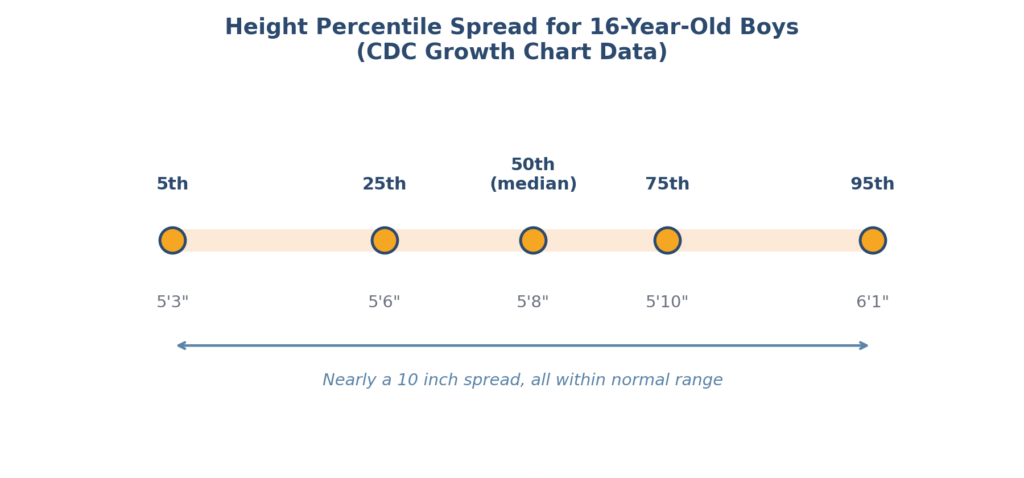
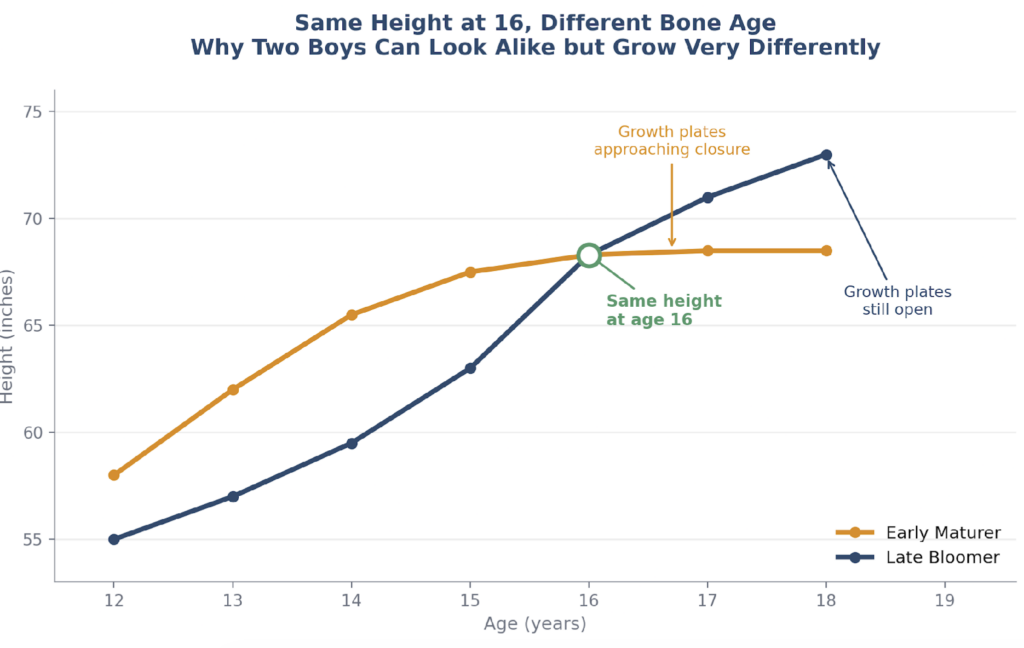
This is exactly why comparing your son to his friend group can be misleading. If his friends happen to cluster on the taller end of that range and he sits on the shorter end, he can look far behind when he is actually within a completely typical distribution. Often what looks like a height gap between friends is really a bone age gap. A friend who entered puberty earlier may already be an “early bloomer,” meaning his growth plates are further along and closer to closing, while your son may be a “late bloomer” whose growth plates are still wide open with years of height gain still ahead. Two boys can stand at the exact same height at 16 and be heading toward very different adult heights, simply because their internal biological clocks are running on different schedules.
🔍 To understand how percentiles actually connect to remaining growth potential, read: Bone Age vs. Chronological Age: Is Your Child’s Biological Clock Ticking Too Fast?
That difference between an early maturer and a late bloomer is exactly why two competing answers about “when boys stop growing” can both be technically true. Which one applies to your son depends on which side of that divide he happens to be on.
Why Do Some Sources Say Boys Stop Growing at 16 and Others Say 20?
This is the question that sends most parents into a frustrating research spiral, and it deserves a straight answer.
Some sources state that boys are largely finished growing by 16, with maybe an inch left in the later teen years. Other sources state that boys can continue growing until 17, 18, or even into their early twenties. Both statements are true. They are simply describing two different groups of boys.
The first group is boys whose puberty started on the earlier or average side. For them, the growth spurt has already peaked between ages 13 and 15, and by 16, their long bone growth plates are approaching closure. For this group, 16 really does mark the end or near end of major height gain.
The second group is late blooming boys, whose puberty started later than average. For them, the growth spurt has not yet peaked, or has only recently begun. These boys are still climbing the steepest part of their growth curve at 16, and can realistically continue gaining significant height for several more years.
The problem is that from the outside, a 16 year old in the first group and a 16 year old in the second group can look almost identical. Same age, similar height, similar build. The difference is invisible to the eye, because it is happening inside the growth plates themselves, not on the surface.
🔍 To understand exactly what closes a growth plate and why the timing varies so much between boys, read: What Age Do Growth Plates Close? A Parent’s Guide to the Biological Clock
How Much More Height Is Realistically Left After 16?
Here is where we can get specific, because the range genuinely does depend on which of those two groups a boy falls into.
For a boy whose long bone growth plates are already approaching closure at 16, the honest answer is usually somewhere around 1 to 2 inches of additional height, mostly from slower, residual growth in the spine and pelvis after the leg bones have essentially finished lengthening.
For a boy who is a genuine late bloomer, meaning his growth plates are still meaningfully open at 16, the remaining potential can be significantly larger, sometimes several more inches over the following one to three years, particularly if his peak growth spurt has not yet occurred.
The honest, complete answer is that both of these outcomes are possible for a 16 year old boy, and averages cannot tell you which one applies to your son. This is not a failure of the research. It is simply the nature of averages. They describe a population, not an individual.
🔍 For the full breakdown of puberty signs, growth spurt timing, and how to tell which category your son falls into, read: How Much Do Boys Grow After 16? A Pediatric Growth Specialist Answers
🔍 If your son is already showing signs of slowed growth and you want to understand what that might mean, read: How Do You Know If Growth Plates Are Closed? 3 Key Signs Parents Often Miss
Bone Age: The One Number That Actually Predicts What’s Left
If chronological age and percentile cannot answer this question reliably, what can?
The answer is bone age. Bone age is the biological age of your son’s skeletal system, based on how mature his growth plates actually are, measured through a simple, low dose X ray of the hand and wrist.
A 16 year old boy with a bone age of 14 still has real growth potential ahead, closer to what a genuine late bloomer experiences. A 16 year old boy with a bone age of 17 is likely much closer to his final adult height, regardless of how tall his friends happen to be.
At I Grow Clinic, we use AI enhanced bone age analysis to compare a child’s growth plates against thousands of reference data points, producing a precise estimate of remaining height potential and a reliable projected adult height. This moves the conversation away from guesswork and averages, and toward an actual answer specific to your son.
🔍 For a closer look at how this two minute X ray is actually read and what the results mean, read: Growth Plate X-Ray Interpretation: What Your Child’s Bone Age Results Actually Mean
A Note From One Parent to Another
If you have spent hours cross referencing height charts trying to figure out whether your son still has time, I understand that impulse completely. It comes from love, not overreaction. Watching your child stand next to his friends and wonder quietly whether he will catch up is a real, valid worry, even when everyone around you says “he will grow later.”

You do not have to keep guessing from averages that were never built to describe one specific child. There is a way to get an actual answer.
Ready for a Real Answer Instead of an Average?
At I Grow Clinic, every case is guided by AI driven bone age analysis, rather than population averages or a flat cutoff age. Because our care is concierge and one to one, we keep new patient onboarding limited each week to protect the quality of every evaluation.
If you are in Southern California, we welcome you for an in-person consultation at our Fullerton clinic. If you are in California, New York, Washington, Florida, or Texas, we offer full telehealth evaluation and follow up care.
🔍 To understand the philosophy behind why we built this clinic the way we did, read: Why I Started a Growth Hormone Clinic
We invite you to request a personalized growth assessment for your son, so you can move from uncertainty to an actual answer.
Frequently Asked Questions
1. Is 5 feet 8 inches short for a 16 year old boy?
No. That is right around the 50th percentile, meaning it is the statistical middle of the normal range for 16 year old boys in the United States. Height at any single percentile, high or low, does not by itself indicate a problem.
2. Can a boy still grow after 17 or 18?
Yes, for boys whose puberty started later than average, meaningful growth can continue into the later teens. The determining factor is whether the long bone growth plates are still open, which is assessed through a bone age evaluation rather than age alone.
3. Does having short parents mean my son will stop growing at 16?
Genetics plays a significant role in a child’s height potential, but it does not determine the timing of when growth plates close. A boy with shorter parents can still have an open growth window at 16 just as a boy with taller parents can have an early closing one.
4. My son hasn’t grown much in the past year. Does that mean he’s done?
Not necessarily. A slowdown can mean growth plates are approaching closure, or it can simply reflect the natural deceleration that happens in the second year of a growth spurt before a possible final phase. A height velocity pattern over several months, combined with a bone age evaluation, gives a much clearer answer than a single year’s data point.
5. What is the most accurate way to find out if my son still has growth potential?
A bone age X ray of the hand and wrist, interpreted alongside his height velocity and pubertal stage, is the most reliable way to determine how much growth window remains. This is a simple, low dose, two minute procedure available both in person and through telehealth.