
“Our dermatologist said Accutane is the next step. I’d heard that it can affect growth plates, and I don’t know what to do.”
“My son is fourteen and still growing two inches a year. I don’t want clear skin to cost him an inch of height.”
“I searched ‘accutane growth plates’ and landed on a forum thread where half the comments said it ruined someone’s height.”
That fear has a specific shape. It is not ordinary acne anxiety. It is the worry that solving one problem creates a bigger one. And that nobody tells you until it is too late to undo.
I’m Jenny Diep, a board certified family nurse practitioner at I Grow Clinic. I review growth cases every week, including families who heard Accutane might affect growth plates and wanted a clear answer before starting. This post walks through what the research actually shows, not the forum version of it.
Why Families Trust I Grow Clinic
| Credential | Detail |
|---|---|
| Children guided | 4,000 with precision growth strategies |
| Treatment retention | 95% rate, reflecting exceptional outcomes and family trust |
| Approach | Meticulous 1:1 personalized management using AI driven bone age analysis |
| Medical Director | Board Certified by the American Board of Physical Medicine and Rehabilitation (ABPMR) |
| Experience | Over 20 years of clinical experience |
| Reputation | 5 Star Google Rating with numerous testimonials |
| Telehealth | Available in CA, NY, WA, FL, and TX |
Here is what this article covers. The real dose and duration where growth plate risk shows up. What to check first if your teen is already short or growing slowly. Whether a growth slowdown during treatment bounces back, or sticks around.
Does Accutane Stunt Growth at Normal Acne Doses?
So does Accutane stunt growth? At the dose most dermatologists prescribe, the data is more reassuring than the search results suggest. But it comes with real numbers attached, not a simple yes or no.
A 2025 study through the Rochester Epidemiology Project followed 226 teenagers on isotretinoin. It compared them to 1,179 teens treated with oral antibiotics instead. By age 18, the isotretinoin group’s final height was not meaningfully different from the comparison group. The gap was less than a centimeter, and it was not statistically significant.
Growth did slow slightly while teens were actively on the medication. Researchers measured a small drop in height velocity during treatment. That slowdown reversed once treatment ended. It did not carry into final adult height.
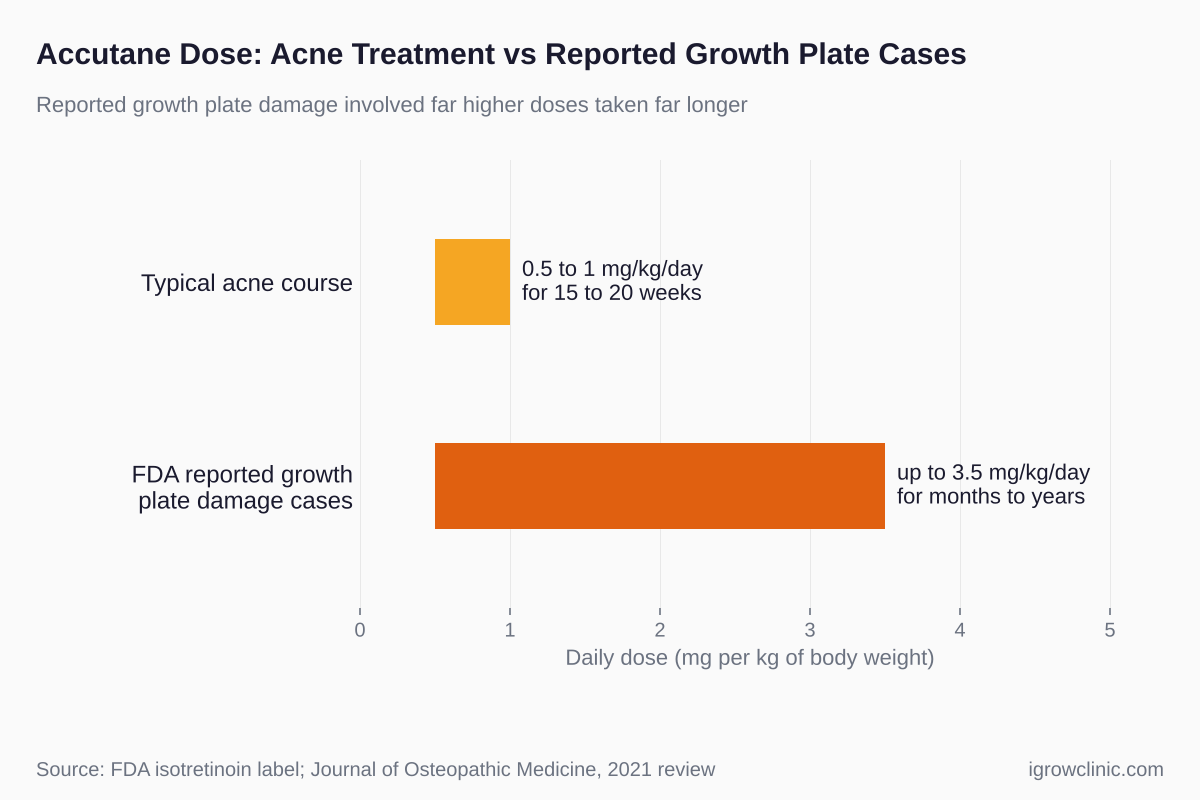
Here is where a lot of online advice stops short. Real cases of growth plate damage have been reported to the FDA, and they are worth taking seriously. But those cases did not come from a standard acne course. They involved far higher doses, in some reports up to 3.5 milligrams per kilogram per day. That exposure lasted months or years. A typical acne course runs 15 to 20 weeks at about 0.5 to 1 milligram per kilogram per day.
A search for isotretinoin teenager height usually turns up exactly this mix. A few useful studies sit buried under a lot of worst case stories with no dose attached. Accutane growth plates concerns are real at the extreme end of dosing, not at the dose your teen is taking.
This applies whether you are researching Accutane for teenage boys or for teenage girls. A large 2026 study from Denmark looked at boys and girls separately. Neither group showed a meaningful drop in adult height.
🔍 If you want the basics on when growth plates typically close in general, this is a good place to start: What Age Do Growth Plates Close? A Parent’s Guide to the Timeline
For a teen with mild, occasional breakouts, Accutane often is not the first step anyway. A salicylic acid cleanser handles a lot of mild acne on its own. For acne significant enough that a dermatologist raises isotretinoin, a stepwise plan is usually tried first. That often means oral antibiotics before Accutane specifically. Reducing unnecessary exposure while a teen is still growing is a reasonable goal on its own.
What If My Teen Is Already Behind on Growth?
Most teenagers starting Accutane are growing at a normal pace already. For them, no guideline requires a growth check before starting treatment.
The picture changes for a teen who is already shorter than expected, or whose growth had clearly slowed before Accutane came up. For these teens, it makes sense to check how much growing time is left before treatment starts.
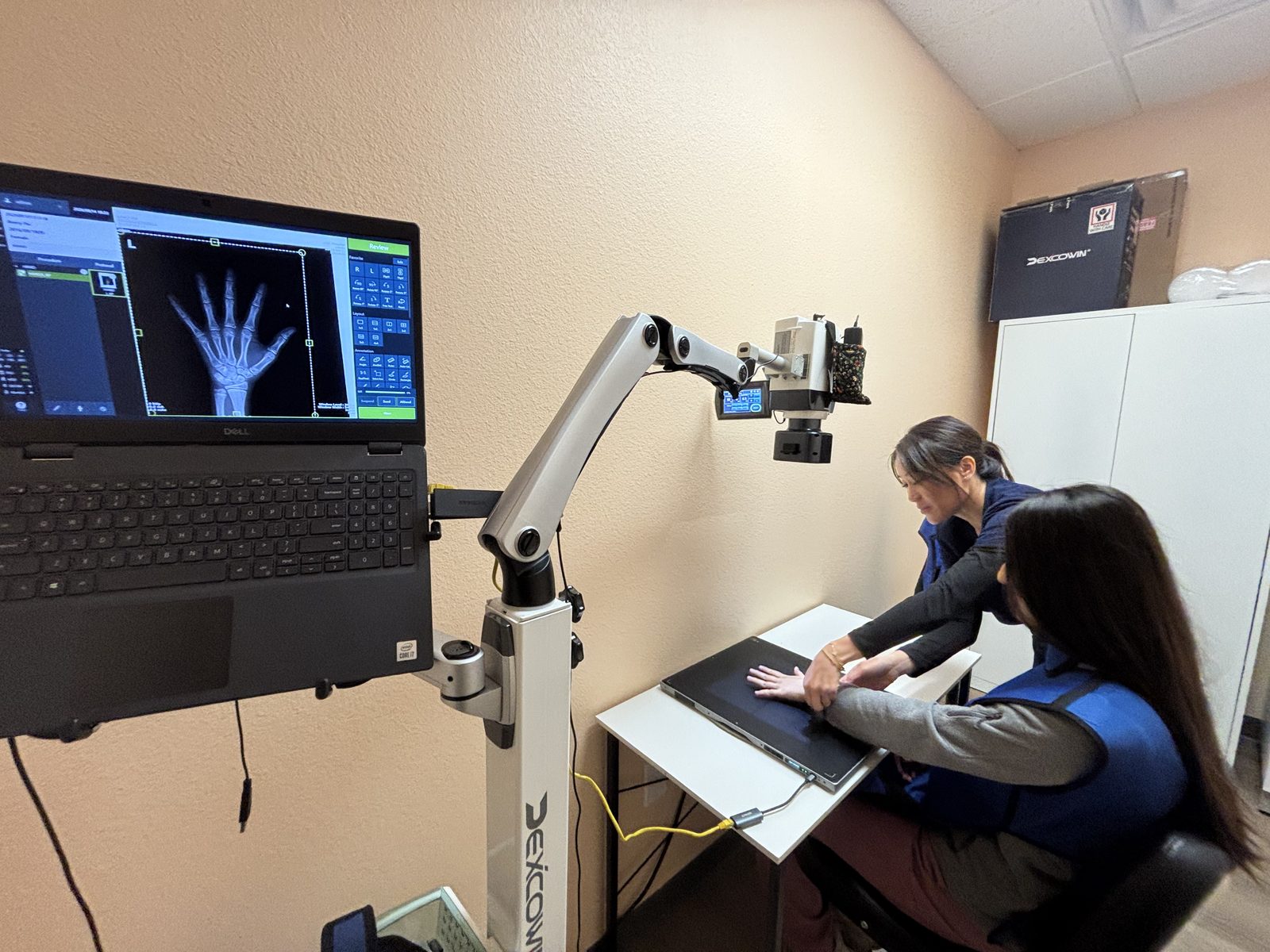
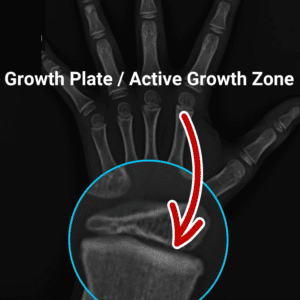
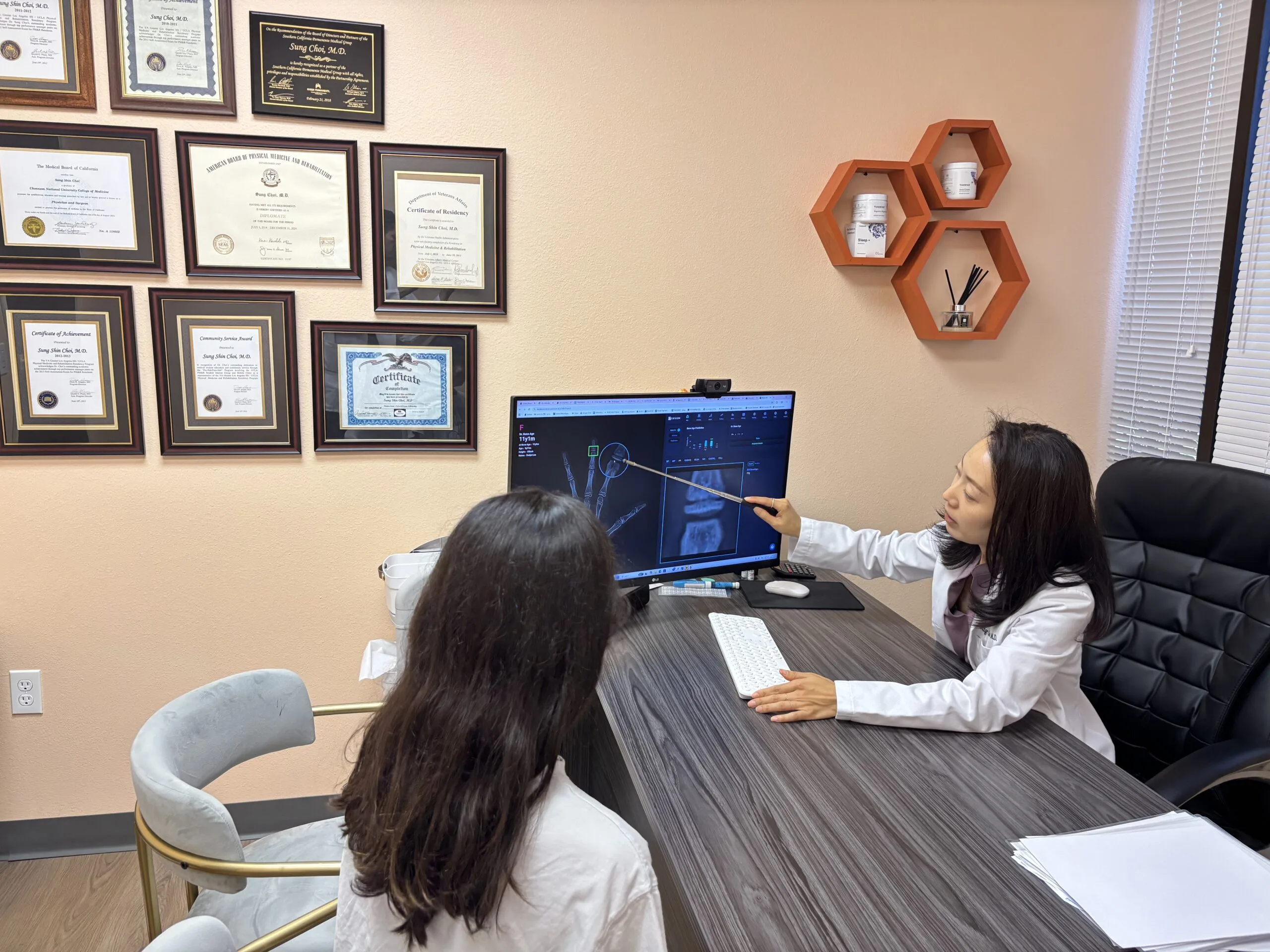
At our clinic, when a family mentions a teen who is already tracking below the growth curve, we start with a bone age X-ray. It is a quick, low dose image of the left hand and wrist. It shows where your teen stands on the growth timeline.
This matters because a slower grower already has less room for error. Say a teen’s bone age is advancing faster than expected for reasons that have nothing to do with Accutane. That is useful to know before adding any new variable to the picture. It also gives a real baseline. If growth slows once treatment starts, there is something concrete to compare it against.
A bone age check is also where growth hormone treatment sometimes becomes relevant for a family. Not because Accutane caused a growth problem, but because the X-ray occasionally uncovers a separate growth concern that was already there. Understanding how growth hormone therapy works is a reasonable next step once a family has that information in hand.
Most teens starting Accutane will never need an X-ray. For a teen whose growth was already in question before the prescription, it turns an open worry into a clear answer.
🔍 For more on what that X-ray shows and how it is read, see: Growth Plate X-Ray Interpretation
Will My Teen’s Growth Catch Up After Accutane?

On Reddit, you will find plenty of teens saying their growth slowed the month they started treatment. Those stories are usually not made up. Growth probably did slow down a bit. What is often missing is what happened after.
Once treatment ends, growth usually returns to its normal pace. In the Rochester study mentioned earlier, teens who slowed down during treatment reached the same final height as teens treated with antibiotics instead. The one group worth watching more closely is teens whose growth was already slow before starting.
A separate study looked at growth plate X-rays in children who took isotretinoin as part of cancer treatment. Those doses were far higher than anything used for acne. About four in ten of those children showed growth plate changes on imaging. Half of those changes resolved on their own. The other half went on to affect bone growth. That is why a visible growth slowdown is worth tracking, even when the overall research is reassuring.
🔍 If a growth slowdown is what brought you here in the first place, separate from Accutane entirely, this post walks through what counts as normal: My Son Is 15 and Barely Growing. Did We Miss the Window?
When Should We Get a Growth Check?
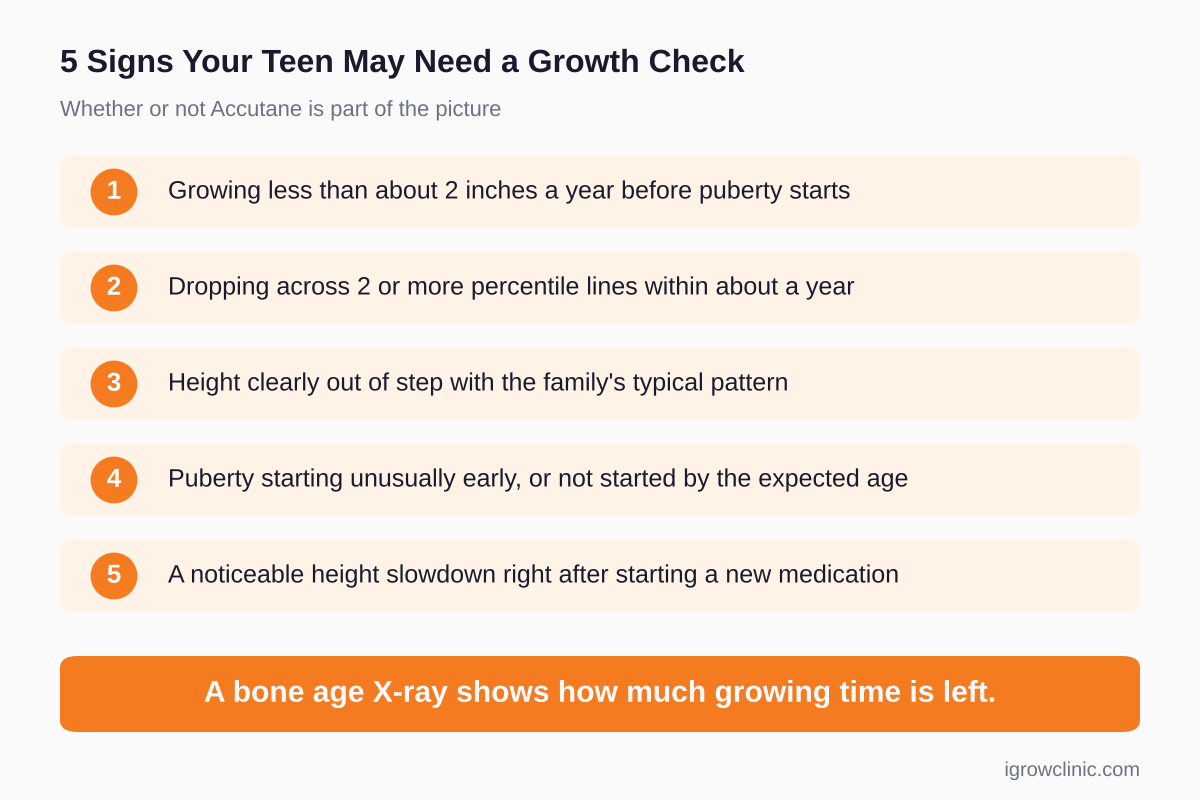
A handful of signs are worth a closer look, whether or not Accutane is part of the picture.
- Growing less than about 2 inches a year in the years before puberty starts
- Dropping across two or more percentile lines on the growth chart within a year or so
- Height that is clearly out of step with the family’s typical pattern
- Puberty signs that started unusually early, or have not started at all by the expected age
- A new, noticeable slowdown in height right around the time a new medication was started, Accutane or otherwise
A bone age evaluation shows how much growing time is left, and it is usually the first step when a family notices one of these signs.
Is Accutane Safe?
Does Accutane stunt growth? For most teens, the research says no, but your own teen’s history still matters. This post is not a substitute for your teen’s own dermatologist. Growth plate response to any medication can vary by child. The dermatologist managing your teen’s acne knows their specific dose, history, and labs. If growth is already a concern in your house, a bone age evaluation gives that conversation real numbers to work with, instead of a guess. Our team is glad to be part of that conversation alongside your dermatologist, not in place of them.
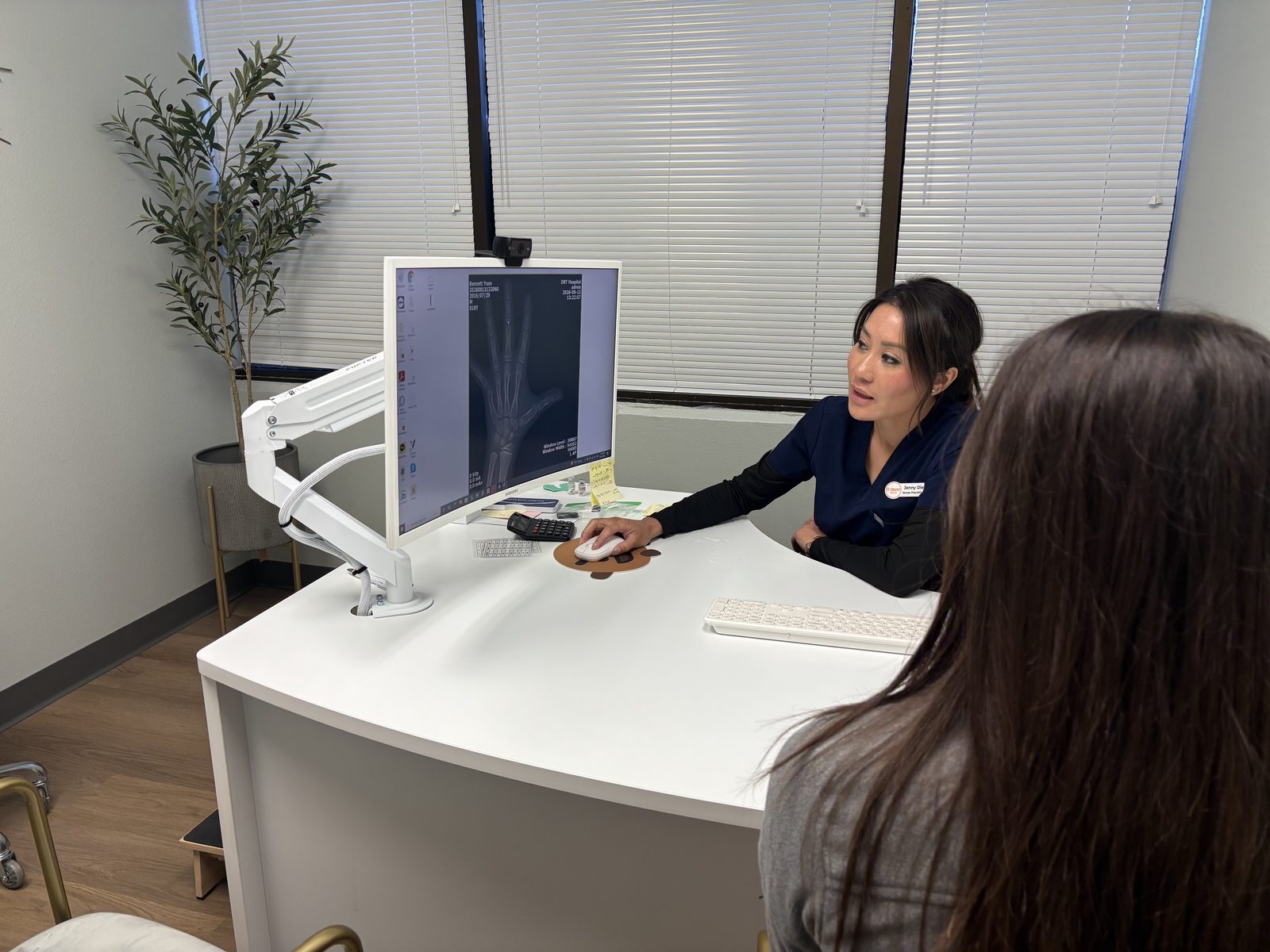
Our clinical team reviews every growth case with AI driven bone age analysis. That holds whether the question is about a medication, a stalled growth spurt, or a chart that looks different than it did last year. Families can work with us in person at our Fullerton clinic, or through telehealth in California, New York, Washington, Florida, and Texas.
🔍 To read why we built our clinic around exactly this kind of clarity: Why I Started a Growth Hormone Clinic
FAQ: What Parents Ask About Accutane and Growth Plates
1. Should my teen get a bone age X-ray before starting Accutane?
Not as a routine step. Most teens starting Accutane are growing normally and do not need one. If your teen was already shorter than expected, or growth had clearly slowed before treatment came up, a bone age X-ray gives you a baseline to compare against later.
2. What are the side effects of Accutane that parents should watch for, beyond growth?
Dry skin and lips are the most common. Some teens notice joint aches, mood changes, or changes in blood work that a dermatologist monitors with regular labs. These vary by teen, and a dermatologist adjusts dose and follow-up based on what shows up. Most side effects of Accutane ease after stopping it.
3. How can I keep track of my teen’s growth during Accutane?
Measure your teen’s height at home every few months, at the same time of day, without shoes, against the same wall. Write each number down with the date. Research shows a small slowdown during treatment is common, but if growth still looks slow a few months after the course ends, bring those numbers to your pediatrician or a growth specialist. A dated record turns a vague worry into a clear picture.
4. My teen already finished Accutane. Is it too late to check on growth?
No. If your teen’s growth picked back up after treatment, that matches what the research shows for most teens. If height still seems stuck months later, a bone age X-ray shows how much growing time is left, whatever the cause. The earlier you look, the more options remain open.
5. Is there a real connection between growth plates and Accutane?
At very high doses taken for months or years, yes, there is a documented connection. At the dose and length of treatment used for a standard acne course, the research has not shown a meaningful effect on final height.