
“My kid is 7 and two deviations short of mean on the growth chart. No issues other than short stature. Is this still something we should investigate, or are we just anxious parents?”
“My husband was a late bloomer and caught up just fine. But I don’t want to just assume the same thing will happen for our son.”
“Our pediatrician keeps telling us to wait and see. But he’s already 11, and I keep wondering: at what point does waiting become the thing we regret?”
Every one of these questions comes down to the same thing: not wanting to look back and wish you had asked sooner.
You are asking the single most important question a parent can ask before pursuing growth hormone therapy: Is now the right time, did we already miss the window, or is it too soon to know anything yet.
Unlike a fever or a broken bone, short stature does not announce itself with an obvious moment to act. There is no single day when a doctor says “now.” Instead, parents are left comparing their child to classmates, watching growth charts, and wondering whether waiting is wise patience or a mistake they will regret.
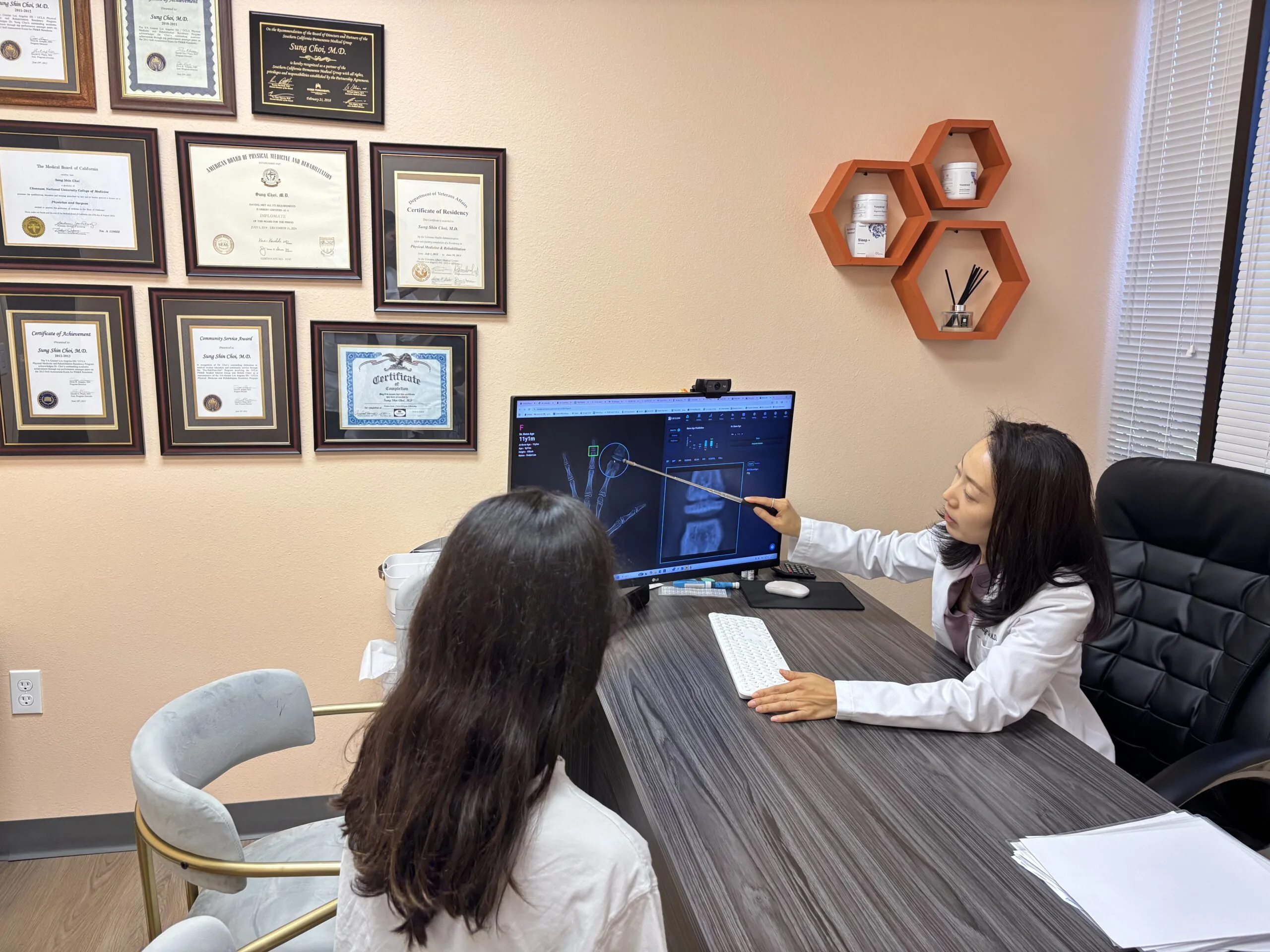
I’m Yuri Kim, a Nurse Practitioner at I Grow Clinic. At I Grow clinic, we have guided nearly 4,000 children through this exact question. Here is what our credentials look like, so you know who you are trusting with this decision.
| Credential | Detail |
|---|---|
| Children guided | Nearly 4,000 with precision growth strategies |
| Treatment retention | 95% rate, reflecting exceptional outcomes and family trust |
| Approach | Meticulous 1:1 personalized management using AI driven bone age analysis |
| Medical Director | Board Certified by the American Board of Physical Medicine and Rehabilitation (ABPMR) |
| Experience | 20+ years specializing in Pediatric Growth and Developmental PM&R |
| Reputation | 5 Star Google Rating with numerous testimonials |
| Telehealth | Available in CA, NY, WA, FL, and TX |
By the end of this article, you will understand what the research says about “best age,” and what determines the right timing in a real-life clinical evaluation.
Why Bone Age, Not Birthdays, Determines the Right Age to Start
Here is something most parents are never told directly: there is no single best age published in medical literature. What the research does show, consistently, is that younger age at the start of treatment predicts a better response, but “younger” is measured against your child’s biological maturity, not the number of their birthday candles.
A 2024 analysis of the NordiNet and ANSWER treatment databases, two of the largest growth hormone registries in the world, found two significant independent predictors of being a strong responder to hGH therapy:
- Starting younger: The younger a child was when they began treatment, the better they tended to respond.
- How far off from their “predicted” height they were. The bigger the gap between a child’s current height and the height you’d predict based on their parents’ heights, the better they tended to respond too.
A separate review published in The Lancet Child and Adolescent Health in 2024 concluded plainly that initiating treatment earlier tends to produce a better height outcome overall.
But here is the nuance most clinicians rarely explain. That same research also identifies delayed bone age, meaning a skeletal age younger than the calendar age, as an independent positive predictor of response. In other words, the two most important pieces of information are not just how old your child is, but how mature their skeleton is, and how much distance exists between their current height and their genetic potential.
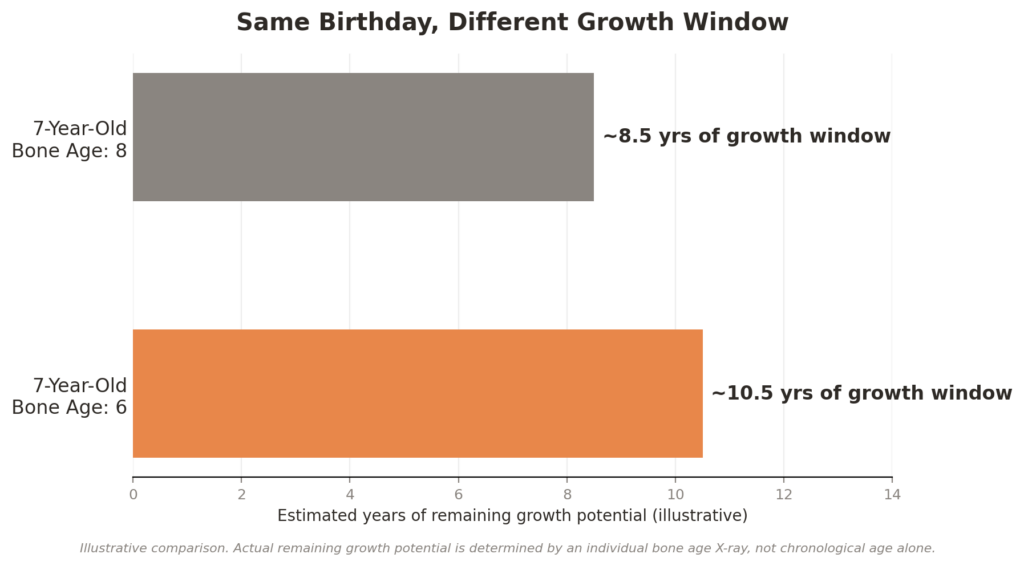
This is why we do not simply ask “how old is your child.” We ask “what does the bone age X-ray show, and how does that compare to the calendar.” A 7 year old with a bone age of 6 has meaningfully more runway than a 7 year old with a bone age of 8, even though both children are the same chronological age today.
🔍 To see what this looks like once your child gets a bone age X-ray, read: Growth Plate X-Ray Interpretation: What Your Child’s Bone Age Results Actually Mean
Is There Such a Thing as Starting Too Early or Too Late?
This is the question underneath the question. Parents are not really asking for a number. They are asking, will we regret the decision we make.
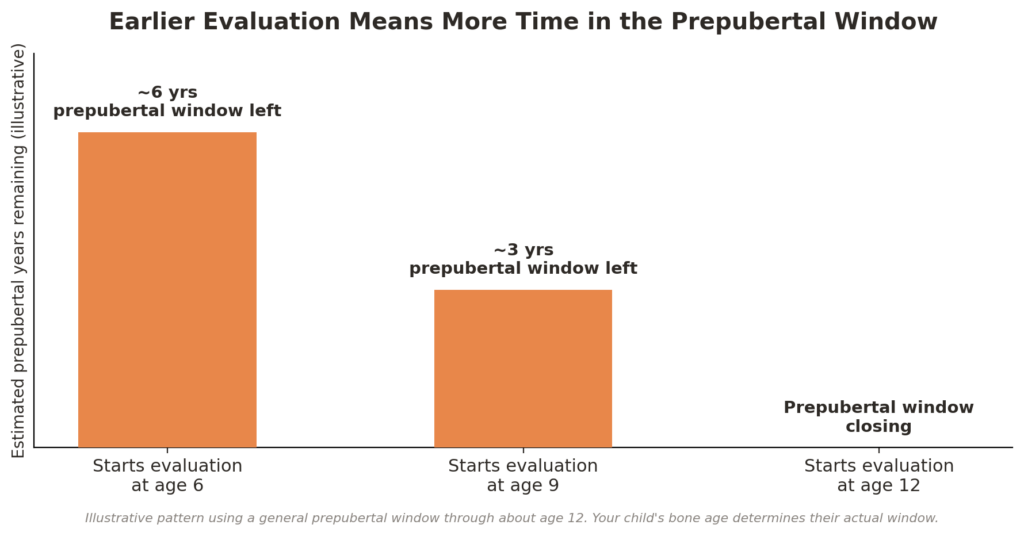
Here is what the research actually shows, and it may surprise you. A landmark NIH randomized trial by Leschek and colleagues found that most of the catch-up growth from treatment happens in the first 2 to 3 years, regardless of what age the child started at. This means the annual benefit of treatment is relatively consistent year to year during that window. Starting earlier simply means your child has more of those high value years still available before puberty complicates the picture.
That is the argument for starting earlier when your child is a genuine candidate. Reviewing across multiple large studies, the general pattern that emerges is that prepubertal initiation, ideally before around age 12 in boys and age 10 in girls, tends to be associated with the strongest height outcomes. But this is a pattern, not a rule carved in stone. No randomized trial has ever established one single best age that applies to every child, because so much depends on your individual child’s bone age, their genetic height potential, and how far their current height sits from that potential.
So is it ever too early? Generally, treatment is only appropriate once a child meets specific clinical criteria, not simply because a parent is eager to start. This is worth saying plainly, because one worry we hear often, is whether pursuing treatment for a child who is otherwise healthy and just smaller than peers is somehow premature or unnecessary. The honest answer is that legitimate candidacy depends on real numbers.
A 6-year-old who meets these criteria is not starting too early. A 6-year-old who falls short of them today isn’t necessarily ruled out. Sometimes it means continued monitoring and a follow up evaluation in six to twelve months, since growth patterns can shift. What matters is that the decision is guided by these numbers and by how your child is actually tracking over time, not by age alone. A good clinician will walk you through exactly where your child stands rather than giving a flat yes or no.
Is it ever too late? Treatment can still be meaningful well into the teenage years as long as growth plates remain open, though the available window naturally narrows as bone age advances. This is exactly why bone age, not chronological age, is the deciding factor rather than a birthday.
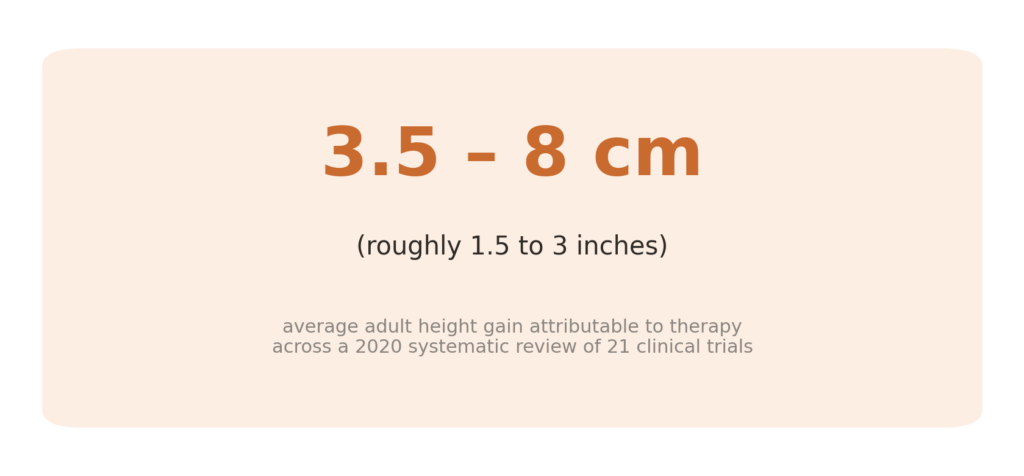
It is also worth being transparent about scale. Across the largest studies available, including a 2020 systematic review of 21 trials, the average adult height gain attributable to therapy for idiopathic short stature runs in the range of about 3.5 to 8 centimeters, roughly 1.5 to 3 inches, over several years of treatment, with real variation from child to child. Annual treatment costs without insurance or a self pay program can exceed $25,000. These are not small commitments, which is exactly why the timing conversation deserves this much care rather than a quick answer.
🔍 If cost is part of what’s weighing on your decision, read: Growth Hormone Cost and Insurance Coverage it will walk you through what typically drives that number and how self pay programs like the one we use can make treatment more accessible.
A Note on the Emotional Side of This Decision
Parents researching this topic are not only weighing centimeters and standard deviations. You are weighing whether your child gets teased at school, whether they feel confident trying out for a team, whether waiting means missing something that mattered.
Research on how short stature affects self-esteem is mixed, some kids are deeply affected, others are not, and that is exactly why the decision should never rest on height numbers alone. It should include an honest conversation about how your child feels about their height.
This is exactly the kind of nuanced, individualized conversation we have with every family before any treatment plan begins.

Why I Grow Clinic Approaches Timing Differently
Because the honest answer to “what is the best age” is not one number. It is a combination of your child’s bone age, growth pattern, and genetic height potential. A one size fits all answer was never going to serve you well. That is why every evaluation at I Grow Clinic starts with the same foundation: a bone age X-ray, analyzed using AI enhanced technology that compares your child’s skeletal maturity against all the relevant data points, combined with height tracking, family height history, and an honest conversation about your child’s own experience of their height. Every case, whether the child is 6 or 15, gets that same level of individualized review rather than a blanket cutoff.
Because our care is concierge and 1:1, we can only take on a limited number of new evaluations each week to protect the quality of that attention. If you are trying to figure out whether now is the right time for your child specifically, the fastest way to get a real answer is a growth assessment rather than more searching. We offer in-person evaluation at our Fullerton, California clinic, and telehealth consultation for families in CA, NY, WA, FL, and TX.
🔍 If you would like to understand more about why we built the clinic this way, our founder’s story, Why I Started a Growth Hormone Clinic, explains the experience that shaped our approach to timing, honesty, and family partnership.
Frequently Asked Questions
1. Is there one universal best age to start growth hormone treatment?
No. Research consistently shows that prepubertal initiation, generally before around age 12 in boys and 10 in girls, tends to produce stronger outcomes, but no randomized trial has established a single ideal age. Your child’s bone age, growth pattern, and genetic height potential matter more than the number on a calendar.
2. Is 6 or 7 too young for evaluation?
Not necessarily. If a child’s height and growth pattern meet clinical criteria, evaluation at this age is appropriate and can allow more years of treatment before puberty. Age alone is never the deciding factor.
3. Is 15 or 16 too late to start?
Not automatically. As long as growth plates remain meaningfully open, based on bone age rather than birth year, treatment can still be worthwhile. The window narrows as bone age advances, which is why timely evaluation matters more than a specific cutoff.
4. How is a good response to treatment measured?
A meaningful first year response is generally a height gain of more than roughly 0.3 to 0.5 standard deviations above the pretreatment rate. If that response does not appear, the treatment plan should be reevaluated rather than continued indefinitely.
5. Does my child need a formal hormone deficiency diagnosis to qualify?
No. Idiopathic Short Stature has been an FDA approved treatment pathway since 2003 for children who are healthy but significantly shorter than peers without an identifiable hormonal cause, based on height percentile and predicted adult height rather than a failed stimulation test.
Sources referenced in this article: Dauber et al. (2024), Tidblad & Sävendahl (2024), Leschek et al. (2004), Paltoglou et al. (2020), Cohen et al. (2008), and Allen & Cuttler (2013).