

“We Want to Help Our Son, But We’re Scared of the Cost.”
“We finally found a clinic that takes our concerns seriously, but when I asked about the price of growth hormone, I almost fell out of my chair.”
“Our insurance denied coverage twice. Our pediatrician said there’s nothing more he can do. We feel completely stuck.”
These are real conversations I have with parents almost every week. The medicine exists. The window is still open. But the financial reality feels like a wall.
I’m Sunjo Chung, FNP at I Grow Clinic. Part of my role is to make sure families understand not just the clinical picture, but the financial one as well, because clarity on cost is just as important as clarity on diagnosis.

Why Families Trust I Grow Clinic
| Clinic Standard | What It Means for Your Family |
|---|---|
| Nearly 4,000 children guided | Proven experience navigating real-world treatment decisions |
| 95% treatment retention | Families stay because outcomes and support meet expectations |
| AI-driven bone age analysis | Precision planning, not guesswork |
| Board-certified Medical Director, 20+ years | Expert oversight at every step |
| Telehealth in CA, NY, TX, WA, FL | Access without geography being a barrier |
| 5-Star Google Rating | Trust built through transparent, compassionate care |
What Insurance Actually Covers
Here is the honest truth most parents don’t hear until they are already deep in the process.
Insurance companies in the United States apply strict criteria before approving growth hormone for a child. Coverage is most commonly approved for diagnosed growth hormone deficiency, confirmed through stimulation testing, or for specific medical conditions such as Turner Syndrome, Prader-Willi Syndrome, or chronic kidney disease.
For children with idiopathic short stature (ISS), meaning they are simply shorter than their peers without a diagnosable hormonal cause, insurance approval is significantly harder to obtain. Insurers typically require a confirmed growth hormone deficiency diagnosis through formal stimulation testing, a height below the 1st percentile, or an underlying medical condition driving the growth problem. Children who are simply shorter than average, even significantly so, often do not meet these thresholds on paper. Many major insurers have narrowed their formularies over time, and prior authorization requirements have become more demanding. Even when a child meets the clinical threshold, families frequently face denials, appeals, and mandatory brand switches mid-treatment.
The reality is this: insurance coverage for growth hormone is notoriously difficult to obtain, and the bar is high.
What this means in practice is that many healthy children who would genuinely benefit from growth hormone support are categorically excluded from coverage, not because the treatment is inappropriate for them, but because insurance criteria are designed around cost containment rather than individual clinical need. Families are left in a difficult position: their child’s need is real, the treatment exists, but the system is not built to help them.
It is also worth noting that growth hormone medications in the United States are significantly more expensive than in most other countries, where pricing is regulated at a national level. This makes the financial burden uniquely challenging for American families, regardless of whether insurance is involved.
The result is that many families who need this support the most are told their child doesn’t qualify, or that the cost is simply out of reach.
🔍To understand why ISS children still benefit from growth hormone support, read: Growth Hormone Therapy for Idiopathic Short Stature

What Does Growth Hormone Actually Cost?
When purchased through retail pharmacy channels without insurance, growth hormone injections typically range from $2,500 to $10,000 per month, depending on the brand, the dose, and the child’s weight.
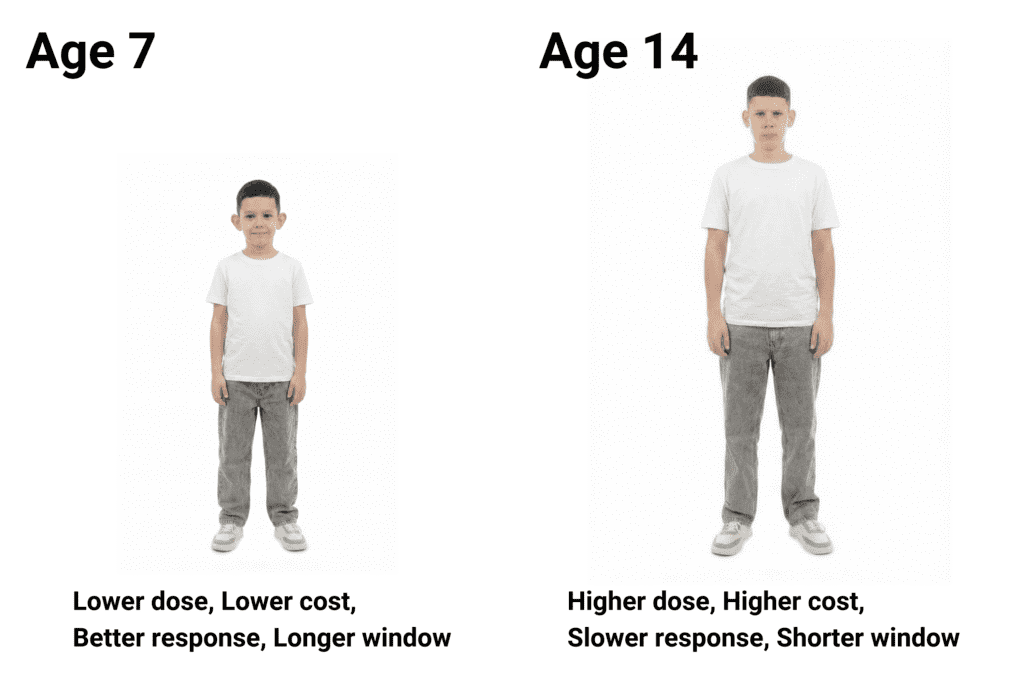
That last point matters more than most families realize. Growth hormone dosing is weight-based. As a child grows and gains weight, the dose needs to increase, which means the monthly cost increases as well. A younger, lighter child will require a smaller dose and therefore a lower monthly cost compared to a heavier teenager receiving the same treatment.
This is one of the clearest clinical and financial arguments for starting earlier when the window is still open. Not only does early treatment produce better results because growth plates are more responsive, it also costs less per month because the dose requirement is lower.
🔍 For more on why timing is everything, read: How Do You Know If Growth Plates Are Closed?
Options Parents Often Don’t Know About
What many families don’t realize is that the retail pharmacy route is not the only path.
Some pharmaceutical manufacturers have established direct self-pay programs that allow patients to access their medication at a significantly reduced cost compared to what insurance companies typically pay for covered patients. These programs work through a small network of contracted specialty pharmacies, and the medication is delivered directly to the family.
The price difference can be meaningful, making treatment genuinely more accessible for families who do not qualify for insurance coverage or who prefer not to go through the insurance approval process at all. Whether this kind of program is the right fit depends on a child’s weight, dosing needs, and overall treatment plan. It is not something that can be set up without a proper medical evaluation first.
Through a manufacturer self-pay program, growth hormone medication typically costs about $1,000 to $2,000 per month. The exact price depends on the dose and your child’s weight, and on whether your child is eligible.
If you are curious about whether this option applies to your family’s situation, the best next step is a direct conversation with our team.
Learn how our growth hormone treatment program works.
A Word of Caution: Medical Spas and “Growth Hormone” Advertising
If you have been researching growth hormone online, you have likely come across advertisements from medical spas and wellness clinics promoting what appears to be growth hormone therapy. Before your family pursues anything based on those ads, there is an important distinction worth understanding.
Many of these clinics are not offering real growth hormone at all. What they market is often a class of compounds called peptides, specifically growth hormone releasing hormone analogs. These are substances that signal the body to produce more of its own growth hormone rather than delivering the hormone itself. Peptides like sermorelin and similar compounds have become popular in adult wellness and anti-aging markets, and there is significant commercial interest in promoting them.
However, these peptides are not FDA-approved for children. Their long-term safety in growing children has not been established.
Real, pharmaceutical-grade human growth hormone is an entirely different category of medicine. It is a large, complex molecule consisting of 191 amino acids, precisely manufactured to mirror the body’s own growth hormone. The engineering required to produce it correctly cannot be replicated in a compounding pharmacy. It must be manufactured by licensed pharmaceutical companies under rigorous, tightly regulated standards, with every batch tested for purity, potency, and stability.
This matters because compounded or peptide-based products are not equivalent, not interchangeable, and not appropriate for children, regardless of how they are marketed. When your child’s growth window is limited and every month counts, the medicine they receive needs to be the real thing, produced and verified to pharmaceutical standards, prescribed and monitored by a qualified clinician.
If you are ever unsure whether a product or program is offering legitimate growth hormone, that is exactly the kind of question our team is here to help you answer.
🔍 To understand the full difference between peptides and real growth hormone, and why we do not use peptides in our clinic, read: Growth Hormone vs. Peptides for Children: What Parents Need to Know Before Choosing
A Note on Starting Early
The families I feel most for are the ones who waited, not because they didn’t care, but because no one gave them a clear picture of what was possible or how to access it.
If your child’s growth window is still open and cost has been the reason you’ve hesitated, I want you to know that there may be more options than you’ve been told. The financial path is not always as closed as it first appears.
Your child’s growth is a mission we share. Whether you are in Southern California or connecting with us via telehealth from New York, Texas, Washington, or Florida, let’s look at the full picture together, clinically and financially, before the window closes.
To see who may qualify, read Growth Hormone for Height: Does My Child Actually Qualify?
To see real results from children we treat, visit our Before and After page.
FAQ: What Parents Ask About Growth Hormone Costs
1. Will insurance ever cover growth hormone for a short but otherwise healthy child?
It depends on the insurer and the clinical documentation. Some policies still cover ISS under specific criteria, but approvals have become less common over time. A thorough evaluation gives you the strongest possible foundation if you choose to pursue that path.
2. Does the dose stay the same throughout treatment?
No. Because dosing is weight-based, the monthly dose and cost will typically increase as your child grows. This is another reason earlier treatment, when children are lighter, tends to be more cost-efficient.
3. Is there any way to make treatment more affordable?
Yes. Beyond standard insurance channels, there are alternative access pathways that many families are not aware of. Some pharmaceutical manufacturers offer programs that allow patients to purchase medication directly at a meaningfully lower cost than retail pricing. Typically, this is about $1,000 to $2,000 per month. Eligibility and availability vary, and the right option depends on your child’s dosing needs and overall treatment plan. Contact our team directly and we can walk you through what may be available for your family.
4. How long does treatment typically last?
It varies by the child’s bone age, remaining growth potential, and response to treatment. Some children benefit from one to two years of support. Others, who start earlier, may continue longer. We map this out clearly at the initial consultation so families can plan accordingly. See How long does growth hormone treatment last?
5. Is it safe to purchase growth hormone online to reduce costs?
No. Growth hormone purchased outside of a licensed, supervised medical program carries serious risks, including contamination, incorrect dosing, and no clinical oversight. This is one area where cutting costs can cause genuine harm.
6. How much does growth hormone cost per month for a child?
At retail, without insurance, it typically ranges from $2,500 to $10,000 per month. Through a manufacturer self-pay program, it is typically about $1,000 to $2,000. The price depends on the brand, the dose, and your child’s weight. See What Does Growth Hormone Actually Cost? above.
Explore More
What Age Do Growth Plates Close?
Bone Age vs. Chronological Age: Is Your Child’s Biological Clock Ticking Too Fast?