

“I saw something about puberty blockers on the news last week, and now I cannot stop thinking about it. Is that the same thing my daughter’s doctor mentioned?”
“Her growth spurt already came so early. If we do this, are we stopping her from growing at all?”
“I don’t even know what question to ask anymore. Everything I read online seems to be about a completely different situation than ours.”
If you recognize any of these thoughts, you are not the only parent asking them. Puberty blockers get discussed constantly on social media and news, almost always in a context that has nothing to do with why a pediatric growth specialist might mention them to you. That mismatch is exactly what makes this topic so disorienting for a parent who is simply trying to understand their own child’s growth chart. You heard a term charged with national debate, and now you are trying to figure out if it belongs anywhere near a conversation about your child’s height.
🔍 If you are still wondering whether what you’re seeing is actually early puberty, read: Is My Child Going Through Puberty Too Early?
I’m Sunjo Chung, a Nurse Practitioner at I Grow Clinic. Our clinic has guided nearly 4,000 children through their growth journeys. When a family hears “puberty blocker” for the first time in our context, it is almost always because their child’s growth plates are maturing faster than their calendar age, often due to early puberty, and we are discussing whether temporarily pausing that hormonal signal could protect their remaining height potential.

By the end of this article, you will understand exactly what the research says about puberty blockers and height, in the specific context of early puberty and short stature, so you can walk into your next conversation with your child’s provider asking the right questions instead of carrying an unclear fear.
Do Puberty Blockers Actually Help My Child End Up Taller?
For a child whose puberty started early, puberty blockers tend to help them end up a little taller as an adult, not shorter, compared to children in the same situation who are never treated.
A 2026 Endocrine Society clinical practice guideline pooled data from 14 studies covering more than 1,400 children and found that treatment with a GnRH agonist, the clinical name for a puberty blocker, was associated with a mean increase in adult height of about 2.7 centimeters compared to untreated children. When treatment continued for more than three years, that benefit grew to nearly 3.9 centimeters. This is not a marginal footnote. It is the central finding of the largest pooled analysis available on this exact question.
A separate, older but still highly relevant randomized controlled trial published in the New England Journal of Medicine looked specifically at adolescents with short stature, not just early puberty, and found something worth sitting with. When researchers gave one group of children an LHRH agonist (a puberty blocker) and compared them to a placebo group, the treated children showed a dramatic slowdown in bone age progression alongside continued, if modest, height gain. The net result was a higher predicted adult height in the treated group. The mechanism is not that the medication adds height directly. It is that the medication slows down the biological clock that governs when growth plates close, which gives a child’s skeleton more calendar time to keep adding height before that window shuts.
This is precisely the concept we walk families through when we talk about the Tall Child Paradox. A child who is tall for their age right now because puberty arrived early is not necessarily headed toward a tall adult height. If their bone age is running well ahead of their actual age, their growth plates may close years sooner than their peers. Puberty blockers, used specifically in that scenario, are one of the few tools that can slow that acceleration down.
🔍 Not sure if your child’s early puberty is low risk or high risk? read: Does Early Puberty Affect Height?
We want to be precise here, because we have seen some confusion online about puberty blockers being framed as a kind of height shortcut, a way to squeeze in a bit of extra growth for a child who is developing entirely on a normal timeline. That is not what the research supports, and it is not how these medications are used in our clinic. The height benefit shown in the studies above appears specifically in children whose puberty started early and whose growth plates were closing ahead of schedule. For a child already on a typical timeline, there is no established evidence that adding this medication provides any additional height.
Will My Child Stop Growing While On Treatment?
This is the fear we hear most often, and it comes from a real, observable fact that gets misunderstood. While a child is on a puberty blocker, their height velocity, meaning how much they grow per year, does slow down. This is because puberty blockers work by pausing the sex hormone surge that drives the rapid pubertal growth spurt. So a child on treatment will grow less in a given year than a child who is actively moving through puberty. If you are only watching the number on the growth chart month to month, that slowdown can look alarming, even like growth has stopped entirely.
Here is the piece that gets left out of most explanations. That slower pace is not a side effect. It is the entire point of the treatment. Growth plates close based on bone age, not birthdays, and bone age advancement slows down at the same time as height velocity, by a proportionally larger amount. So while your child is gaining height more slowly this year, their growth plates are staying open longer, which means they have more total time ahead of them to keep growing than they would have had otherwise.
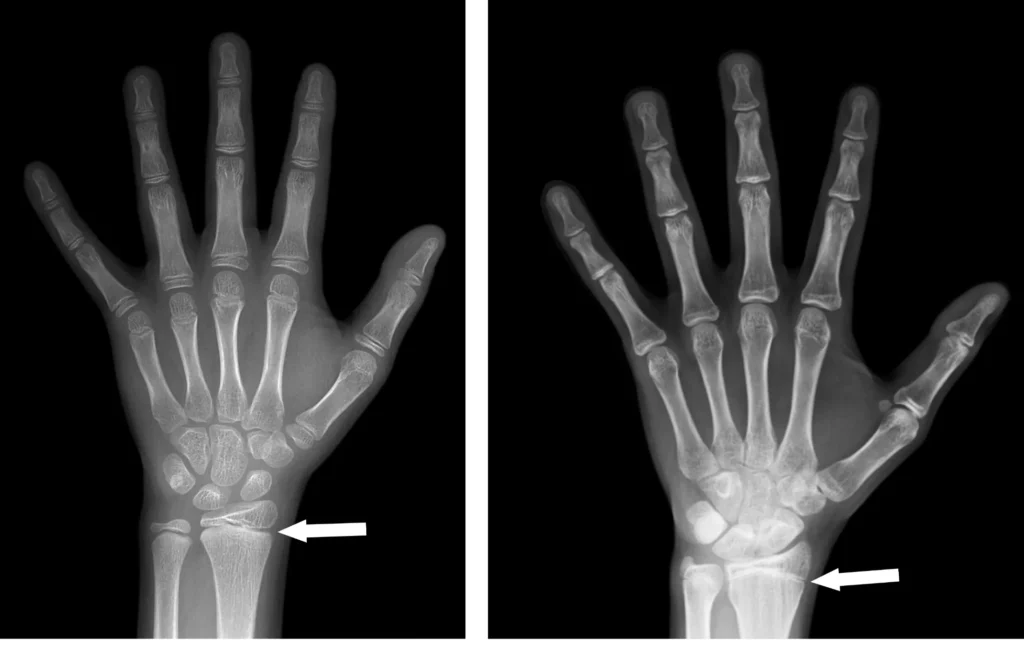
This comparison tells us how much growing time your child has left.
There is also an important piece we do not want you to miss. Slowing the process down is only half of the strategy. At I Grow Clinic, children on puberty blockers are paired with growth hormone therapy as a standard part of the treatment plan. The puberty blocker buys back time on the growth window. The growth hormone is what helps your child make the most of that extra time, supporting steady height gain during the very years the growth plates would otherwise have already been closing.
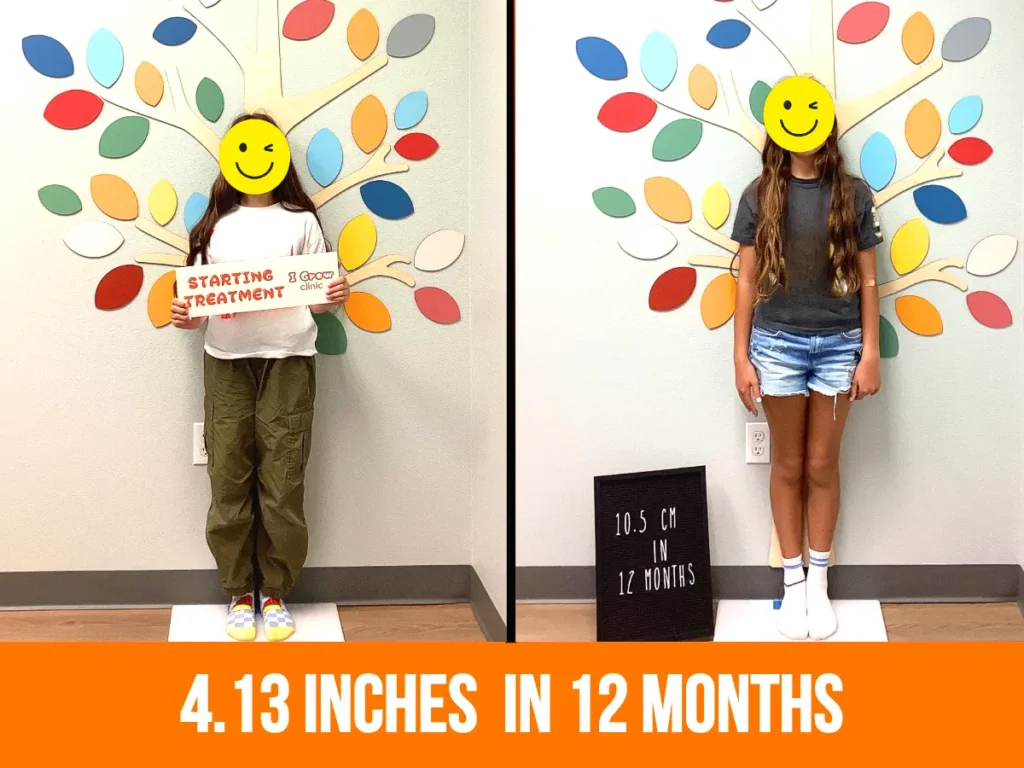
It is shown for illustration only and is not related to the specific context described above.
We monitor both sides of this closely with regular bone age imaging and growth velocity tracking, so a family never has to guess whether what they are seeing on the growth chart is expected or a sign that something needs to be reassessed.
🔍 To understand how we read bone age results in context, read: Bone Age vs. Chronological Age: Is Your Child’s Biological Clock Ticking Too Fast?
How Long Can My Child Safely Stay On Puberty Blockers, and What Happens After?
Puberty blockers are not designed to be a permanent state. At I Grow Clinic, treatment duration is individualized based on your child’s bone age, height velocity, and how their growth plates are responding.
While your child is on treatment, we monitor them closely, typically with follow up visits every three to six months, along with periodic bone age imaging and lab work. This is not a “start it and check back next year” medication. The entire value of treatment comes from tracking your child’s individual response and adjusting course as needed. The effects are reversible. Once treatment stops, the body’s own hormonal signals resume, and puberty continues from where it was paused.
One important clinical caution worth naming directly: puberty blockers are not intended to be used alone, indefinitely, without a plan for what comes next. National guidelines are explicit that prolonged use without a clear endpoint carries its own considerations, particularly around bone health. This is exactly why the evaluation, monitoring, and stopping point all matter as much as the decision to start.
To Every Parent Reading This Late At Night
We know what it feels like to be the parent doing this research after everyone else in the house has gone to sleep. You are not trying to make your child taller than nature intended. You are trying to make sure that if there is a window still open, you do not miss it.

Every family who sits across from me with this question is carrying the same quiet weight: wanting to do right by their child, without a script for how. It is the reason evaluations like this exist in the first place.
A Personalized Answer Starts With Your Child’s Own Growth Picture
Nothing in this article replaces an individualized evaluation, and that is intentional. Whether a puberty blocker is the right tool for your child depends entirely on their bone age, their growth velocity, and where they currently sit in their pubertal development. Dr. Choi personally supervises every treatment plan at I Grow Clinic, and every recommendation is built on AI driven bone age analysis paired with 1:1 concierge management, not a one size fits all protocol.
Because our care model is concierge and closely managed, we are only able to bring on a limited number of new patients each week. If you are ready to understand exactly where your child stands, we would be glad to walk through it with you.
We see families in person at our Fullerton, California clinic, and via telehealth for families in California, New York, Washington, Florida, and Texas. Request a consultation, or schedule a growth assessment, whenever you are ready for real answers instead of another late night search.
🔍 To understand why this kind of clarity became our mission, read: Why I Started a Growth Hormone Clinic
Frequently Asked Questions
1. Are puberty blockers reversible?
Yes. Once a child stops treatment, the body’s own hormones resume signaling puberty to continue, and development picks up from where it was paused. Bone density, which is maintained at a stable level during treatment, typically catches up as puberty resumes.
2. Do puberty blockers cause infertility in children treated for early puberty?
When used for central precocious puberty in the way we use it at I Grow Clinic, treatment is paused and puberty later resumes naturally, allowing normal reproductive development to continue on its own timeline. This is a different clinical context than prolonged use into and through the reproductive years.
3. What age do doctors typically start puberty blockers for early puberty?
Treatment is considered when a child shows signs of puberty significantly earlier than their peers and when a bone age evaluation confirms the growth plates are maturing faster than the calendar suggests.
4. Can puberty blockers be combined with growth hormone therapy?
In most cases, yes. When a child’s evaluation shows both an accelerated bone age and a growth trajectory that would benefit from additional support, providers may consider combining the two therapies to maximize remaining height potential. This decision is always individualized.
5. Is puberty blocker treatment covered by insurance?
Coverage varies significantly by insurer and by diagnosis. Treatment for confirmed central precocious puberty is more commonly covered than off label uses. Our team can help you understand what applies to your child’s specific situation during your evaluation.
References
Latronico AC, Roberts SA, Alonzo M, et al. Central Precocious Puberty: An Endocrine Society Clinical Practice Guideline. The Journal of Clinical Endocrinology and Metabolism. 2026.
Yanovski JA, Rose SR, Municchi G, et al. Treatment with a Luteinizing Hormone Releasing Hormone Agonist in Adolescents with Short Stature. The New England Journal of Medicine. 2003;348(10):908-17.
Park HK, Choo MS, Shim YS. Adult height after gonadotropin releasing hormone agonist treatment in girls with early puberty: A meta-analysis. Clinical Endocrinology. 2020;93(2):135-145.
Wit JM. Should Skeletal Maturation Be Manipulated for Extra Height Gain? Frontiers in Endocrinology. 2021;12:812196.
Mauras N, Ross J, Mericq V. Management of Growth Disorders in Puberty: GH, GnRHa, and Aromatase Inhibitors: A Clinical Review. Endocrine Reviews. 2023;44(1):1-13.