
“My son just turned 11 and he started developing pubic hair. Does that mean he will end up shorter than he should be?”
“My daughter started developing breast bud at 8. Everyone keeps telling me not to worry, but something feels off. Could this affect how tall she grows?”
That quiet unease you are carrying deserves a clear answer, not reassurance to wait and see. Early puberty raises a legitimate question about height, and the answer is more nuanced than most medical professionals let on. The short answer is: early puberty does not automatically mean shorter adult height. But when early puberty comes with an advanced bone age, the risk is real, measurable, and time-sensitive.
The difference between those two scenarios is exactly what most parents are never told, and why so many families spend years waiting when they should be getting an accurate bone age evaluation.
I am Yuri Kim, FNP at I Grow Clinic. Our team has guided nearly 4,000 children through their growth journeys.
I have sat with families who came to us after months of being told their child’s early development was nothing to worry about, only to discover on the bone age study that the growth plates were already closing significantly ahead of schedule. The parents often go quiet when I explain what that means. Some tear up, and I always find myself thinking: if we had met this family just a year or two earlier, before the bone age had advanced this far, we would have had so many more options on the table.
That is why I want every parent reading this to have the full picture now, while there is still time to act if action is needed.
Why Families Trust I Grow Clinic
| Credential | Detail |
| Children Guided | Nearly 4,000 with precision growth strategies |
| Treatment Retention | 95% rate, reflecting exceptional outcomes and family trust |
| Approach | Meticulous 1:1 personalized management using AI-driven bone age analysis |
| Medical Director | Board Certified by the American Board of Physical Medicine and Rehabilitation (ABPMR) |
| Experience | 20+ years specializing in Pediatric Growth and Developmental PM&R |
| Reputation | 5-Star Google Rating with numerous testimonials |
| Telehealth | Available in CA, NY, WA, FL, and TX |
By the end of this post, you will understand the real relationship between early puberty and height, the specific signs most parents miss at home, and exactly what a bone age evaluation can tell you that no amount of waiting can.
Does Early Puberty Always Mean Shorter Adult Height? The Answer Most Parents Never Get
This is the question parents type into Google at midnight, and the answer they find is almost always incomplete.
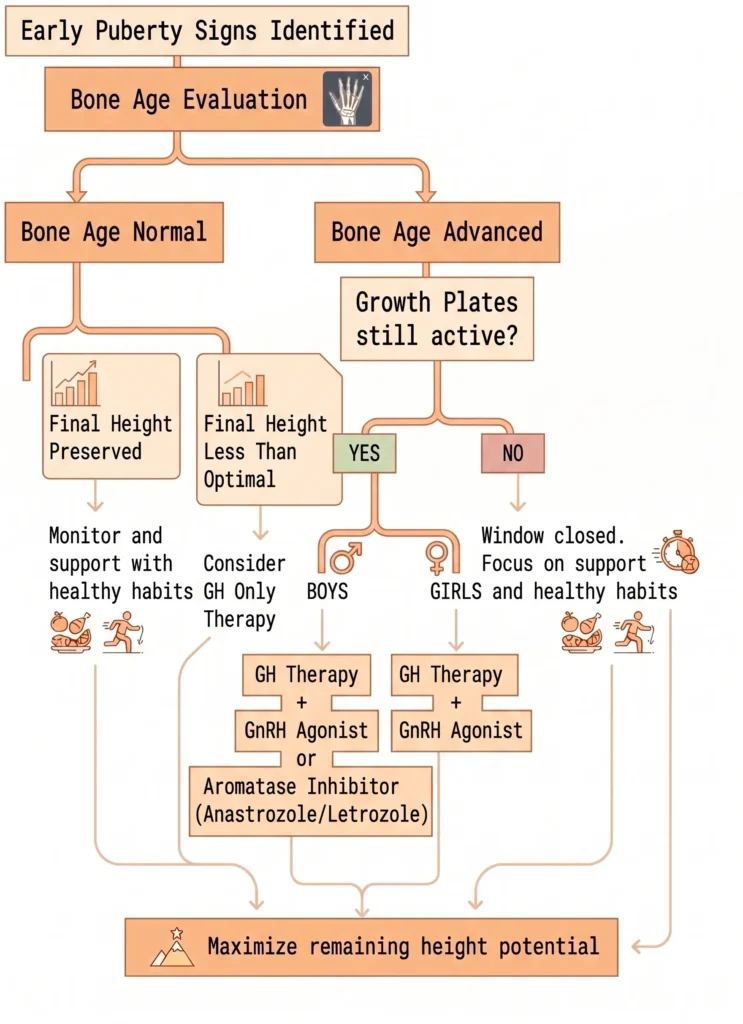
Here is the full picture. Early puberty triggers a surge in sex hormones. These hormones do two things simultaneously. They drive the growth spurt that makes your child shoot up seemingly overnight. And they accelerate bone maturation, pushing the growth plates toward fusion earlier than the chronological age would suggest.
The key word there is accelerate. Not every child with early puberty accelerates at the same rate. Some children enter puberty on the earlier side of normal and their bone age stays close to their chronological age. In those cases, the body often compensates through a longer duration of pubertal growth, and final adult height may not be significantly affected.
But for children whose bone age runs significantly ahead of their chronological age, the story is different. Their growth plates are aging faster than the calendar. The window for height gain is closing on an accelerated schedule. And the final adult height they reach may fall meaningfully below their genetic potential, not because early puberty is inevitable in its effects, but because the bone clock moved faster than anyone realized.
This is the distinction that almost no medical professional explains clearly, and it is the most important thing you can take from this post.
Early puberty with normal bone age progression: lower risk. Compensatory mechanisms may preserve final height.
Early puberty with advanced bone age: real risk. The growth window is closing faster than the calendar suggests. The time to act is now, not later.
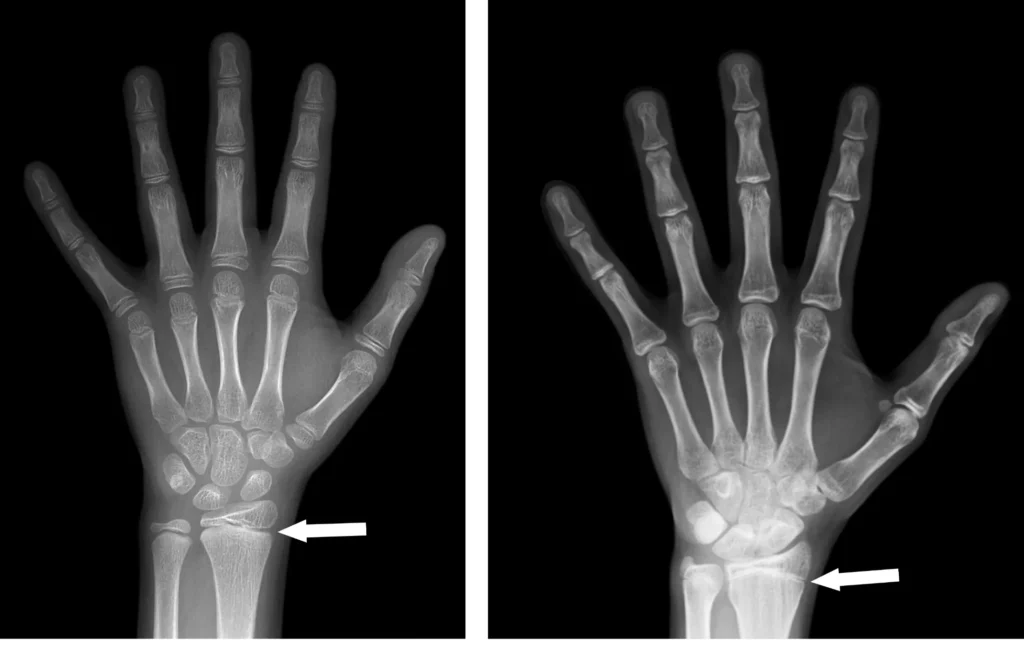
The best way to know which situation your child is in is a bone age study. A simple, 2-minute, low-dose X-ray of the left hand and wrist that reveals the true biological age of your child’s skeletal system.
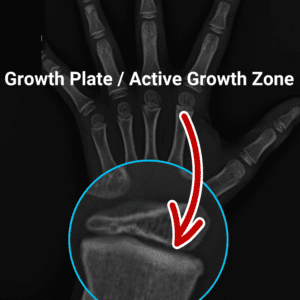
🔍 To understand how growth plates mature and what fusion actually looks like, read: Growth Plate X-Ray Interpretation: What Parents Need to Know
Warning Signs of Early Puberty Most Parents Miss at Home
The signs that matter most for height are not always the obvious ones. Some of the most significant early puberty indicators arrive quietly, and by the time they become visible on the outside, the bone age may already be running significantly ahead of schedule.
Here is what to watch for, starting with the signs that tend to arrive quietly:
In girls:
- Breast budding before age 7 or 8, even a small tender lump under the nipple counts
- A sudden and noticeable growth spurt before age 9, especially if she is now clearly taller than her peers
- A first period before age 10
In boys:
- Testicular enlargement before age 9, this is the first sign of puberty in boys and is easily missed because parents are not always monitoring for it
- Pubic hair or underarm hair before age 10
- A rapid height surge significantly earlier than male peers
- Voice changes or early facial hair development before age 11
If you are seeing any of these signs, the next step is not to wait for more. It is to find out what the bone age actually shows.
🔍 To understand the full puberty timeline and Tanner staging, read: Tanner Stages of Puberty: A Parent’s Visual Guide
🔍 For a deeper look at recognizing early puberty and what it means for your child’s growth window, read: Is My Child Going Through Puberty Too Early? What Parents Need to Know
What Advanced Bone Age Means for Your Child’s Options, and Why Timing Matters
Once a bone age study reveals that your child’s skeletal age is running significantly ahead of their chronological age, two questions become urgent. How much growth potential is realistically left? And is there still time to protect it?
What options remain depends on how advanced the bone age is and how open the growth plates still are. At I Grow Clinic, we use three primary interventions depending on the child’s individual clinical picture:
- Growth Hormone (GH) Therapy maximizes height gain during the remaining open window.
- GnRH Agonist Therapy temporarily slows bone maturation, buying more time before the growth plates fuse.
- Aromatase Inhibitor Therapy (anastrozole or letrozole) is used in boys to reduce estrogen-driven bone maturation, offering an additional pathway to protect height potential.
Treatments at I Grow Clinic are highly personalized to each child’s unique bone age, growth plate activity, pubertal stage, and clinical history. Data gives you choices. Waiting without measuring does not.
When to Seek a Growth Specialist Evaluation
You do not need a diagnosis or a clear threshold to request a bone age evaluation.
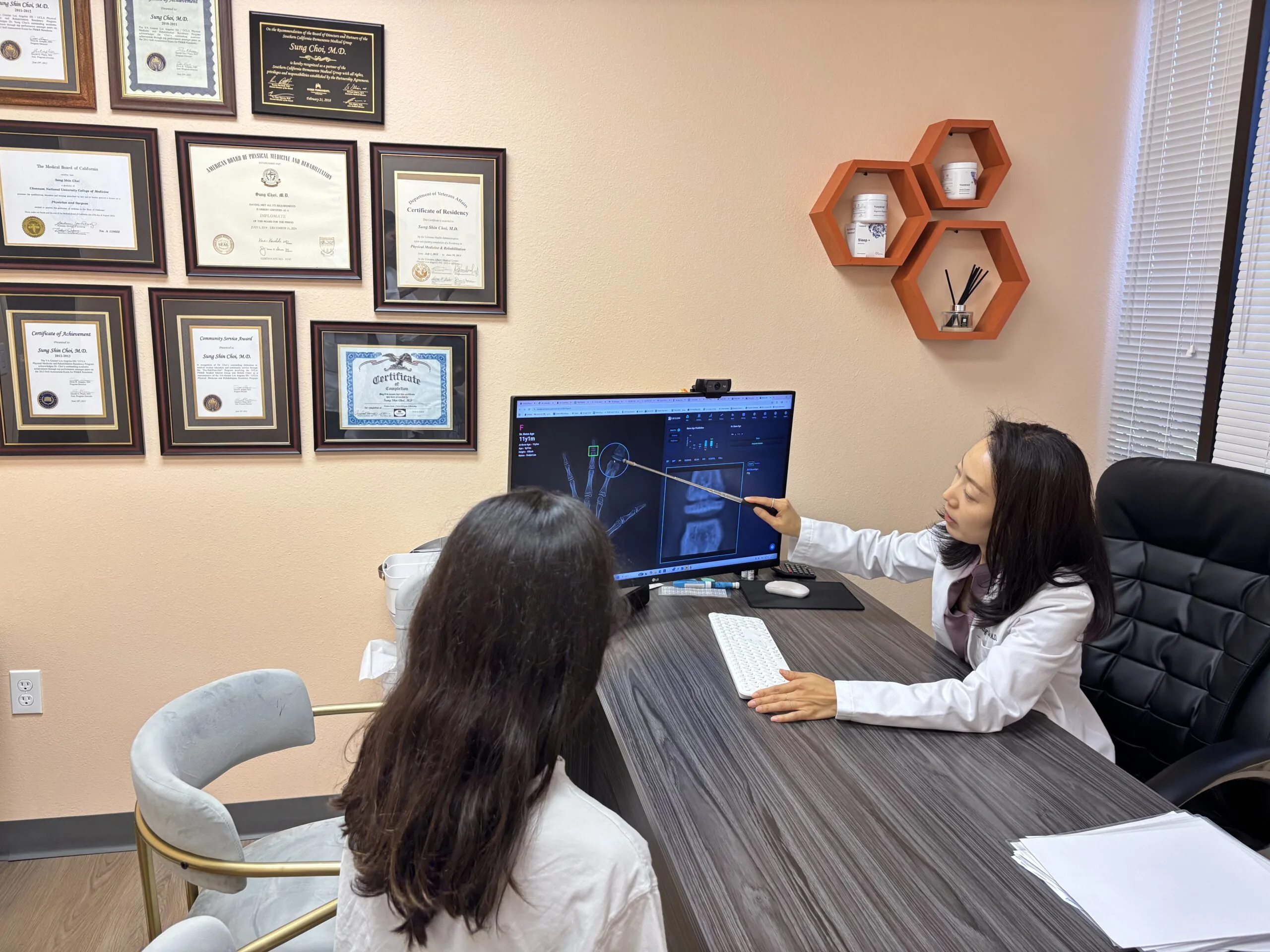
If your child seems to be showing puberty signs earlier than you expected, or if your gut is telling you something is moving too quickly, that is enough reason to find out where they stand in their growth journey. A bone age study is a simple, low-dose X-ray of the left hand and wrist. It takes about 2 minutes. At I Grow Clinic, we pair this with AI-enhanced analysis to calculate your child’s predicted adult height and a precise picture of remaining growth potential. This gives your family a data-driven answer, not a reassurance to wait.
Whether you are in Southern California or connecting with us via telehealth from New York, Texas, Washington, or Florida, our team is here to give your family clarity while the window is still open.
🔍 To understand how we read growth plates and what open versus closed looks like, read: How Do You Know If Growth Plates Are Closed? 3 Key Signs Parents Often Miss
🔍 To understand why we built this clinic and what we believe about growth and confidence, read: Why I Started a Growth Hormone Clinic
Frequently Asked Questions
1. Does early puberty always cause short stature?
Not always. Early puberty combined with a bone age that closely matches chronological age may allow the body to compensate through a longer growth period, preserving final height. However, early puberty combined with a significantly advanced bone age does create a real risk of shorter adult height.
2. Does early puberty affect height in boys differently than in girls?
The underlying mechanism is the same in both. Sex hormones accelerate bone maturation and drive growth plates toward fusion earlier than expected leading to shorter final height. However, early puberty is less common in boys and is more likely to have an underlying medical cause compared to girls.
3. Does precocious puberty lead to short stature if left untreated?
Yes. When bone age is significantly advanced and puberty hormones continue unchecked, untreated precocious puberty can result in adult height below genetic potential. Growth plates may fuse years earlier than expected, which is why timely evaluation and, when indicated, treatment to slow bone maturation can make a meaningful difference
4. What strategies does I Grow Clinic use to protect height potential in children with early puberty?
At I Grow Clinic, the primary strategies include GnRH agonist therapy to slow bone maturation, growth hormone therapy to maximize height gain during the remaining open window, and aromatase inhibitor therapy for boys as an additional option. The right approach depends on each child’s bone age, growth plate activity, and individual clinical picture.
5. My child’s pediatrician said early puberty is normal and not to worry. Should I still get a bone age evaluation?
A pediatrician’s reassurance is well-intentioned, but a routine visit cannot tell you what the bone age actually is. Two children can show the same early puberty signs and have very different bone ages, and therefore very different amounts of growth potential remaining. A bone age evaluation gives you a specific, data-driven answer that a physical exam alone cannot provide. If you have a concern, the evaluation itself will tell you whether there is anything to act on