
“We started injections 2 months ago and I keep staring at the doorframe height marks. Is something supposed to be happening by now?”
“My son’s pediatrician said it could take years. Years. I have no idea what that means in terms of actual inches. Nobody will give me a straight answer.”
“We committed to this. We drive two hours for every visit. I just need to know what we’re working toward and whether what we’re seeing is normal.”
If any of those thoughts have run through your mind in the last few months, you are not reading too much into things. The commitment families make to growth hormone treatment is real. The injections are daily. The appointments are regular. The financial investment is significant. And yet the timeline question, the one you most need answered, is often the one clinicians are least specific about.
What you are really asking is not just “how long.” You are asking: “How do I know this is working? What am I watching for? And when does it end?” Those are exactly the right questions, and they deserve a real answer.
My name is Sunjo Chung. I’m a Family Nurse Practitioner at I Grow Clinic, and I work alongside our medical team to guide families through exactly this kind of treatment. The questions you just read above are the ones I hear most often, and they deserve a clear, honest answer.
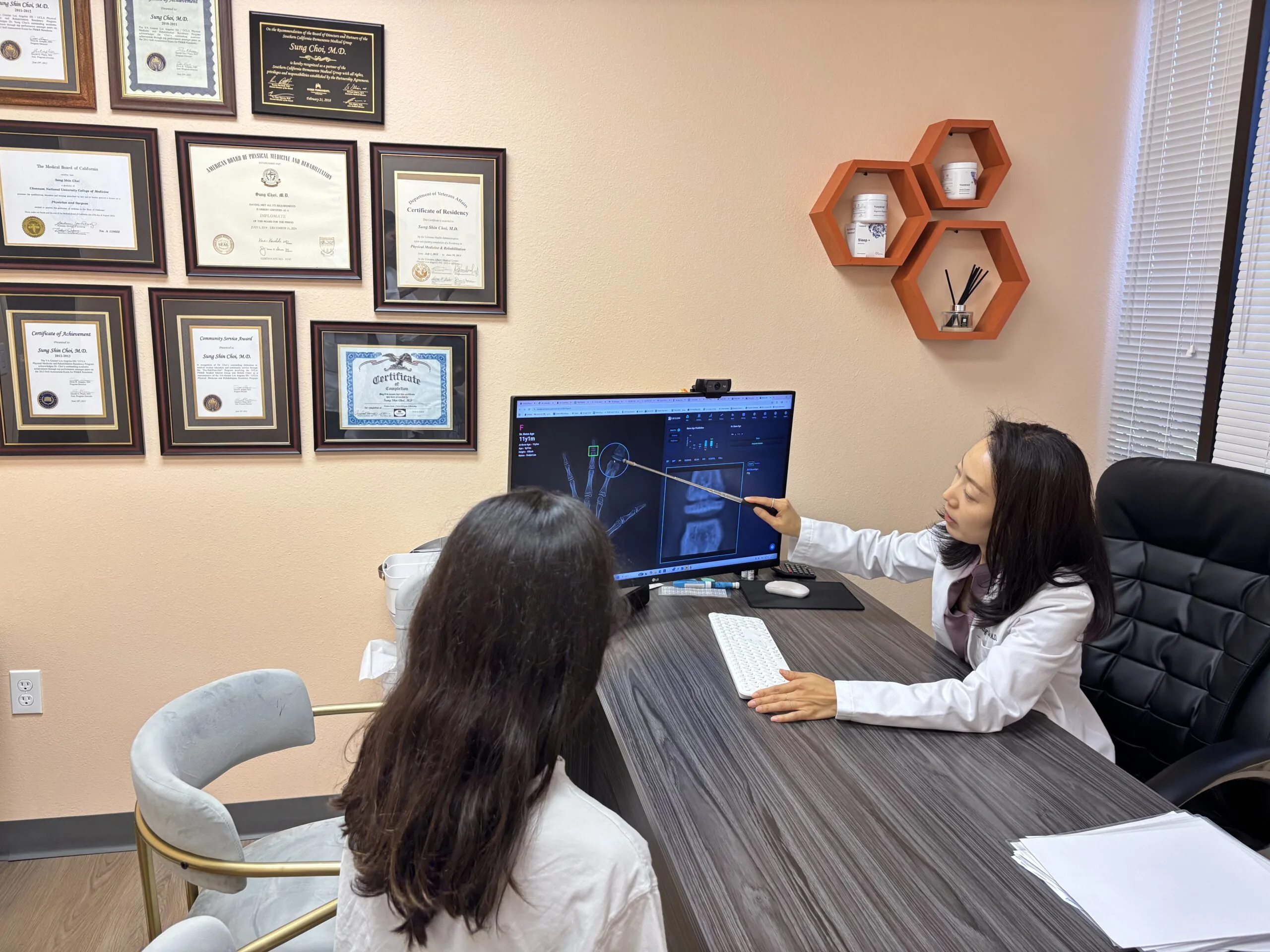
At I Grow Clinic, we have guided nearly 3,000 children through growth hormone therapy. Every treatment plan at our clinic is built around AI-driven bone age analysis, which means we are not guessing at your child’s timeline based on their calendar age. We are reading what their skeleton is telling us.
| Children Guided | Nearly 3,000 children successfully treated |
| Treatment Retention | 95% retention rate, reflecting exceptional outcomes and family trust |
| Approach | Meticulous 1:1 personalized management with AI-driven bone age analysis |
| Medical Director | Board Certified by the American Board of Physical Medicine and Rehabilitation (ABPMR) |
| Clinical Experience | Over 20 years specializing in Pediatric Growth and Developmental PM&R |
| Patient Reviews | 5-Star Google Rating with numerous testimonials |
By the end of this post, you will know what to look for in the first few weeks of treatment, how your child’s bone age determines how long therapy continues, and what a complete course of treatment looks like for a healthy child with idiopathic short stature.
What Are the Signs That My Child’s Growth Hormone Treatment Is Actually Working?

This is the question parents come back to repeatedly in the first few months. The injections are happening every evening. The routine is established. But you find yourself checking the doorframe marks more often than you expected, and wondering whether what you are seeing, or not yet seeing, is normal. Not because something is wrong. Because you do not yet know what right is supposed to look like.
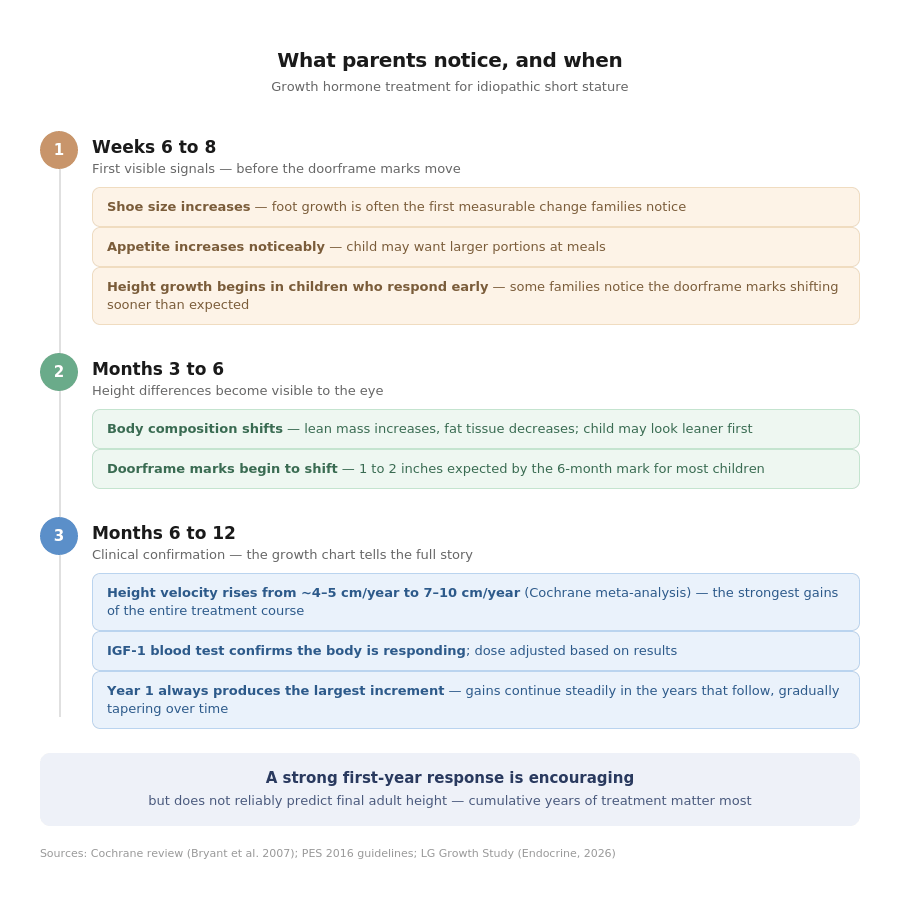
Here is what the clinical data show. In the first year of treatment, most children with idiopathic short stature roughly double their growth rate. Before treatment, the typical child grows 4 to 5 centimeters per year. On growth hormone, that number climbs to 7 to 10 centimeters. That difference is what the Cochrane meta-analysis of multiple trials found, and it is what we see consistently in our own patients.
That is an absolute increase of approximately 2.5 to 5 centimeters over what the child would have grown without treatment. In real terms, the difference between their pre-treatment growth rate and their on-treatment growth rate amounts to about 1 to 2 inches in that first year.
Shoe size is one of the first visible signals. Appetite increases noticeably. A child who previously ate small portions may suddenly want second helpings. Body composition shifts too: lean muscle mass increases while fat tissue decreases, so your child may look slightly leaner even before they look taller.
The first 3 to 6 months are the calibration period. Your child’s clinical team is measuring height at every visit, reviewing growth velocity, and checking IGF-1 levels in the bloodstream. IGF-1 is the hormone that growth hormone stimulates the liver to produce, and it is one of the clearest signals that the body is responding to treatment. According to PES 2016 guidelines, IGF-1 is measured at baseline before treatment begins, again at 3 to 6 months after any dose adjustment, and then every 6 to 12 months during ongoing therapy. The goal is to keep IGF-1 within the normal range for your child’s age and pubertal stage, neither too low nor too high.
A strong first-year response is encouraging, but it does not reliably predict final adult height. What it does confirm is that the treatment is active and the body is responding. What matters for the long run is the cumulative effect across all years of treatment, not any single year’s numbers. Research from the LG Growth Study of over 3,000 patients confirmed that the largest height increment always occurs in year one, with each subsequent year yielding smaller but meaningful additional gains. Think of it as a sprint followed by a steady jog. Both matter.
How Does My Child’s Bone Age Determine When Treatment Ends?
This is the question most parents never think to ask, because most parents do not know that bone age is what drives the stopping decision. The answer to “how long will my child be on treatment” is not a number of years. It is a set of biological signals that your child’s skeleton sends when it is finished growing.
Bone age is a measurement of skeletal maturity. It is read from an X-ray of the left hand and wrist, where a trained specialist examines the growth plates, the cartilage zones at the ends of each bone where growth occurs. A child’s bone age can be younger, the same as, or older than their calendar age. A nine-year-old child with a bone age of seven still has more growth ahead of them than their birthday suggests. A thirteen-year-old child with a bone age of fifteen has less remaining window than their calendar age implies.
At I Grow Clinic, we use AI-enhanced bone age analysis to read these X-rays with a precision that traditional manual reading alone cannot match. This analysis is taken every 6 to 12 months throughout treatment and is the single most important tool we use to answer the “how long” question for each individual child.
According to the Pediatric Endocrine Society 2016 guidelines, growth hormone treatment continues until one of the following stopping criteria is met. First, growth velocity falls below 2 to 2.5 centimeters per year, which signals that the growth plates are producing very little additional height. Second, bone age reaches maturity thresholds: approximately 14 to 15 years for girls and 16 to 17 years for boys. Third, the growth plates themselves show near-closure on the bone age X-ray. The PES guidelines also note that continuing growth hormone at pediatric doses after the growth plates have fused can cause changes that should be avoided, which is why the bone age X-ray, not the calendar, is the exit signal.
What this means practically for your family is that two children of the same age can have very different treatment timelines based on what their skeletons show. A ten-year-old with a bone age of eight may be on treatment for six or more years. A fourteen-year-old with a bone age of fifteen may be approaching the end of their treatment window already. Neither situation is better or worse. They are simply different biological profiles, and the treatment plan is built around the child in front of us, not an average.
🔍 Bone age is central to everything we do at I Grow Clinic. This post explains what a bone age X-ray actually measures and why it matters more than your child’s birthday. What Is the Best Age to Start Growth Hormone Treatment?
What Does a Full Course of Treatment Actually Look Like for a Child Without a Hormone Deficiency?

Most of the information parents find online is written for children who have been diagnosed with growth hormone deficiency. The clinic websites, the hospital FAQ pages, the medication manufacturer materials: they are all oriented around deficiency. If your child has idiopathic short stature, meaning they are a healthy child who simply falls short of the height expected for their family and age, the treatment timeline and expectations carry some important differences. The starting dose is higher than what is used for hormone deficiency, and it is adjusted over time based on how your child grows and how their labs respond.
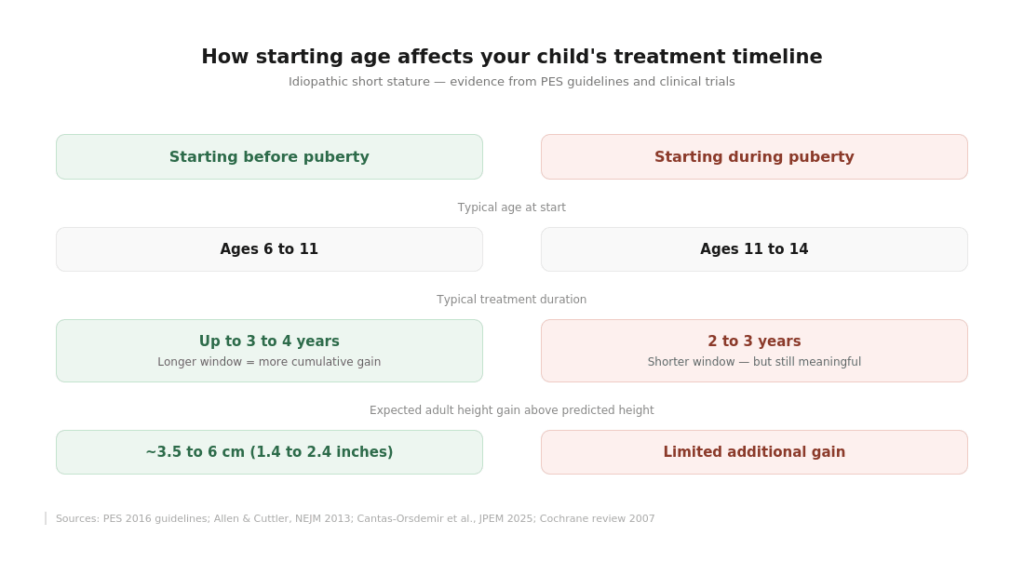
Children who begin treatment before puberty consistently achieve greater total height gain than those who start during puberty, and this is because they have more years of open growth plates ahead of them. A child who starts at age eight and a child who starts at thirteen are not on equivalent timelines. The earlier starter has more runway. That said, even children who begin during puberty can also draw significant benefit. In such scenario, growth velocity increases substantially in the first year, and the bone age extension that sometimes accompanies the treatment protocol can add meaningful growth time.
What does the day-to-day look like across those years? At I Grow Clinic, our standard protocol uses daily growth hormone therapy, administered by subcutaneous injection six days per week. The seventh day is a rest day. Each month, families measure their child’s height at home, same location, same time of day, and submit the reading through our patient portal. Every three months, we meet for a formal evaluation, either in person at our Fullerton clinic or via telehealth. At each of those visits, height and weight are measured, growth velocity is calculated, and a bone age X-ray and blood tests are taken if due, with the dose adjusted based on the child’s current weight and response. For families outside of Southern California, our telehealth program serves patients in CA, NY, TX, FL, and WA, with bone age imaging coordinated through our imaging partners in each state.
🔍 Wondering how monitoring visits and blood tests fit into the treatment routine? This post explains what IGF-1 levels measure and why they matter throughout the process. IGF-1 Levels and Height Growth
🔍 Daily injections versus once-weekly formulations is one of the most common questions families ask. This post compares both approaches so you can have an informed conversation with your provider. Weekly vs Daily Growth Hormone Injections: Which Is Right for My Child?
Watching your child grow takes patience. Not every month shows a visible change. There are plateaus, and there are spurts. But across the years, the trajectory bends upward in a way that the child’s untreated path would not have taken, and that is the point of the commitment you made.
Ready to Know What Your Child’s Timeline Actually Looks Like?
A blog post can give you the framework. What it cannot give you is the answer specific to your child: how open their growth plates are right now, how much bone age delay they have, how their first-year response compares to clinical benchmarks, and what a realistic timeline looks like given where they are today. That answer requires a bone age X-ray and a clinical evaluation.
At I Grow Clinic, every case follows a structured protocol: bone age findings, growth velocity data, and IGF-1 results are all reviewed before any protocol decision is made. Because we operate a concierge model, we work with a limited number of new patients each month to protect the quality of care our families expect. Families in Southern California are welcome to visit our Fullerton clinic in person. Families in CA, NY, TX, FL, and WA can begin with a telehealth consultation and have bone age imaging completed locally through our imaging partners.
Learn more about how our telehealth program works for families outside of Southern California.
🔍 Every commitment I Grow Clinic makes to families starts with the same belief: that a child’s short stature deserves a real answer, not a dismissal. Dr. Choi shares what led her to build this clinic. Why I Started a Growth Hormone Clinic
Frequently Asked Questions
How soon will parents notice results after the child starts growth hormone treatment?
Most families notice the first physical changes within 6 to 8 weeks of starting, though these early signs are usually in shoe size and appetite rather than measurable height. In children who respond early, height growth can begin within this same window. Height differences typically become visible to the eye around 3 to 6 months. On the growth chart, clinicians generally expect to see a meaningful increase in annual height velocity by the 6 to 12 month mark.
How long will my child actually need to stay on growth hormone?
For children with idiopathic short stature, the stopping point is not determined by a fixed number of years. It is determined by bone age. Two children who start treatment at the same age can have very different durations based entirely on what their bone age shows and how their growth plates respond over time.
Does starting growth hormone earlier make a difference to how long treatment lasts for my child?
Yes, in a meaningful way. Children who begin treatment before puberty typically have a treatment window of up to 3 to 4 years and achieve greater total adult height gains because more of their growth plates remain open. Children who begin during puberty have a shorter window of roughly 2 to 3 years, but still see meaningful results.
How do I know if the treatment is not working well enough to continue?
A poor first-year response, typically defined as less than a 0.3 to 0.5 standard deviation increase in height score after 12 months on an adequate dose, should prompt a clinical review. This review evaluates injection adherence, whether the dose is appropriate for the child’s current weight, IGF-1 levels, and whether any underlying condition may be affecting the response. A slow first year does not automatically mean treatment should stop. It means the clinical team needs more information before making that decision.
References
1. Grimberg A, DiVall SA, Polychronakos C, et al. Guidelines for Growth Hormone and Insulin-Like Growth Factor-I Treatment in Children and Adolescents. Hormone Research in Paediatrics. 2016;86(6):361-397.
2. Bryant J, Baxter L, Cave CB, Milne R. Recombinant growth hormone for idiopathic short stature in children and adolescents. Cochrane Database of Systematic Reviews. 2007.
3. Allen DB, Cuttler L. Short Stature in Childhood: Challenges and Choices. New England Journal of Medicine. 2013;368(13):1220-1228.
4. Lee MM. Idiopathic Short Stature. New England Journal of Medicine. 2006.
5. Bakker B, Frane J, Anhalt H, Lippe B, Rosenfeld RG. Height Velocity Targets From the National Cooperative Growth Study for First-Year Growth Hormone Responses in Short Children. Journal of Clinical Endocrinology and Metabolism. 2008;93(2):352-7.
6. Cantas-Orsdemir S, et al. Do Patients With Idiopathic Short Stature or Partial GHD Need to Continue GH Therapy During Puberty? Journal of Pediatric Endocrinology & Metabolism. 2025.
7. Kim M, Kim EY, Kim EY, So CH, Kim CJ. Investigating Whether Serum IGF-1 and IGFBP-3 Levels Reflect the Height Outcome in Prepubertal Children Upon rhGH Therapy. PLoS One. 2021.