

“She used to pick at her dinner. Now she eats more than her dad and is back in the pantry an hour later.”
“The sneakers I bought her at the start of summer don’t fit anymore, and it has only been ten weeks.”
“I have to call her three times every morning now. She used to be up before her alarm.”
You notice the empty plates, the outgrown sneakers, the hard mornings, and you start to wonder if they add up to something. Is she in a growth spurt, or is this just a phase? That question matters more than it seems. A growth spurt is the last big push of growth in her arms and legs, and it moves faster than most parents expect. Once it passes, it doesn’t come back. That’s why knowing when hers began, and when it’s likely to end, is one of the most useful things you can know as her parent.
I’m Sunjo Chung, a Nurse Practitioner at I Grow Clinic. Our team has worked with nearly 4,000 children, and I hear this exact question almost every week. So let’s walk through it together, and by the end, you’ll know what to look for.

your daughter is growing.
Why Parents Trust Our Read on a Child’s Growth
| Credential | Detail |
|---|---|
| Children guided | Nearly 4,000 with precision growth strategies |
| Treatment retention | 95 percent, reflecting outcomes families stay for |
| Approach | One on one personalized management, with bone age analysis powered by AI |
| Board certification | ABPMR, Physical Medicine and Rehabilitation |
| Experience | Over 20 years of clinical experience |
| Reputation | 5 star Google rating with numerous testimonials |
| Telehealth | Available in California, New York, Washington, Florida, and Texas |
By the end of this, you will know the five signs that most reliably show a growth spurt is underway, the patterns that mean it’s time for an actual evaluation rather than more waiting, and how a bone age X ray settles the question a growth chart alone cannot.
What Are the Real Signs My Daughter Is Having a Growth Spurt?
If you are asking yourself whether your daughter is having a growth spurt right now, these are the signs that most reliably show up first, often weeks before a growth chart would ever reflect it.
A noticeable jump in appetite. A growth spurt takes real energy to build new bone and tissue, and the body asks for it through hunger. A daughter who used to leave half her plate and now finishes seconds is showing one of the clearest signs of a growth spurt in a girl’s body.
Shoes that stop fitting first, then clothes. In a growth spurt, the feet usually grow first, before the legs start to lengthen. So a jump in shoe size is often the earliest clue, sometimes months before her pants start to look short. Shoes that had room to grow into now pinch at the toes. Then, a little later, pants that were fine at the start of the season suddenly sit above the ankle. This is one of the fastest, most objective signs available to a parent.
Shifts in mood that do not match anything else going on. A growth spurt in girls is driven by rising puberty hormones, and those same hormones affect mood. A daughter who is more irritable, more easily overwhelmed, or quicker to cry, without a clear cause may simply be growing.
More sleep Deep sleep is when the body releases the most growth hormone, so a child in a growth spurt often needs more of it. She may sleep longer on weekends and have a much harder time getting up on school mornings.
The specific signs of puberty. For most girls, breast budding is the earliest sign, and it usually shows up about a year before the growth spurt begins. That makes it the best time to start tracking her height closely. Around a year later, when pubic hair starts to appear, the growth spurt is usually getting underway. Her first period tends to follow about 1 to 1.5 years after that.
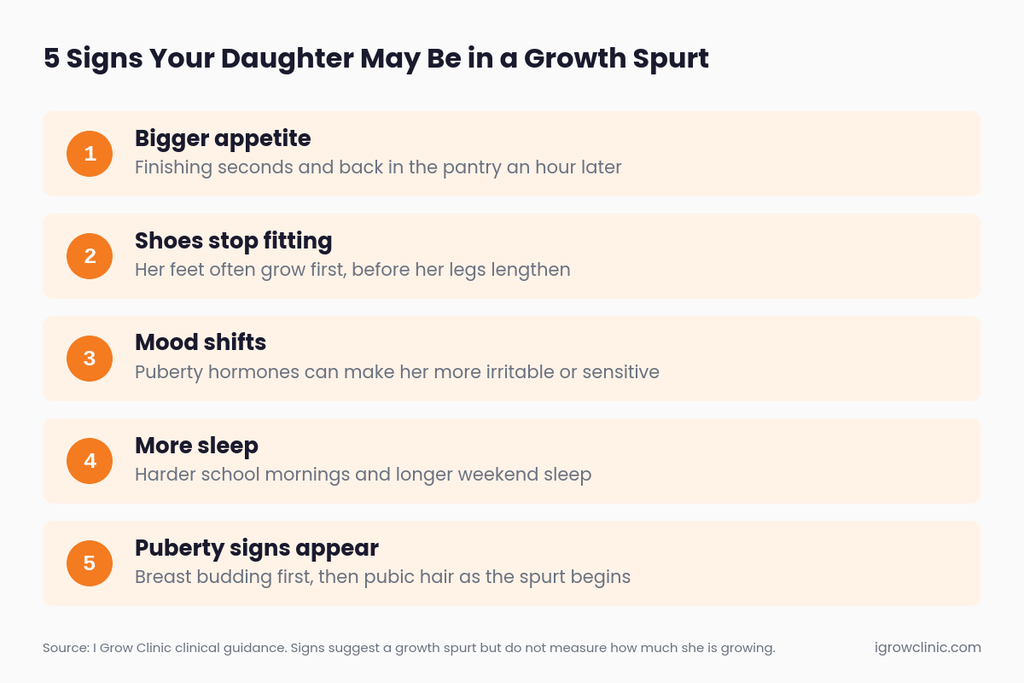
These signs tell you something is probably happening, but not how much. A growth chart can’t answer that in real time either, because percentile lines often look flat for months around the start of puberty and then jump. What actually confirms a growth spurt is growth velocity, meaning how much height she gains over time. Two measurements taken at least six months apart, the same way each time, tell you far more than any list of signs.
🔍 If you are also wondering when this whole process winds down for good, this companion post covers that endpoint directly. When Do Girls Stop Growing?
At What Age Will My Daughter Have Her Growth Spurt?
Most girls hit the fastest part of their growth spurt somewhere between ages 10 and 13, gaining roughly 2.5 to 4 inches in a single peak year. After her first period, growth slows down, and most girls have about 1.5 to 2 years of growth left. Timing also runs in families. If you started your period early or late, your daughter’s timing may follow a similar pattern.
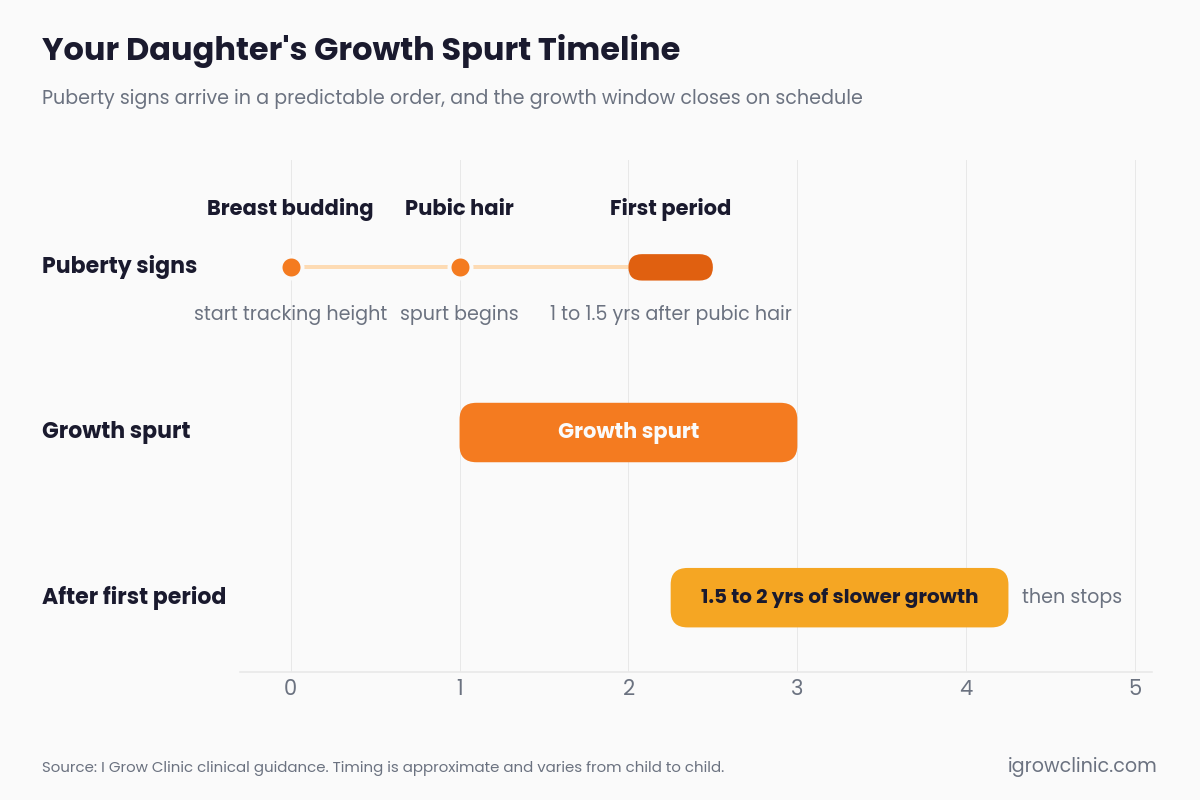
and the growth window closes on schedule.
🔍 For a full breakdown of what happens at each stage of puberty, in order, this post walks through it clearly. Tanner Stages of Puberty
When Is a Growth Change in My Daughter Worth Having Checked?
Three patterns deserve a closer look. The first is a growth spurt that starts early. When a girl shoots up ahead of her friends, it looks like great growth. But an early spurt often means her growth plates are maturing early too, and her growth window may close sooner than expected. Many early bloomers end up shorter as adults than their early height suggested. An early start isn’t always a problem, but it’s worth checking whether her bone age is moving much faster than her calendar age.
The second pattern is easier to miss. Her puberty signs are clearly there. Breast budding has started, pubic hair is appearing, and she’s showing the other signs of a growth spurt too. But her height isn’t really climbing. Many parents read this as a spurt that hasn’t arrived yet and decide to wait. More often, the spurt has already started. It’s just producing less growth than it should. Waiting doesn’t bring that height back later. Puberty keeps moving forward, and her growth plates close on their own schedule, whether she’s gained the height or not.
The third is a steady change on her growth chart. If she crosses a major percentile line in either direction over a year or so, for example from the 60th to the 30th, that’s more than ordinary variation. The same is true if her yearly height gain drops well below what’s typical for her age and stage.
Any of these patterns is a reason to measure rather than wait. Many girls turn out to be on a normal path once someone looks at the full picture. But the only way to know is to look while there’s still time to act on the answer.
🔍 If a percentile shift is the specific thing on your mind, this post walks through what it does and does not usually mean. Your Child’s Height Percentile Dropped This Year: Should You Worry?
Everything above is a reasonable way to notice that something is probably happening. However, none of it tells you how much runway your daughter has, or whether her body’s internal timeline matches her calendar age. That is what a bone age evaluation is built to answer, and it is the piece missing from every symptom checklist.
A bone age evaluation is a simple, low dose X ray of the left hand and wrist. It shows the true maturity of her growth plates, which is a far more accurate measure of where she stands in her growth than her age in years alone. At I Grow Clinic, a bone age evaluation compares her film against thousands of reference data points, giving us a clear picture of how much height potential she likely has left, not a guess based on symptoms alone.
A mother brought in her 10 year old daughter last year. Pubic hair had started to appear a few months earlier, and her mother had been waiting for the growth spurt to kick in. But her height had barely changed. Her bone age film showed her skeletal maturity was running about a year ahead of her calendar age. Her growth spurt wasn’t coming later. It had already started, and it was producing far less growth than it should have. Her growth plates were still open, so there was time to build a plan with her family. What made the difference was not waiting for a spurt that had already begun.
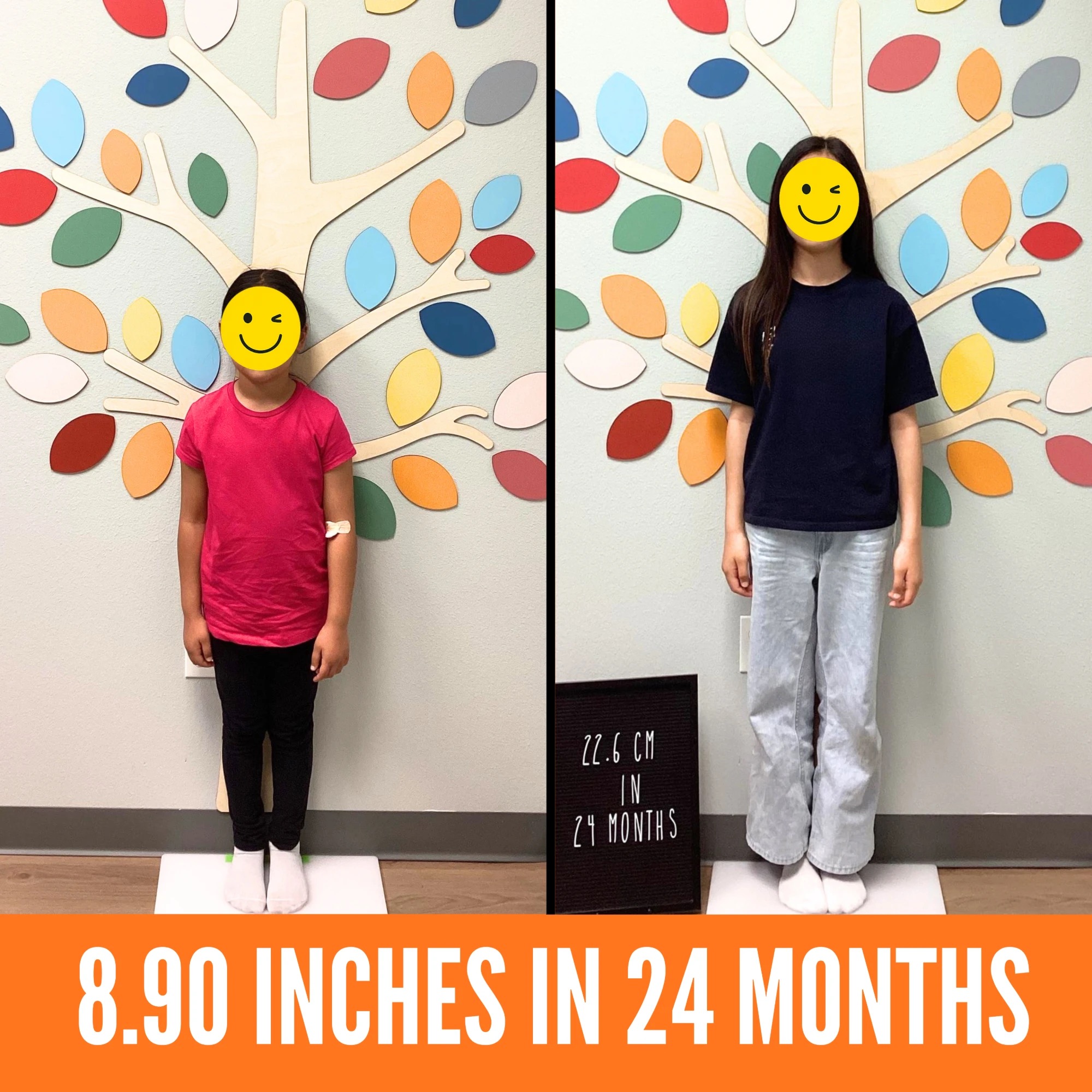
This photo is shared as a general example and is not connected to the case described above. Individual results may vary.
Every child’s timeline is different, but the pattern is one we see often: a growth spurt that’s already underway and needs attention while the growth plates are still open. You can see more of our patient results from families who chose to look early rather than wait.
For the Parent Who Just Wants to Know
Most of the time, what you are seeing is exactly what it looks like: a healthy girl doing exactly what her body is supposed to do, on her own timeline. Every so often, the pattern is different enough that it deserves an actual look rather than another season of wondering. You do not have to guess which one you are dealing with.
Our clinical team reviews every case individually, using bone age imaging paired with growth history rather than a single visit snapshot, so a family gets a real answer instead of a reassurance that may or may not hold up. Because this level of one on one attention takes real time, new evaluation slots are limited each week. Families work with us either in person at our Fullerton clinic or through our telehealth program for families in California, New York, Washington, Florida, and Texas, with the same clinical review either way.
🔍 To understand why we built the clinic around exactly this kind of clarity, read this. Why I Started a Growth Hormone Clinic
FAQ: What Parents Ask About Growth Spurts in Girls
1. How long does a growth spurt in a girl usually last?
Most girls’ growth spurts last about two years from start to finish, and the fastest growth happens in roughly one year inside that window. Growth then slows down but doesn’t stop right away. After her first period, most girls still have about 1.5 to 2 years of slower growth left.
2. Can a growth spurt cause mood swings or make my daughter more emotional?
Yes. During puberty, rising sex hormones such as estrogen and progesterone help drive her growth spurt, and they also affect how she feels. Increased irritability or emotional sensitivity is a common and expected part of the process. If mood changes are severe, persistent, or clearly tied to something else going on in her life, it’s worth mentioning to her pediatrician.
3. Is it normal for my daughter’s growth spurt to start earlier than her friends’?
It can be, but it’s worth watching closely. An early growth spurt often means her growth plates are maturing early too, which can shorten her growth window and lower her final adult height. If breast budding started before age 8 or 9, or her growth spurt began well ahead of her friends’, a bone age X ray can show whether her skeletal age is running ahead of her calendar age.
4. What if my daughter hasn’t shown any of these signs yet?
Timing varies more than most parents expect. Family history can help you guess when her growth spurt might begin, especially when you and her other parent started puberty. If she’s well past the age when her friends or family pattern suggest signs should have started, or she has no breast development by age 13, it’s worth asking for an evaluation rather than waiting.
5. Can a home growth chart tell me if she’s growing on schedule?
Not reliably on its own, especially right around the start of puberty. A growth chart shows where she has been. Confirming what is happening in the present takes either careful measurement spaced at least six months apart or a bone age evaluation, which gives a far more precise picture than height alone.