
How to Tell If Your Daughter Still Has Time, and How to Find Out for Certain
“My daughter just got her period at 11. Is it too late for her to grow taller?”
“She’s been the same height for almost a year now. Is she done growing?”
“Everyone says girls stop growing after their period, but is that really true?”
These are among the most common questions I hear from parents, and they deserve a clearer answer than most articles provide. Telling you “girls usually stop growing around 14 to 16” is technically true but not particularly useful. What actually matters is where your daughter sits on her own biological timeline, and whether there is still time to act on that information.
I’m Jenny Diep, FNP at I Grow Clinic. Our team has guided nearly 4,000 children through their growth journeys.
Why Families Across the U.S. Trust I Grow Clinic
| Credential | Detail |
|---|---|
| Patient experience | Successfully guided nearly 4,000 children with precision growth strategies |
| Treatment retention | 95% retention rate, reflecting exceptional clinical outcomes and family trust |
| Care Model | Meticulous 1:1 personalized management based on each child’s unique growth potential and AI-driven bone age analysis |
| Medical Director | Board Certified by the American Board of Physical Medicine and Rehabilitation (ABPMR) |
| Clinical Experience | Over 20 years specializing in Pediatric Growth and Developmental PM&R |
| Reputation | 5-Star Google Rating with numerous testimonials highlighting compassionate, family-centered care |
Here is what I will help you understand today: the truth about when girls actually stop growing, why your daughter’s first period is not the finish line most parents think it is, and the specific signs that tell you whether her growth window is still open or closing fast.
What Most Parents Find Out Too Late
I see many 12 to 15 year old girls come to our clinic for growth plate evaluation, and far more often than parents expect, I have to explain that the growth plates are already closing or nearly closed. In those moments, I often see mothers go quiet, some tear up, and I can feel them silently asking themselves, “Why didn’t I bring her in sooner?”
That moment is heartbreaking, and it is the reason I wrote this post. Because most of those families did not miss the signs of early puberty or slowing growth. They simply did not know that those signs had a timeline attached to them, and that the window to act was shorter than they realized. Once a girl’s growth plates fuse, no amount of effort, supplements, or wishful thinking can reopen that window.
The good news: if you are reading this while your daughter is still in the active phase of puberty, you almost certainly still have time. The question is how much, and how to use it well.
How Do I Know If My Daughter Is Still Growing?
Here is the single most important thing to understand about girls and growth, and it is something most parents do not hear until it is too late:
Menarche is not the end of your daughter’s growth. It signals that the peak growth spurt has passed, but roughly 1.5 to 2 years of height gain typically still remains.
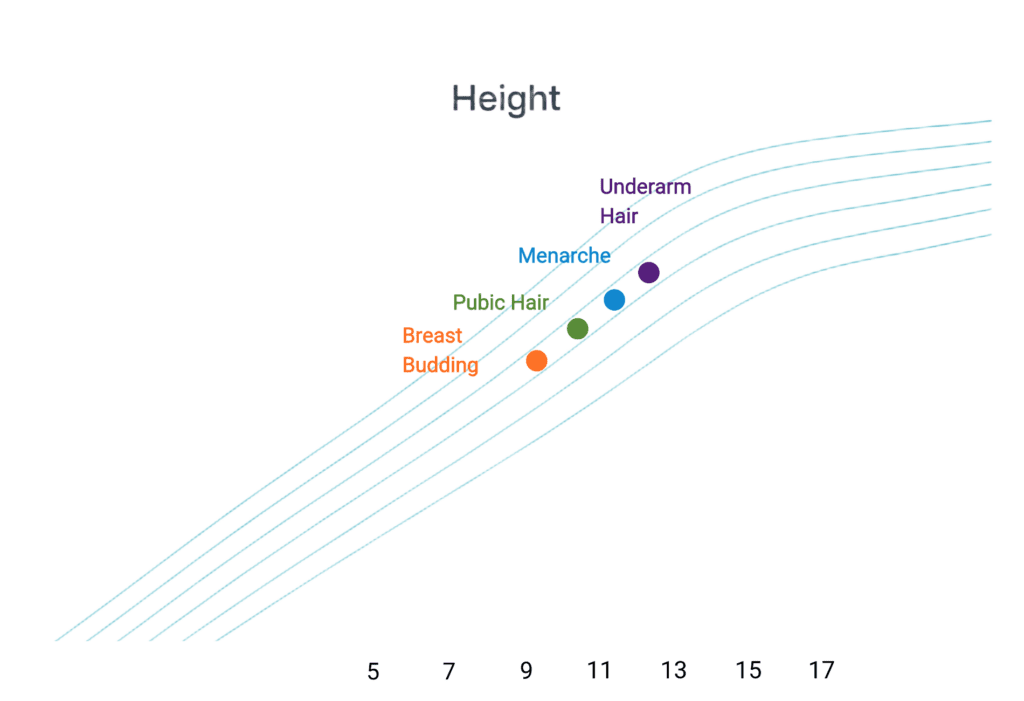
The timing of menarche matters more than the fact of it. A girl who gets her first period at 10 or 11 typically has a shorter remaining growth window, with a bone age that is often advanced beyond her chronological age. A girl who reaches 13 or later without menstruation may actually have more potential left. The same milestone can mean very different things depending on when it arrives.
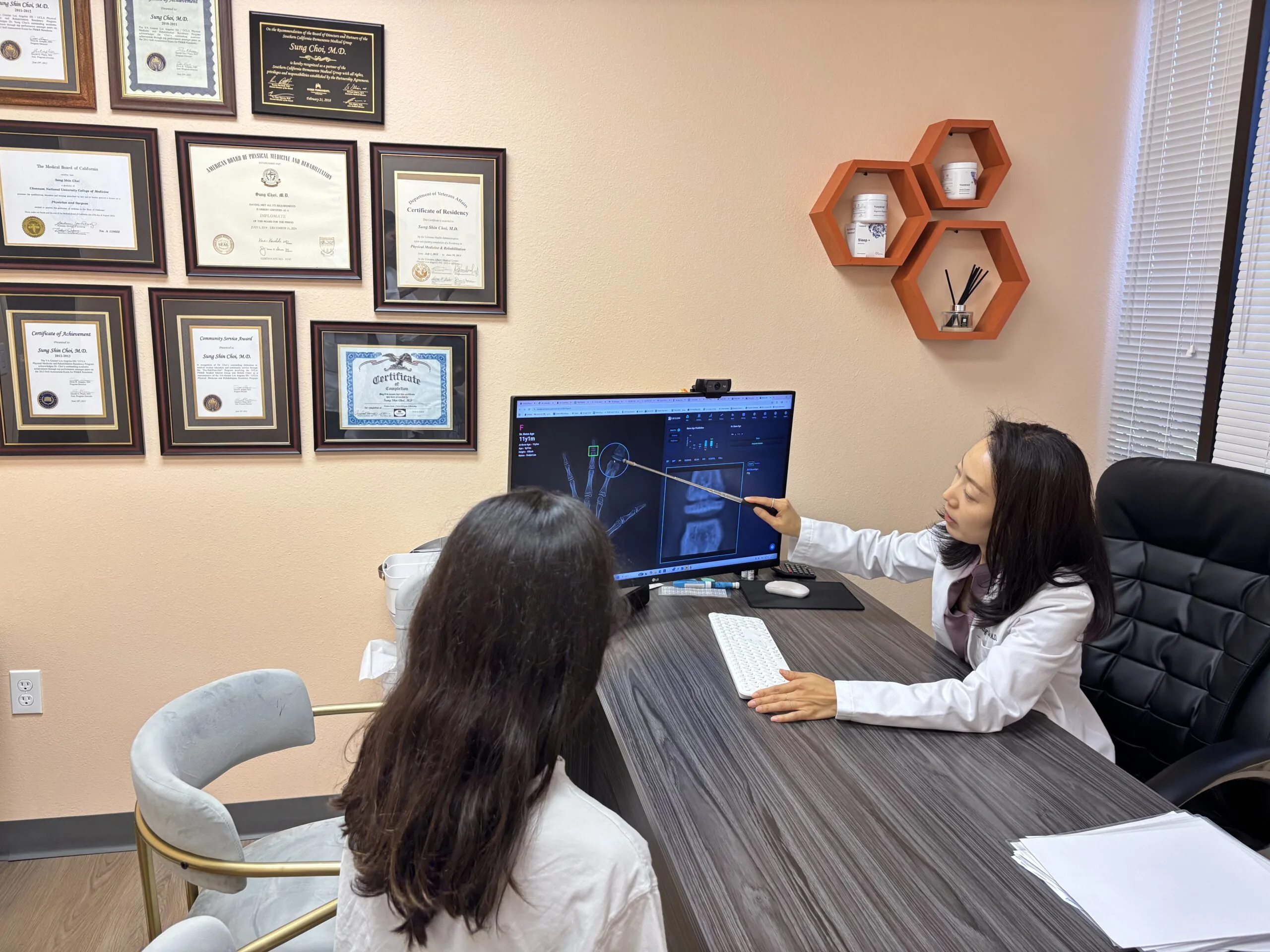
So the question is not simply whether she has started her period. The more important question is when it arrived, and how her skeletal maturity compares to her chronological age. A simple, low-dose hand X-ray reveals her bone age, the true biological age of her skeleton, and gives a far more accurate picture of how much time is left.
🔍 If you want to understand why bone age matters more than birthdays, our guide on Bone Age vs. Chronological Age breaks it down in detail.
She Got Her Period. How Much Height Is Left?
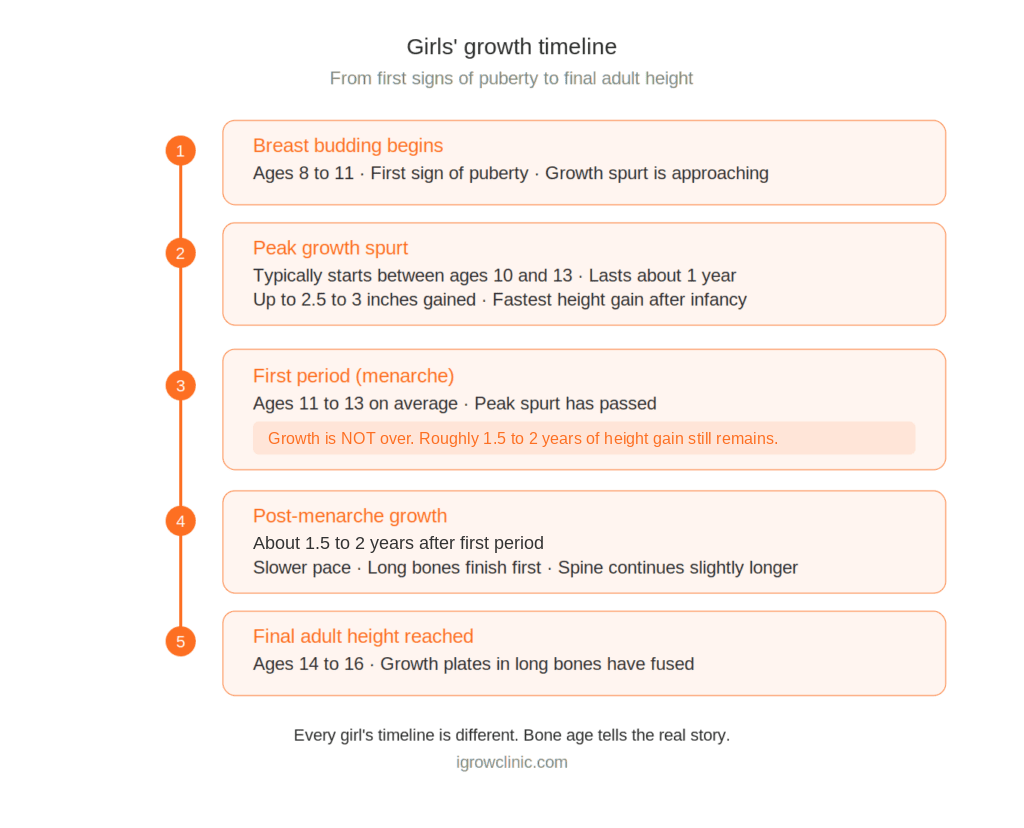
To know where your daughter is, you have to know what the full timeline looks like. Here is the typical sequence for girls.
Stage 1 Breast Budding (Thelarche), Ages 8 to 11
The very first sign of puberty in girls is breast budding, often before anything else changes. Small, sometimes tender lumps appear under the nipple. This is the official start of puberty, and it marks the beginning of the runway to the growth spurt.
Stage 2 The Growth Spurt, Ages 10 to 13
About one year after breast budding, girls enter their peak growth phase. In the year before her first period, most girls grow about 2.5 to 3 inches per year, or roughly 6 to 8 centimeters. This is the fastest she will ever grow after infancy. Pants get short, and shoes need replacing more often. The second year is slower, and it continues after her first period. The whole growth spurt lasts about 18 to 24 months, and most of her final adult height is added during this time.
Stage 3 First Period (Menarche), Ages 11 to 13 on Average
The first menstrual period typically arrives after the peak growth spurt, not before it. By the time menarche begins, your daughter has usually already gained the majority of her adult height. From this point, growth slows noticeably but does not stop.
Stage 4 Post-Menarche Growth, About 1.5 to 2 Years
After her first period, your daughter will typically grow another 1 to 3 inches over the following 18 to 24 months. Hands, feet, and long bones finish first. The spine continues to lengthen slightly even after the long bones stop.
Stage 5 Final Adult Height, Ages 14 to 16
Most girls reach their final adult height between 14 and 16, though some late bloomers continue gaining small amounts of height into their late teens. By this point, the growth plates in the long bones have fused, and the window for meaningful height gain has closed.
🔍 If you want a parallel view of how this differs from boys, our most-read post, How Much Do Boys Grow After 16? walks through the boys’ timeline in the same way.
Three Warning Signs the Growth Window Is Closing Faster Than Expected
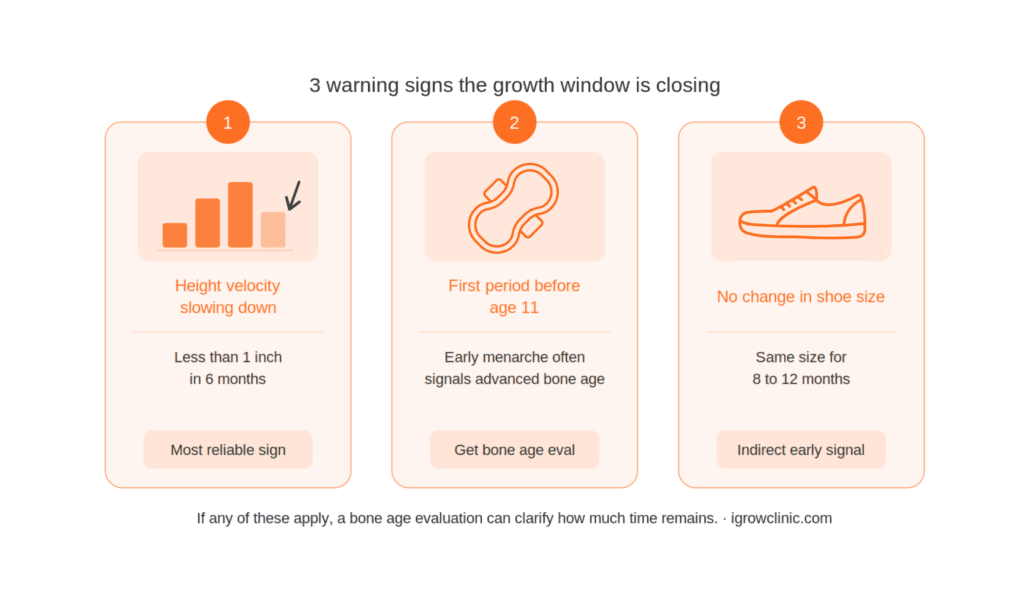
Here are the three signs to monitor at home.
1. Height Velocity Has Slowed to Less Than 1 Inch in 6 Months
The single most reliable home indicator is how fast your daughter is gaining height. Track it every 3 months and write it down. A noticeable slowdown in velocity, typically less than 1 inch over a 6 month period during an active growth phase, is the earliest and most accurate signal that the window is beginning to close.
If her height has not changed for a long time, read Your Child’s Height Percentile Dropped This Year: Should You Worry?
2. Her First Period Was Earlier Than Her Peers
Early menarche, especially before age 11, often signals that bone age is advancing faster than the calendar. When that happens, the growth plates tend to close earlier than expected. This is why early menarche is one of the most important reasons to get a bone age evaluation, rather than assuming a standard amount of growth time remains.
3. Shoe Size Has Plateaued
The growth plates in the hands and feet close before the long bones in the arms and legs. If your daughter has been wearing the same shoe size for 8 to 12 months, it is a strong indirect signal that her skeletal maturity is advancing into the final stages of fusion. The long bones usually follow within a year.
🔍 If you want to understand exactly how we evaluate these signs at the clinical level, our guide on how to know if growth plates are closed walks through the full diagnostic picture.
A Real Case: How One Family Acted in Time
A mother brought her 12 year old daughter to our clinic last year, worried because her daughter had gotten her first period at 10 years and 8 months, and her height had only changed by half an inch in the previous 6 months. She was already shorter than most of her classmates.
Her bone age X-ray showed a skeletal age of 13.5, advanced about 1.5 years beyond her chronological age. The growth plates were still open, but they were narrowing. Predicted adult height without intervention was approximately 5 feet 0 inches.
With early identification, AI-driven bone age tracking, and a personalized plan, we were able to maximize her remaining growth window. Over the next 18 months, she gained nearly 2.5 inches, well beyond her original projected trajectory. Her family told us the height gain was meaningful, but what they valued most was seeing their daughter grow more confident in herself. For our team, hearing that is the reminder of why we do this.
Not every girl will respond the same way. Outcomes depend on bone age at evaluation, the cause of advanced maturity, and individual response. But this case shows what is possible when families act while the window is still open instead of after it has closed.
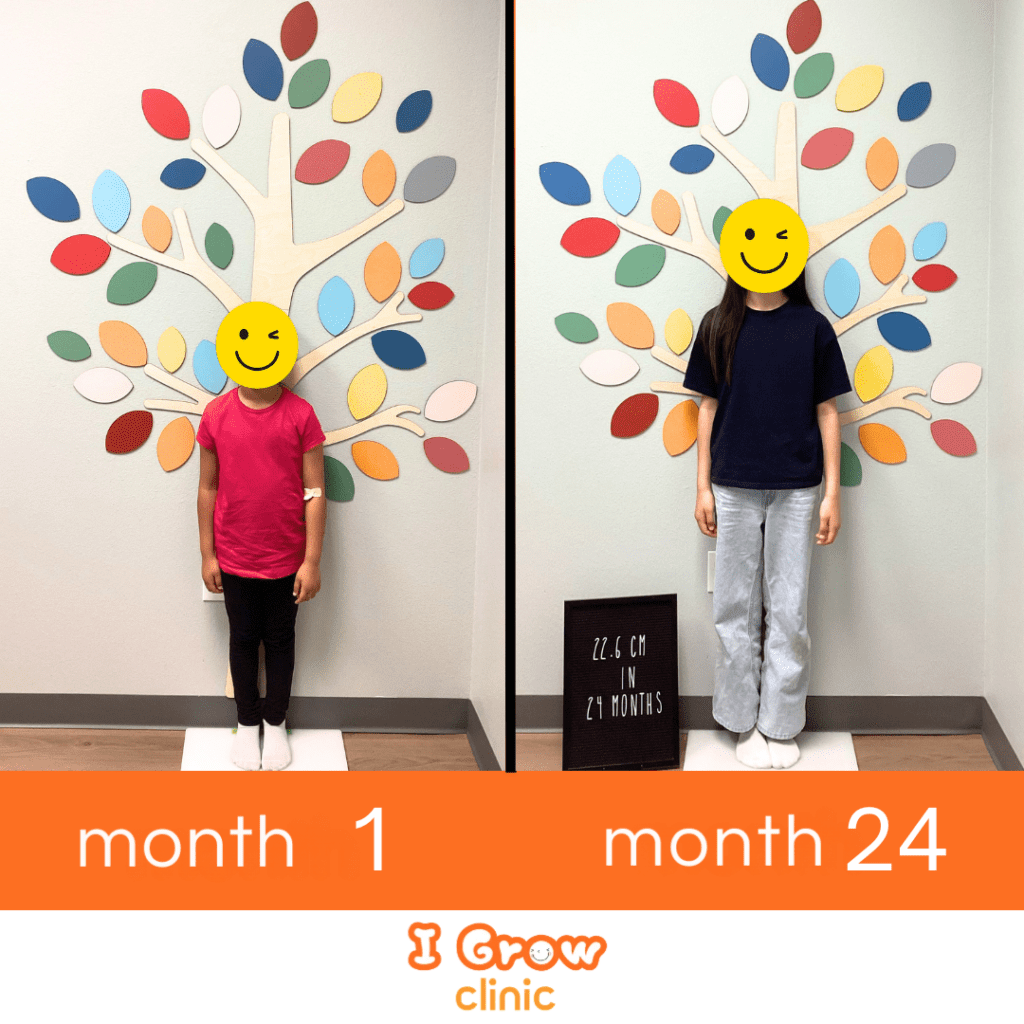
Acting while the growth window was still open made this possible.
When to Seek a Pediatric Growth Specialist Evaluation
Consider scheduling a bone age evaluation if any of these apply to your daughter:
- She had her first period before age 11
- She is in the early to mid phase of puberty but has grown less than 1 inch in the past 6 months
- She is consistently shorter than the 10th percentile for her age
- Her shoe size has not changed in 8 to 12 months
- You have a “gut feeling” that her body is maturing faster than her age suggests
- She is approaching age 13 with no signs of any puberty (this signals delayed puberty, which is also worth evaluating)
A specialist evaluation includes a bone age X-ray, growth chart review, and a discussion of whether the remaining window can be optimized through lifestyle, monitoring, or in select cases, medical intervention.
Healthy Habits That Support Remaining Growth
While habits cannot reopen a closed growth plate, they meaningfully support the growth that is still happening. Encourage consistent sleep before 10 p.m., since growth hormone is released in pulses during deep sleep. Prioritize protein and calcium rich meals, daily physical activity, and limit excess sugar and ultra-processed snacks. These are not minor details. They directly influence the hormonal rhythm that drives final height.
The Window May Still Be Open. Let’s Find Out Together.
Every girl’s growth story is different, which is why we never rely on averages alone. At I Grow Clinic, every protocol is built on AI-driven bone age analysis and 1:1 personalized care. Because we operate as a concierge practice, new patient slots are limited each week to protect the quality of attention every family receives.
If you are in California, you can request an in-person consultation at our Fullerton clinic. If you live in New York, Texas, Washington, or Florida, you can request a telehealth growth assessment from home. Telehealth patients will need to complete a low-dose hand X-ray at an imaging center in their own state before the consultation, which we will help coordinate. Either path begins with the same step: a clear, honest evaluation of how much time your daughter has left, and what can be done with it.
Our team reviews the results together with the family during a virtual consultation.
🔍 To understand the deeper why behind our clinic and how we approach growth differently, you can read Why I Started a Growth Hormone Clinic.
Frequently Asked Questions
1. When do girls stop growing taller on average?
Most girls reach their final adult height between ages 14 and 16. However, the more accurate answer depends on bone age, not chronological age. A 14 year old with a bone age of 13 may still have meaningful growth left, while a 14 year old with a bone age of 15 may already be near final height.
2. Do girls keep growing after their first period?
Yes. Girls typically grow another 1 to 3 inches after menarche, but the pace is slower. The first period signals that the fastest phase of the growth spurt has ended, not that growth itself is over.
3. Can my daughter still grow if she started her period at 10?
She can, but early menarche often indicates that bone age is advancing faster than the calendar, which means growth plates may close sooner than expected. Rather than assuming how much time remains, a bone age evaluation gives a clear and accurate picture of where she actually stands.
4. What is the earliest sign that growth has stopped?
The earliest and most reliable sign is a significant slowdown in height velocity, typically less than 1 inch over a 6 month period during what should still be an active growth phase. Plateaued shoe size is another strong indirect signal.
5. Is 5 feet considered short for an adult woman in the US?
The average adult height for women in the US is approximately 5 feet 4 inches. Heights below 5 feet fall in the bottom percentile, but “short” is medically defined by growth charts and bone age findings, not by a single number. What matters most is whether final height matches genetic potential.
6. Her feet have not grown in over a year. Is she done growing?
Not necessarily. Feet often stop growing before the rest of the body. A flat shoe size is a clue, not proof. A bone age X-ray shows whether her growth plates are still open.
7. She is already taller than me at 12. Is she close to done?
Being tall early does not mean she is almost done. A girl who starts puberty early can grow fast and finish sooner than her peers. Her bone age shows which one applies to her.
8. Is there a test that predicts my daughter’s final height?
A bone age X-ray is the most useful starting point. A clinician combines it with her current height and her parents’ heights. It is an estimate, not a promise. See How Tall Will My Child Be?
9. Is 16 too young to be done growing?
It can be. Many girls finish growing in the mid-teens, and some finish earlier. If she stopped sooner than you expected, a growth plate X-ray gives a clear answer.