
“My daughter is the shortest kid in her third grade class by almost a head, and her pediatrician says there’s nothing wrong”
“He used to be right in the middle at every school picture. This year he’s the shortest kid in the whole row, and I can’t stop noticing it.”
“How do I find out if my child has growth hormone deficiency.”
If any of that sounds like the conversation running through your mind, you are asking a fair question. Is this a real medical issue, or is your child just on a normal, slower path. Right now you do not have enough information to know which one it is, and that is exactly the gap this article is here to close.
I am Jenny Diep, FNP, and I work alongside our clinical team to review growth cases like this every week, including many children who have seen multiple specialists and still left without a clear answer.
| What We Bring to This Evaluation | |
|---|---|
| Children treated | Over 3,000 |
| Retention through full evaluation | 95% |
| Physician credential | ABPMR board certified |
| Bone age analysis | AI driven, compared against thousands of reference data points |
| Patient reviews | 5-star Google rating |
| Clinical experience | 20+ years |
By the end of this article, you will understand the three most likely explanations for your child’s growth pattern, the specific signs we look for in a real evaluation, and how our same day bone age X-ray can give you answers most families wait months to hear.
What Is Growth Hormone Deficiency, and How Is It Different From Just Being Short?
True GHD accounts for only a small percentage of short children. Understanding which category your child actually falls into is the real job of an evaluation.
Growth hormone deficiency, or GHD, is a specific medical condition where the pituitary gland does not produce enough growth hormone. It comes in three forms: congenital, meaning it has been present since birth due to a genetic or structural issue in the brain; acquired, meaning something later in childhood, like an injury or a tumor, damaged the pituitary gland; and idiopathic, meaning doctors can identify the pattern but not the underlying cause. True isolated GHD is rare. Research published in Nature Reviews Endocrinology estimates it affects roughly 1 in every 4,000 to 10,000 children.
That number matters, because it means the overwhelming majority of children who are short for their age do not have GHD at all. Most fall into one of three other categories, and this is the part most parents never hear from a standard pediatric visit.
- Idiopathic short stature (ISS): the child is significantly shorter than expected with no identifiable hormonal or genetic cause, and healthy in every other way. This is a broad category, and familial short stature falls within it.
- Familial short stature: a recognizable pattern within ISS where the child is simply following the height trajectory their parents also followed.
- Constitutional delay (late bloomer): the child is growing at a normal rate but on a delayed timeline, and will likely catch up later than peers.
🔍 If you are wondering whether treatment is even an option for a child without a confirmed hormone deficiency, this post walks through exactly how that works. Can Growth Hormone Therapy Help If My Child Does Not Have a Hormone Deficiency?
Sorting your child into the right category is the actual job of a proper evaluation, and it is also why a single symptom or a quick conversation with a pediatrician is rarely enough to get there.
What Signs Does a Doctor Actually Look For?
Before we walk through what a clinician looks for, here is something worth understanding. GHD is the least common of the four categories, and most children referred for a growth evaluation do not have it. Our clinic specializes in evaluating and treating idiopathic short stature and constitutional delay, the categories that account for the vast majority of children we see. If an evaluation does point toward true GHD, we coordinate with the appropriate specialist to make sure your child gets the right care. Either way, knowing which category your child falls into is the starting point for everything that comes next.
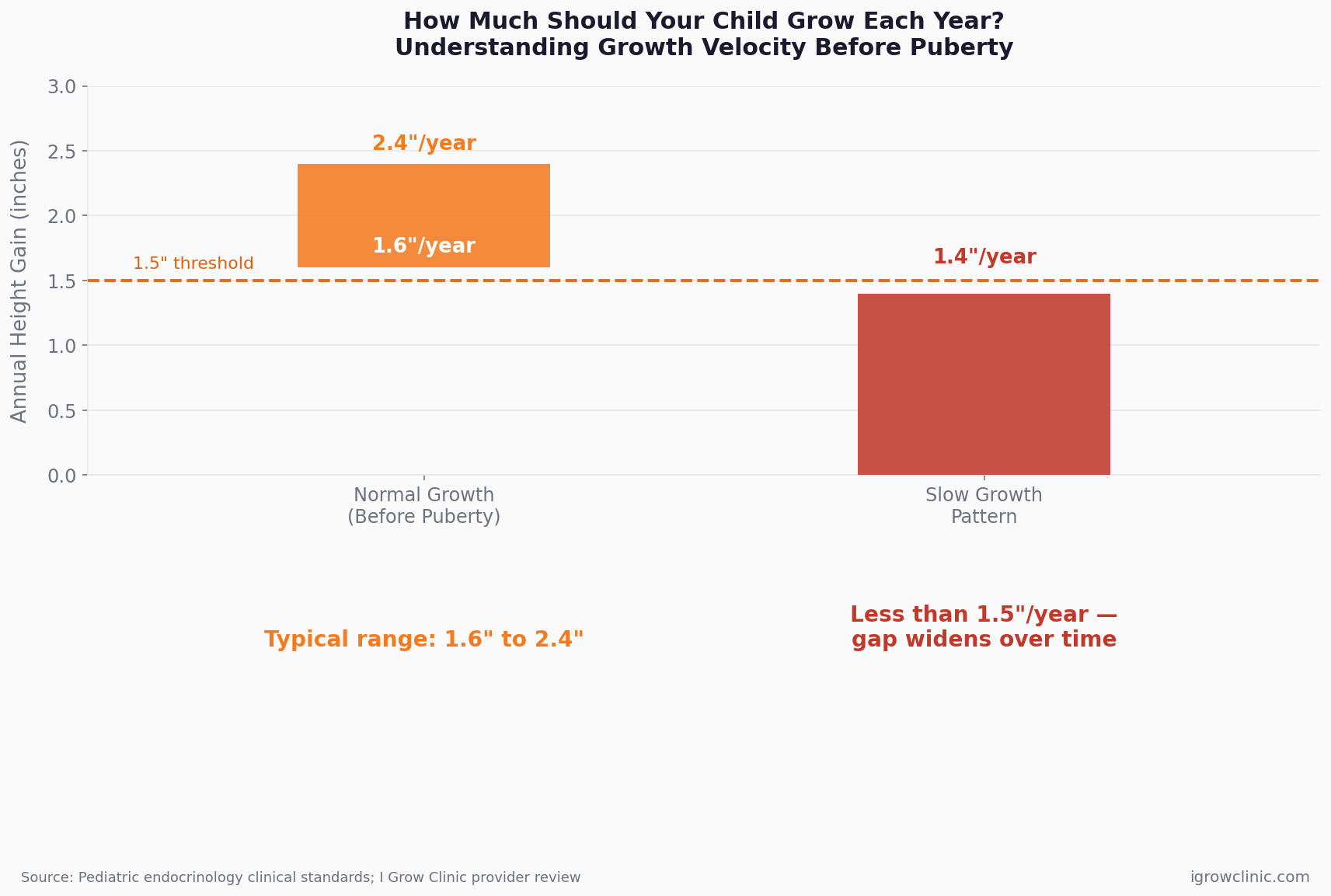
Growth velocity, meaning how many inches your child gains per year, is often the first and most telling sign a clinician looks at. Before puberty, most children without a growth concern gain around 1.6 to 2.4 inches a year. Once early childhood has passed, a child with true GHD tends to fall noticeably below that, often under 1.5 inches a year, and the pattern is typically progressive, meaning the gap widens over time rather than staying flat. That single number, tracked over time on an actual growth chart rather than remembered from memory, tells a clinician more than almost anything else in the first conversation.
Direct GH blood testing is unreliable on its own, since growth hormone is released in short pulses, mostly overnight, and can be undetectable in a random daytime draw. That is why clinicians instead look at IGF-1, the hormone the liver produces in response to GH, because they stay more stable across the day. Even then, IGF-1 has to be read alongside your child’s puberty stage and bone age, not as a standalone number, since IGF-1 levels can nearly double once puberty begins regardless of whether a growth concern exists at all.
🔍 If you are trying to understand whether your child’s current height and growth pattern actually meet the clinical bar for treatment, this post breaks down what qualification really looks like. Growth Hormone for Height: Does My Child Actually Qualify?
A real evaluation is a pattern built from growth history, physical exam, and targeted labs. But one of the most important pieces of that picture is a bone age X-ray, and it is often what finally gives families a concrete answer.
How Does a Growth Plate Exam Help Sort This Out
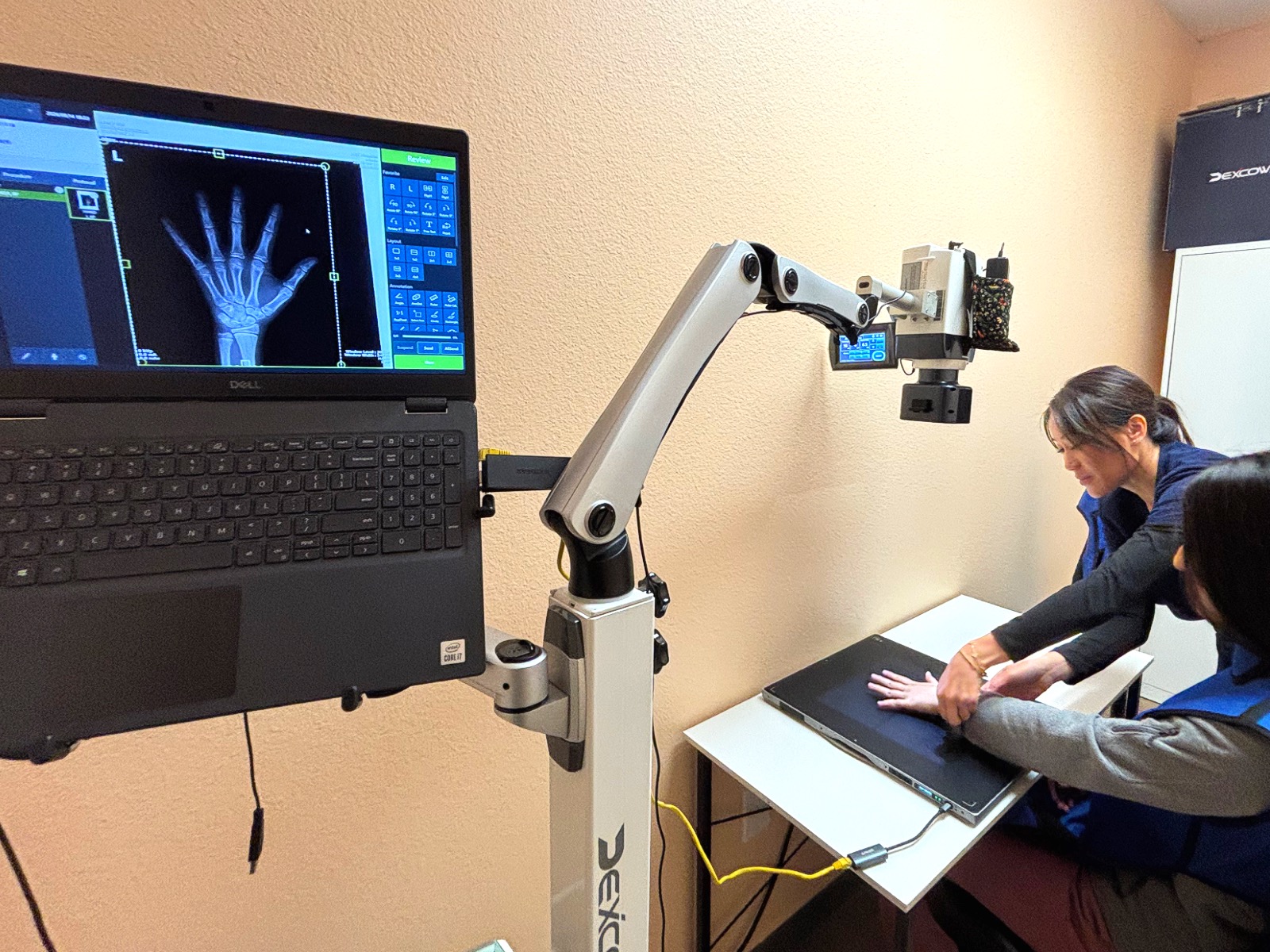
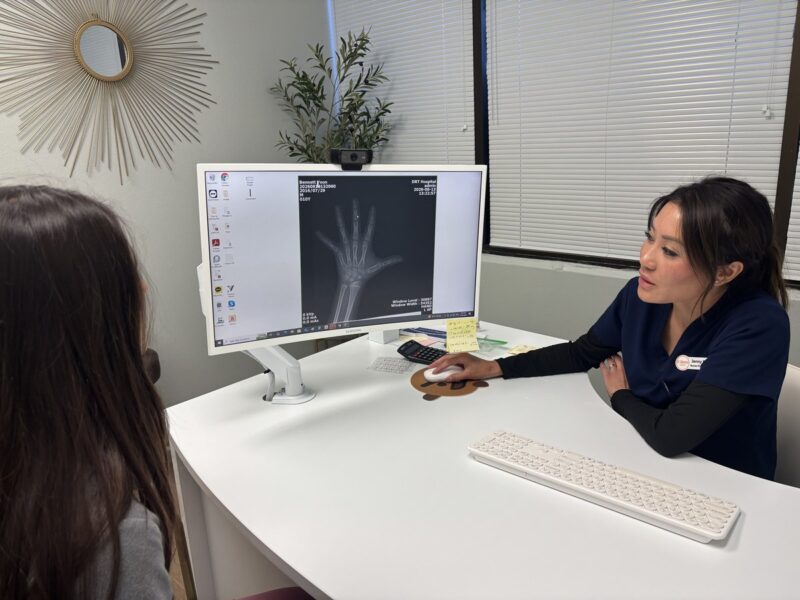
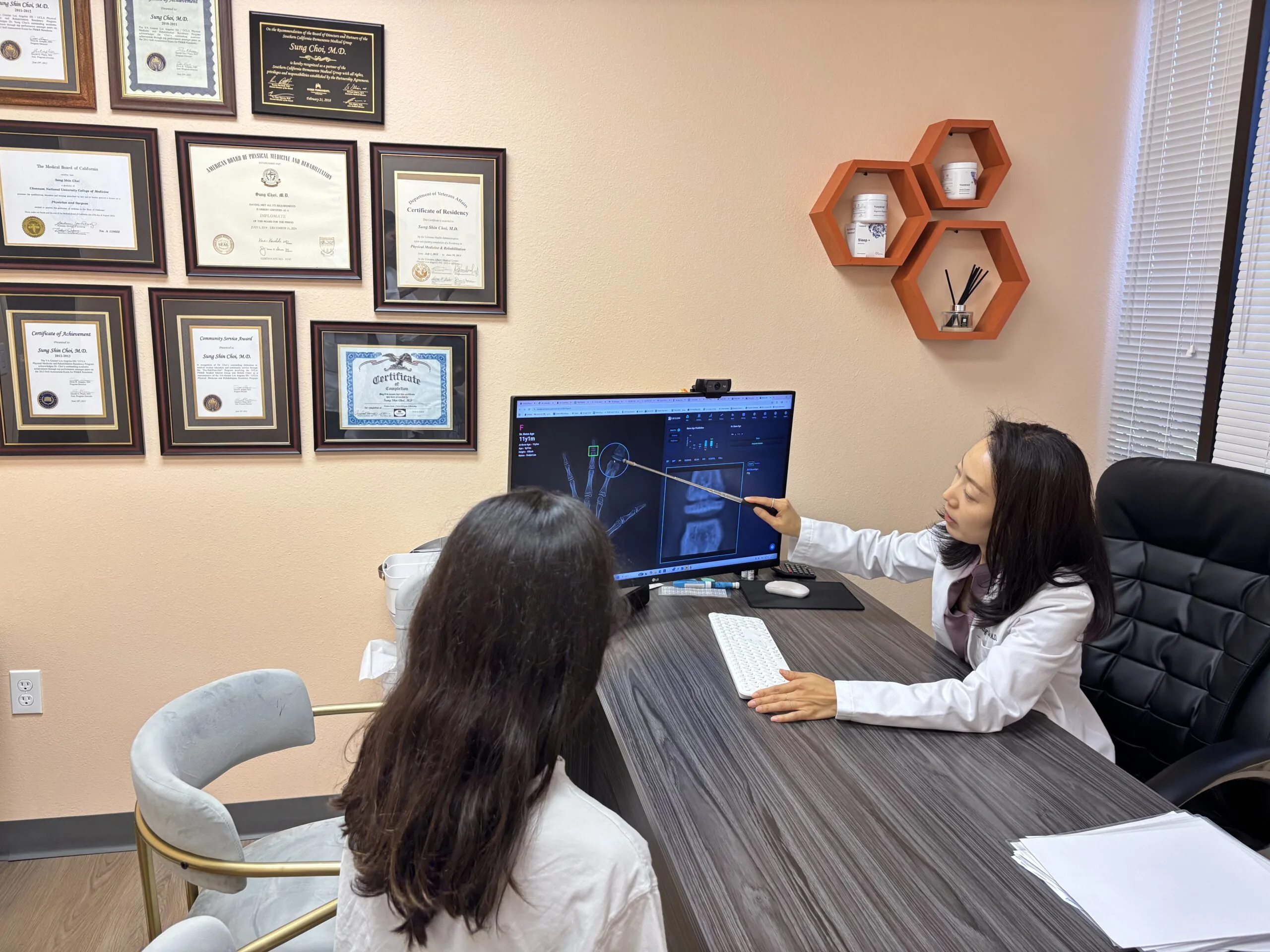
A bone age X-ray is a quick, low-dose image of the left hand and wrist that takes just two to three minutes. It measures the skeletal maturity of the growth plates, which reflects how much growing time your child actually has remaining, more accurately than their calendar age alone. At I Grow Clinic, that image is reviewed through a formal bone age evaluation using AI-assisted analysis compared against thousands of reference data points, giving families a level of precision that goes beyond a standard visual read.
What the bone age X-ray shows, combined with growth velocity and lab results, is what allows us to sort your child into the right category. It is the full picture together that points us toward whether we are looking at constitutional delay, idiopathic short stature, or something worth investigating further. And regardless of which category your child falls into, having that answer clearly in hand is what allows us to move forward with a plan that is actually built for your child.
🔍 If the evaluation points away from GHD, this is often where families land next, and it is worth understanding before you get there. Growth Hormone Therapy for Idiopathic Short Stature
If It Is Not GHD, It Is Not Nothing
A ruled-out GHD diagnosis is not a dead end. Whatever category your child falls into, our role is to get you a clear, evidence-based answer quickly, using tools most primary care visits do not have time to run, so that you are not the one left connecting the dots alone at midnight.
You Deserve a Faster Answer Than a Six Month Wait
A focused evaluation with AI-assisted bone age analysis can deliver answers in weeks, not months. Our clinical team personally reviews every case that comes through our clinic, and every evaluation includes AI-assisted bone age analysis alongside a real, one on one conversation about your specific child’s growth history, not a generic printout. Because our model is built around this kind of concierge evaluation, we intentionally keep our evaluation slots limited so every family gets real time with a provider, rather than a rushed ten minute visit squeezed between other patients.
Families reach us two ways. If you are near Fullerton, California, you can come in for an in-person bone age X-ray and consultation. If you are further away, we offer a virtual growth assessment for families in California, New York, Washington, Florida, and Texas, with the same bone age imaging and physician review built into the process either way.
🔍 If you want to understand why this clinic exists in the first place, and what Dr. Choi saw in her own practice that led her to build a different kind of growth evaluation, this is where that story lives. Why I Started a Growth Hormone Clinic
FAQ: What Parents Ask About Growth Hormone Deficiency in Children
1. Is growth hormone deficiency the same thing as idiopathic short stature?
No. Growth hormone deficiency is a specific condition where the pituitary gland underproduces growth hormone, and it is confirmed through growth history, bone age, and targeted testing. Idiopathic short stature describes a child who is significantly shorter than expected with no identifiable hormonal or genetic cause, and healthy in every other measurable way.
2. How is a bone age X-ray different from a regular growth chart?
A growth chart shows where your child sits today and how fast they have been moving over time. A bone age X-ray shows how mature your child’s skeleton is, which tells you how much growing time is realistically left. The two together give a far clearer picture than either one alone, and the bone age result is often what changes the conversation from “let’s wait and see” to “here is what we can actually do.
3. What is a normal growth rate for a child before puberty?
Most children without a growth concern gain roughly 1.6 to 2.4 inches a year before puberty begins. A pattern that consistently falls under about 1.5 inches a year is one of the clearest signals worth having evaluated.
4. Can growth hormone therapy help a child who does not have a hormone deficiency?
Yes, in appropriate candidates. Growth hormone therapy is an FDA-approved treatment for idiopathic short stature, meaning children who are significantly shorter than expected with no identifiable hormonal cause. The decision depends on your child’s current height, predicted adult height, bone age, and how much of the growth window remains. That is exactly what a growth evaluation is designed to assess.
5. At what age should parents start thinking about a growth evaluation?
There is no single right age, but earlier is generally better. A child who is consistently tracking below the third percentile, whose growth has slowed noticeably compared to their own past pace, or who is significantly shorter than both parents would predict is worth evaluating at any age between six and sixteen. The most important factor is not the calendar age but how much of the growth window is still open, which is exactly what a bone age X-ray determines.