
I Grow Clinic · Growth Reference Tool
Where does your child’s height fall?
Compare your child’s height to CDC national growth data for the same age and sex. Takes 15 seconds, no email required.
You just typed in a number and got a percentile back. Maybe it made you exhale. Maybe it made your stomach drop.
Either way, here is what that number is not telling you.
“My daughter is 5th percentile and her pediatrician says it’s fine, but every website I read makes it sound like I should be worried.”
“My son is 85th percentile and I thought that meant he was set, until I read something about bone age is what matters. I’m confused now.”
“30th percentile. I don’t even know if that’s a number I should be relieved about or not.”
A percentile can tell you where your child stands today. It cannot tell you where they are headed, whether that number is stable or sliding, or how much growing they actually have left. Those three things matter far more than the number itself, and almost nothing online explains why.
At I Grow Clinic, this is exactly the gap we built our evaluation process to close.
| Credential | Detail |
|---|---|
| Children guided | Nearly 3,000 with precision growth strategies |
| Treatment retention | 95 percent rate, reflecting exceptional outcomes and family trust |
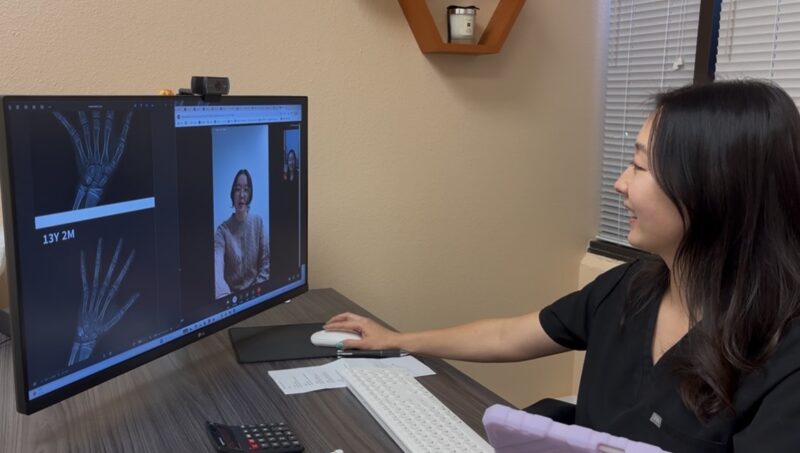
| Approach | Meticulous 1:1 personalized management using AI driven bone age analysis |
| Medical Director | Board Certified by the American Board of Physical Medicine and Rehabilitation (ABPMR) |
| Experience | 20+ years specializing in Pediatric Growth and Developmental PM&R |
| Reputation | 5 Star Google Rating with numerous testimonials |
| Telehealth | Available in CA, NY, WA, FL, and TX |
Why the Number Alone Can Mislead You
Here is the part most percentile calculators will not tell you. A 9 year old at the 30th percentile and a 9 year old at the 70th percentile can end up exactly the same height as adults, depending on their bone age and family height pattern. Meanwhile, two 9 year olds standing at the identical 50th percentile today can be headed toward completely different adult heights, because one has years of growth plate runway left and the other’s growth plates are already advancing toward closure.
This is why a pediatrician glancing at a single percentile and saying “that’s normal” is not wrong, but it is only half the answer. Percentile tells you how your child compares to other children their age right now. It says nothing about your child’s own trajectory, which is the actual question every parent searching this term is really asking: is my child on track, or are we missing a window.
So before you close this tab with just a number in hand, here is what actually determines the answer.
A percentile is a snapshot, not a forecast. 40th percentile means 40% of same-age, same-sex kids are shorter and 60% are taller today. It says nothing about what happens next.
The direction matters more than the position. A child who has calmly sat at the 40th percentile since toddlerhood is a very different story than a child who was at the 60th last year and has dropped to the 40th this year. Same number, completely different level of concern.
Two kids at the same percentile can have very different amounts of growing left. Bone age is what tells you that, not percentile, and it’s the piece no online calculator accounts for, which is why we build our entire evaluation process around it.”
The Two Numbers That Actually Matter More Than Percentile
Here’s the one thing to take away: stop focusing on the percentile number itself. Two other numbers matter more, whether that percentile is trending up or down over time, and your child’s bone age, which tells you how much growing is actually left.
A dropping trend beats a low position every time as a reason to act. A child who was at the 60th percentile last year and is at the 40th this year has lost ground relative to peers, which is a meaningfully different situation than a child who has quietly sat at the 40th since toddlerhood. The second child is likely just following their own curve. The first child’s curve just changed, and that is worth understanding why.
If this applies to your child, the next useful step is not another calculator, it is a bone age evaluation that can actually explain what is happening rather than just re-confirming the number you already have.
The Piece Almost No One Tells You About: Bone Age
Here is the detail that changes everything and that a height percentile simply cannot capture. Two children can stand at the exact same height, the exact same percentile, and the exact same chronological age, and still be years apart in how much growing they have left.
The reason is bone age, meaning the skeletal maturity shown on a hand and wrist X-ray, which can run ahead of or behind a child’s actual age. A 9 year old with a bone age of 7 has meaningfully more growth runway than a 9 year old with a bone age of 11, even though both are, on paper, “9 year old boys at the 50th percentile.” Percentile cannot see this difference. Bone age can.
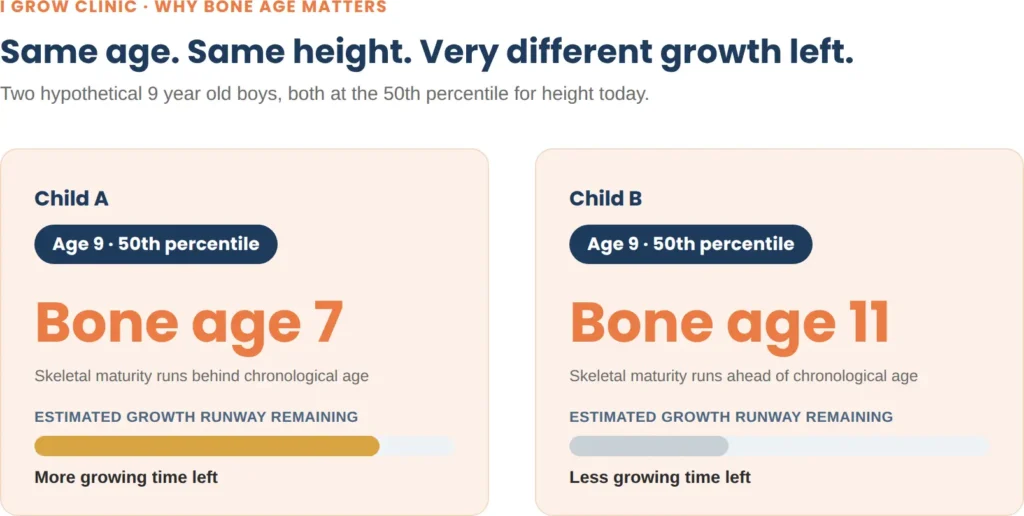
This is the exact gap between a percentile check and a real evaluation, and it is why we start every case at I Grow Clinic with a bone age X-ray read against height, growth pattern, and family height history together, rather than a single number in isolation.
🔍 To see how bone age actually gets read and what it means for your child specifically, read: Bone Age vs. Chronological Age: Is Your Child’s Biological Clock Ticking Too Fast?
🔍 Wondering whether your child’s growth plates are still open or already closing? Read: How Do You Know If Growth Plates Are Closed? 3 Key Signs Parents Often Miss
How Often Should You Check?
For most children, height is already being tracked at annual pediatric well visits, and that is often enough. If you have a specific concern, such as your child growing less than 2 inches in the past year, a child who seems noticeably shorter or taller than classmates, or a family history of a growth condition, tracking every 3-6 months can help establish whether a pattern is emerging.
If that pattern holds after a few checks and still looks off, the next step is not more tracking, it is a bone age X-ray to see how the growth plates are actually doing. That single image tells you more about remaining growth potential than another six months of measurements ever could. I Grow Clinic offers this evaluation in person in Fullerton, and by telehealth consultation in California, New York, Washington, Florida, and Texas, so families outside Southern California can start this conversation without a flight.
🔍 To see exactly how a telehealth growth evaluation works state by state, read: Pediatric Growth Specialists Available via Telehealth: What Families in CA, NY, TX, FL, and WA Need to Know
Frequently Asked Questions
1. Does height percentile predict adult height?
Not on its own. Percentile alone does not account for bone age or puberty timing, both of which affect how much growth remains. A bone age evaluation gives a far more accurate estimate of predicted adult height than a percentile chart.
2. My child was always around the 50th percentile and just dropped to the 20th. Should I worry?
This is one of the patterns worth a conversation with a pediatrician or growth specialist. A meaningful drop across percentile bands over 6 to 12 months is more relevant than the specific percentile number itself.
3. Is being below the 3rd percentile always a medical problem?
No. Many children below the 3rd percentile are healthy and simply following a genetic pattern, especially if parents are also shorter than average. It is, however, a reasonable threshold for requesting a bone age evaluation to rule out a treatable cause and to understand growth potential.
4. Does this calculator work the same for all ethnic backgrounds?
The CDC reference data reflects a broad US population sample rather than any single ethnicity. It remains the standard clinical reference in the US, but individual family height patterns can reasonably shift where a healthy child falls on the chart.
5. What is the next step if my child is below the 3rd percentile or dropping across percentile lines?
The most useful next step is a growth evaluation that includes a bone age X-ray, height tracking, and family height history together, rather than relying on a percentile number alone. That combination is what actually tells you whether there is room for a treatable, catch up growth strategy.