
“He gets close to nine hours of sleep, just not until eleven. Does the bedtime itself matter, or only the total?”
“She naps an hour after school. I am wondering if that covers the late bedtimes.”
“He slept badly all last year. Did that already cost him height I can’t get back?”
You already know sleep matters for growth. Every pediatrician says it, every parenting article says it, and you have probably rearranged your evenings around it more than once. What nobody gives you is the specific part. How many hours, by what age, by what time, and whether the nights you already lost actually cost your child anything.
I’m Jenny Diep, a Nurse Practitioner at I Grow Clinic. This article gives you the specifics, the ones parents almost never get in a fifteen minute visit.
What Families Trust Us With
| Credential | The Detail |
|---|---|
| Children guided | Over 3,000 through personalized growth evaluations |
| Treatment retention | 95% of families who start treatment continue with us |
| Approach | 1:1 concierge care using AI-driven bone age analysis |
| Medical Director | ABPMR board certified |
| Experience | 20+ years of clinical experience |
| Reputation | 5-star Google rating across hundreds of reviews |
| Access | In-person in Fullerton, telehealth in CA, NY, WA, FL, and TX |
By the end of this article, you will know whether bedtime timing matters more than total hours, what a slipped bedtime costs at the hormone level, and when a growth slowdown is worth a bone age look.
How Much Does Sleep Affect Your Child’s Height?
Does sleep affect height in children in a way you can measure, or is it more of a general wellness idea? The physiology every credible source agrees on is this: growth hormone is not released steadily throughout the day. It comes in bursts, and the largest burst happens shortly after your child drops into deep, slow-wave sleep in the first stretch of the night. That is the piece most sleep advice skips, and it is why the first few hours of the night carry more weight than the last few.
What is less settled is how much a bad sleep stretch actually costs in inches. Large studies consistently find that children with a diagnosed sleep disorder are more likely to be short for their age. But the research tying ordinary, garden-variety short sleep to a measurable height deficit is thinner than most parenting articles suggest. Both are true at once. The connection is real enough that we take it seriously, and no website can tell you how big that effect is in your child specifically.
There is also a direction most sleep articles never mention. Poor sleep can blunt a child’s growth hormone pulses, but a genuine growth hormone problem can also disrupt a child’s sleep in the first place, showing up as trouble settling, frequent waking, or excessive daytime sleepiness. When a family cannot tell which came first, that is exactly the situation a bone age evaluation is built to sort out. Most of the time, though, the explanation is far more ordinary: bedtime has simply drifted later than it used to, often by more than parents realize until they track it for a week.
🔍 If what you are really asking is whether your child still has growing time left, this post walks through the signs parents most often miss: How Do You Know If Growth Plates Are Closed? 3 Key Signs Parents Often Miss
Does Bedtime Timing Matter for My Child, or Is It Only About Total Hours?
Both matter. When parents search for the best time to sleep for growth hormone release, 10 PM is the number that comes up, and it is a reasonable one. We use it at the clinic for most school-age children because it holds up in practice. It is early enough to protect the first deep sleep window and realistic enough to survive a school night with homework.
Here is what is happening underneath that number. Growth hormone release is tied to sleep stage, not to the clock itself. The largest pulses come during the first rounds of slow-wave sleep, in the earliest hours after your child falls asleep. What it does not account for is the gap between getting into bed and actually falling asleep. A child in bed at 10 who takes forty minutes to settle is not getting the same night as a child who is asleep at 10.
So read it as asleep by 10, not in bed by 10. Younger children should be earlier. Teenagers naturally run on a later internal clock, so their realistic bedtime often lands closer to 10:30, and that is fine as long as it stays consistent night to night.
That consistency matters most during a growth spurt. In the fastest growth months of puberty, your child’s body is already asking more of that overnight hormone release, so a chaotic bedtime in that stretch has more to disrupt, not less.
Can Daytime Naps Make Up for a Late Bedtime?
Not in the way most parents hope. Daytime naps are lighter and shorter than nighttime sleep cycles, and children rarely drop into the deep, slow-wave stage during a nap the way they do in the first hours after a nighttime bedtime. An hour afternoon nap can genuinely help a sleep-deprived child feel less exhausted the next day, but it is not standing in for the specific overnight window where the largest growth hormone pulses occur.
There is a real trade-off here too. A long or late afternoon nap often pushes bedtime even later, which shortens the very window it was meant to make up for. If naps have become a regular part of your child’s routine because bedtime keeps slipping, the nap is a symptom of the sleep schedule, not a fix for it.
How Much Sleep Does My Child Need, by Age?
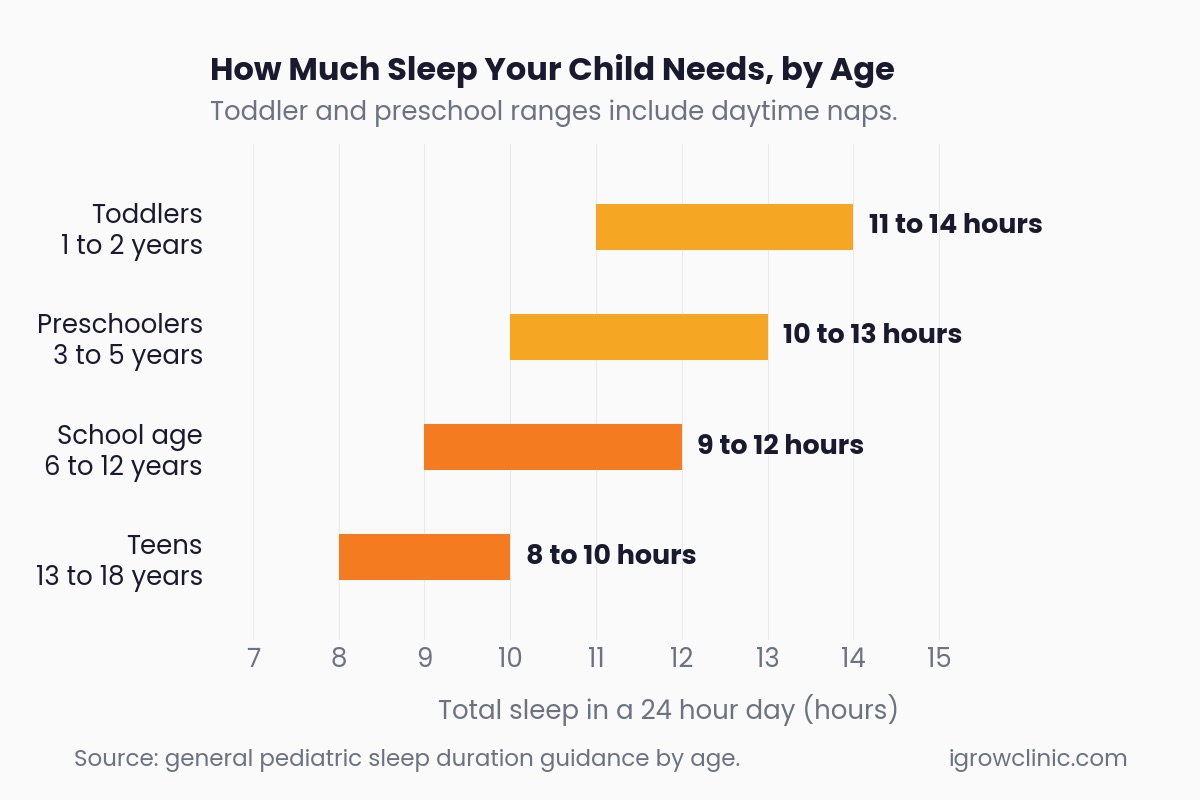
General pediatric sleep guidance breaks down by age this way:
- Toddlers (1 to 2 years): 11 to 14 hours, including naps
- Preschoolers (3 to 5 years): 10 to 13 hours, including naps
- School-age children (6 to 12 years): 9 to 12 hours
- Teens (13 to 18 years): 8 to 10 hours
By school age, most children have dropped daytime naps entirely, which is part of why nighttime sleep quality carries more weight for this age group than it did at three or four.
These ranges answer how much sleep affects height only in the broadest sense. A child who is consistently getting an hour or two less than their range, night after night, is the pattern worth tracking, not one late night before a trip. Age changes what that shortfall costs. A 15-year-old in the middle of a growth spurt is relying on that overnight hormone release far more than a 6-year-old is, so the same hour of lost sleep does not carry the same weight at both ages.
🔍 Since the timing of that growth spurt changes everything about how much time is left, this post explains what happens when it arrives early: Does Early Puberty Affect Height?
When Better Sleep Isn’t the Fix: When a Growth Slowdown Needs a Specialist Look
Fixing sleep hygiene is the right first move for most families, and for most children it is enough. But there are specific signs that mean sleep alone is not going to answer the question you have.
Loud, regular snoring, gasping or pauses in breathing, or a child who seems exhausted no matter how many hours they log are signs of obstructed breathing during sleep, not a behavioral bedtime problem. Obstructed breathing can suppress the same overnight hormone pulses a late bedtime does, and it needs its own evaluation rather than an earlier one. The encouraging part is that catch-up growth after obstructed sleep is treated is well documented, usually unfolding over six to twelve months with most of the gain in the first several months. When the problem is simply a late but fixable bedtime, growth velocity tends to normalize over a similar stretch once sleep genuinely improves, though the research on that path is thinner.
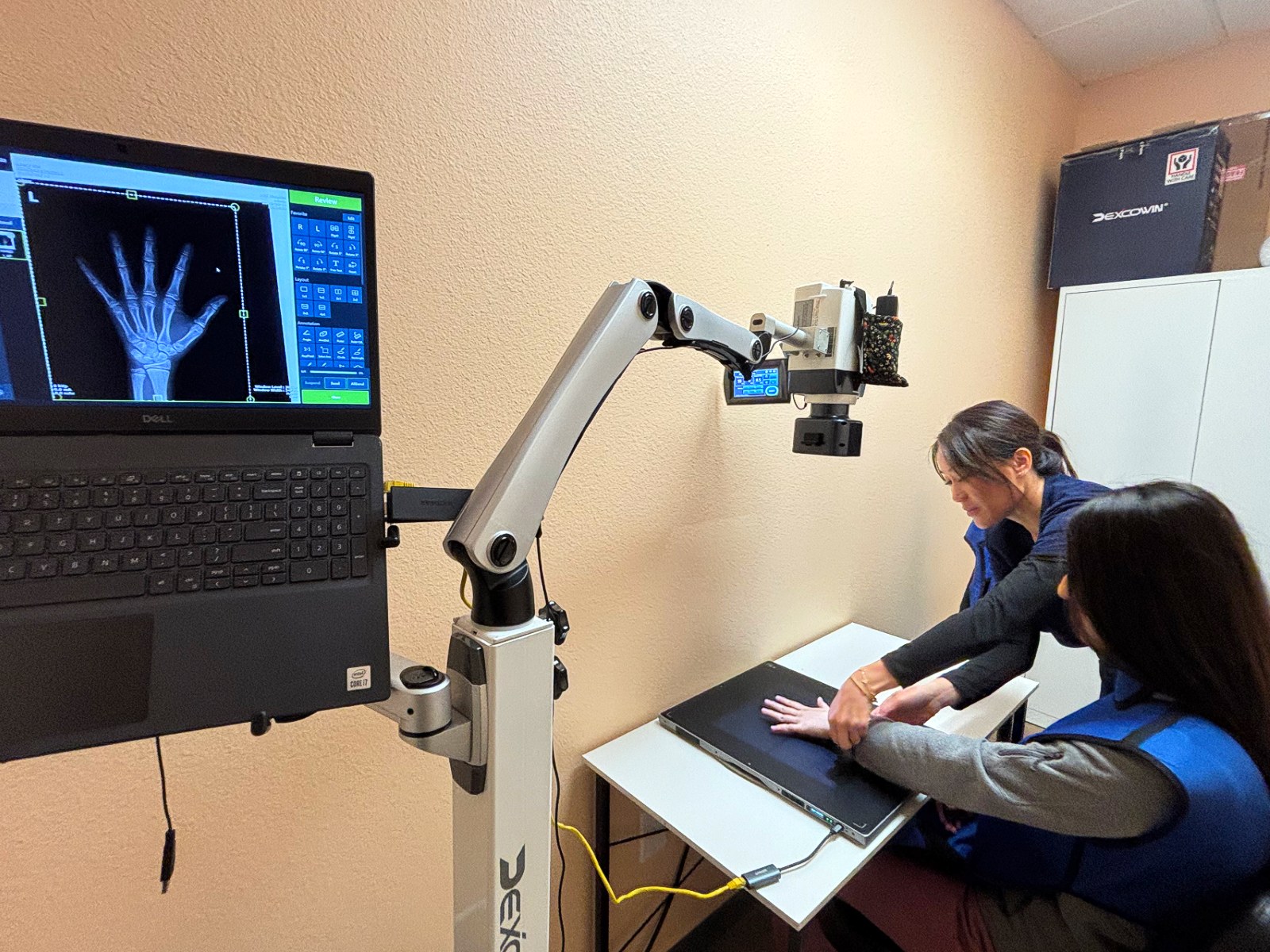
Beyond snoring, a few patterns mean it is time to look past sleep entirely: growth that has clearly slowed compared to your own child’s past pace, a height that sits well below where your family history would predict, or a growth chart line that has crossed more than a line or two on the percentile chart in the past year or two. None of these are things a parent can measure from a growth chart at home with any real confidence. They are exactly what a bone age evaluation is built to clarify, comparing your child’s actual skeletal maturity against how much growing they likely have left, sleep problem or not.
A Word From One Parent to Another

Most parents who ask me about sleep have already fixed the bedtime. They moved it up thirty minutes, took the tablet out of the room, held the line for two months. Then they come in anyway, because the height did not move and they have no way to tell whether that means the sleep was not the problem, or whether it was and they got to it too late.
Sleep is one input into your child’s growth. Bone age, pubertal stage, and how fast your child has been growing compared to their own past pace are the others, and those are the ones that tell you where you actually stand.
Getting a Real Answer, Not Another Guess
Every case at I Grow Clinic is reviewed by our physician-supervised clinical team using AI-driven bone age analysis. That is how a general range becomes an answer about your own child. Because every evaluation is built around one child’s growth history rather than a standard protocol, new consultation slots are limited each week. Families can work with us in person at our Fullerton clinic or through our telehealth program in California, New York, Washington, Florida, and Texas.
🔍 To read about why we built the clinic around exactly this kind of clarity, read: Why I Started a Growth Hormone Clinic
FAQ: What Parents Ask About Sleep and Their Child’s Height
1. Does sleep really affect my child’s height, or is that overstated?
Sleep and short stature genuinely do show up together more often than chance would predict, and the mechanism behind that, overnight growth hormone pulses, is well established. What is overstated is the idea that one bad sleep stretch measurably costs a specific child a specific number of inches. That part depends on your child’s age, pubertal stage, and how long the sleep problem lasts.
2. Is 10 PM really the best bedtime for growth hormone release?
No specific clock time is magic. What matters is that your child falls asleep early enough and consistently enough to reach deep, slow-wave sleep without interruption. For most families that lands somewhere in the 9 to 10 PM range simply because of school and wake-up times.
3. Can my child catch up on sleep over the weekend and still grow normally?
No. Weekend recovery sleep helps your child feel less exhausted, but it does not replace the deep sleep windows already missed on weeknights. It also pushes Sunday night bedtime later, which starts the next week short. A weekday shortfall that gets patched with weekend sleep every single week is the pattern worth fixing.
4. Does sleep affect height in teens the same way it does in younger kids?
Not exactly. Teens in an active growth spurt are asking more of that overnight hormone window, so a shortfall during puberty has more growth to disrupt than the same shortfall would in early childhood.
5. My child sleeps enough hours but still seems to be growing slowly. What should I do next?
Enough hours does not rule out a bone age, growth plate issue, or a hormonal cause. A growth evaluation that includes a bone age X-ray and a look at your child’s growth velocity over time is the next real step, rather than adjusting bedtime further.