

“I bought the top rated gummies on Amazon. They promise extra inches, but am I just feeding my son sugar?”
“My daughter barely eats, so she gets a growth gummy every morning. How much does it really help?”
“He’s fourteen and this feels like our last shot. Is a height supplement worth trying, or are we wasting the time he has left?”
That mix of hope and doubt is exhausting. You’re spending money on something that might help, while suspecting it might not. What you really want to know is whether your child is growing the way they should, and a gummy is simply what search results hand you first.
I’m Jenny Diep, a Nurse Practitioner at I Grow Clinic. Every week, I see families who relied on a supplement for months before anyone checked whether it was enough. This post covers what’s actually in these products, what the research says, and how to tell whether your child needs a different kind of help.
Why Parents Trust Our Growth Specialists
| Credential | Detail |
|---|---|
| Children guided | Near 4,000 with precision growth strategies |
| Treatment retention | 95% treatment retention rate |
| Approach | Meticulous 1:1 personalized management using AI driven bone age analysis |
| Medical Director | Board Certified by the American Board of Physical Medicine and Rehabilitation (ABPMR) |
| Experience | 20+ years specializing in Pediatric Growth and Developmental PM&R |
| Reputation | 5 Star Google Rating with numerous testimonials |
| Telehealth | Available in CA, NY, WA, FL, and TX |
By the end of this article, you’ll know which gummy ingredients have real research behind them and what to check before counting on one for your child’s height.
What’s In Height Gummies, and Can Any of It Make My Child Taller?
Peel back the marketing, and most height gummies contain the same basic mix. Calcium, vitamin D, zinc, vitamin B12, and an amino acid like arginine. Some add a probiotic or herbal blend on top. Most supplements for height growth, whether gummies, powders, or capsules, share very similar core ingredients.
For a healthy child who is already eating enough and getting a reasonable range of nutrients, no ingredient commonly found in these products has been shown to increase final height.
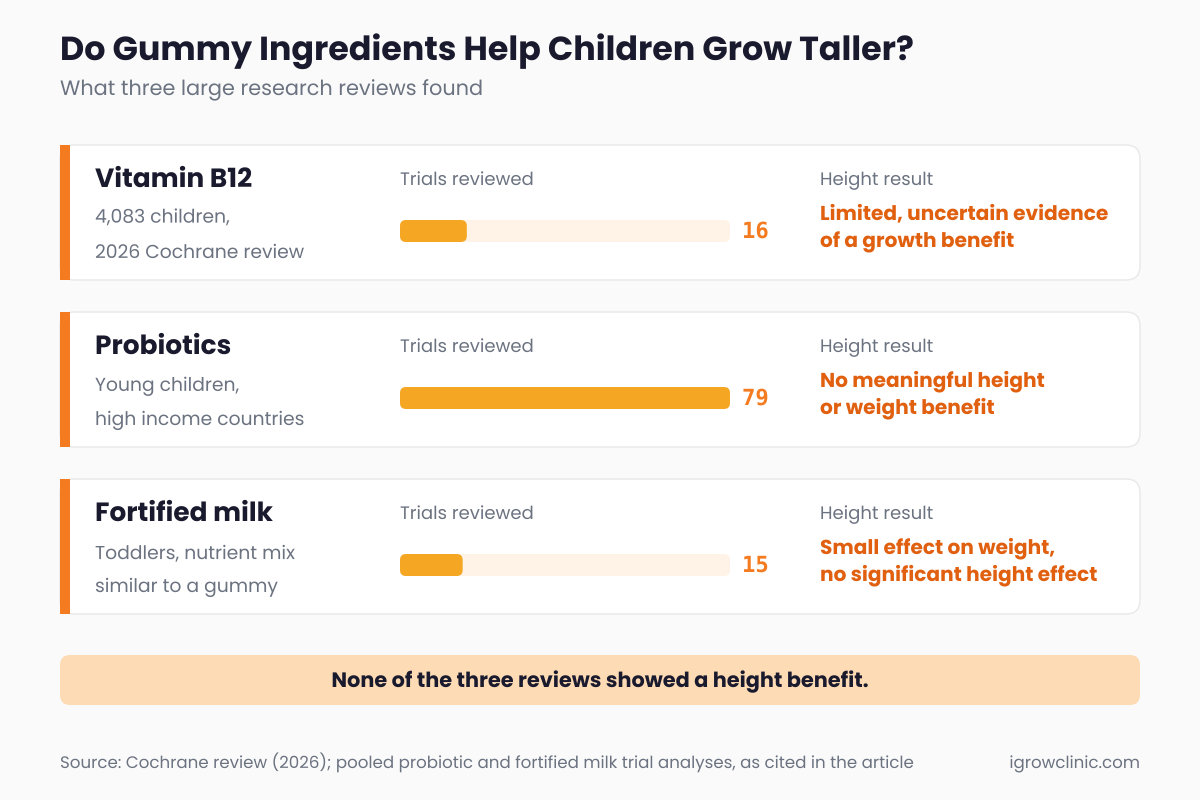
Here’s what three large research reviews found:
Vitamin B12: A 2026 Cochrane review of 16 trials and 4,083 children found limited, uncertain evidence that B12 improves growth. That’s notable, since B12 is one of the most heavily marketed ingredients on gummy labels.
Probiotics: A pooled analysis of 79 trials found no meaningful height or weight benefit in young children from high income countries.
Fortified milk: A review of 15 trials in toddlers, using a nutrient mix similar to a typical gummy, found a small effect on weight but no significant effect on height.
None of the three showed a height benefit. These studies focused on younger children, but research has not shown a height benefit in well fed school age children either.
Calcium is worth a closer look. A pooled analysis of dairy supplementation found real gains in children’s bone density. But bone density is not the same as height. A denser bone is not automatically a longer one.
One more thing to check if your child also takes a daily multivitamin. Vitamin D and zinc can add up past a safe upper limit when products overlap. Each bottle often contains close to 100 percent of the daily value on its own. B12 is less of a concern, since the body clears what it doesn’t need. If your child takes more than one product with vitamin D or zinc, add up the totals.
Every child also has a genetic height range, shaped largely by their parents’ heights. This is often called the mid parental height estimate. No supplement can raise it. Whether a child actually reaches that range comes down to nutrition, overall health, and timing. Timing is the part most parents overlook. Early bloomers start puberty sooner, so their growth plates close sooner too. They may look tall now but finish shorter than expected. Late bloomers have more time left, and many catch up later. A bone age X ray shows which path your child is on.
🔍 The only way to see how much growing time your child actually has left is a bone age X ray. This guide explains what those results mean. Growth Plate X Ray Interpretation
When Do Vitamins for Height Growth Actually Help Your Child?
There is one situation where a supplement genuinely changes a child’s growth trajectory: a confirmed deficiency. A child who is truly low in vitamin D, iron, or another specific nutrient can grow more slowly because of it, and correcting that deficiency lets growth catch back up to where it should have been. The distinction that matters is the word confirmed. That requires a blood test, not a guess based on a picky dinner plate or a hunch that a chewable multivitamin probably covers the gaps. If mealtime battles are part of what is driving the worry, that deserves its own conversation about nutrition and intake, not a blanket assumption that any gummy fixes it.

Without a confirmed deficiency, a daily gummy mostly offers reassurance. It can feel like growth is being taken care of. However, that sense of security can let a real slowdown go unnoticed for months. And if growth has truly slowed, no vitamin can stop the growth plates from moving toward closure.
🔍 If your child’s growth percentile has shifted recently, a supplement is not the way to find out why. Read: Your Child’s Height Percentile Dropped This Year: Should You Worry?
Is My Child Growing Too Slowly, and Is It Too Late to Catch Up?
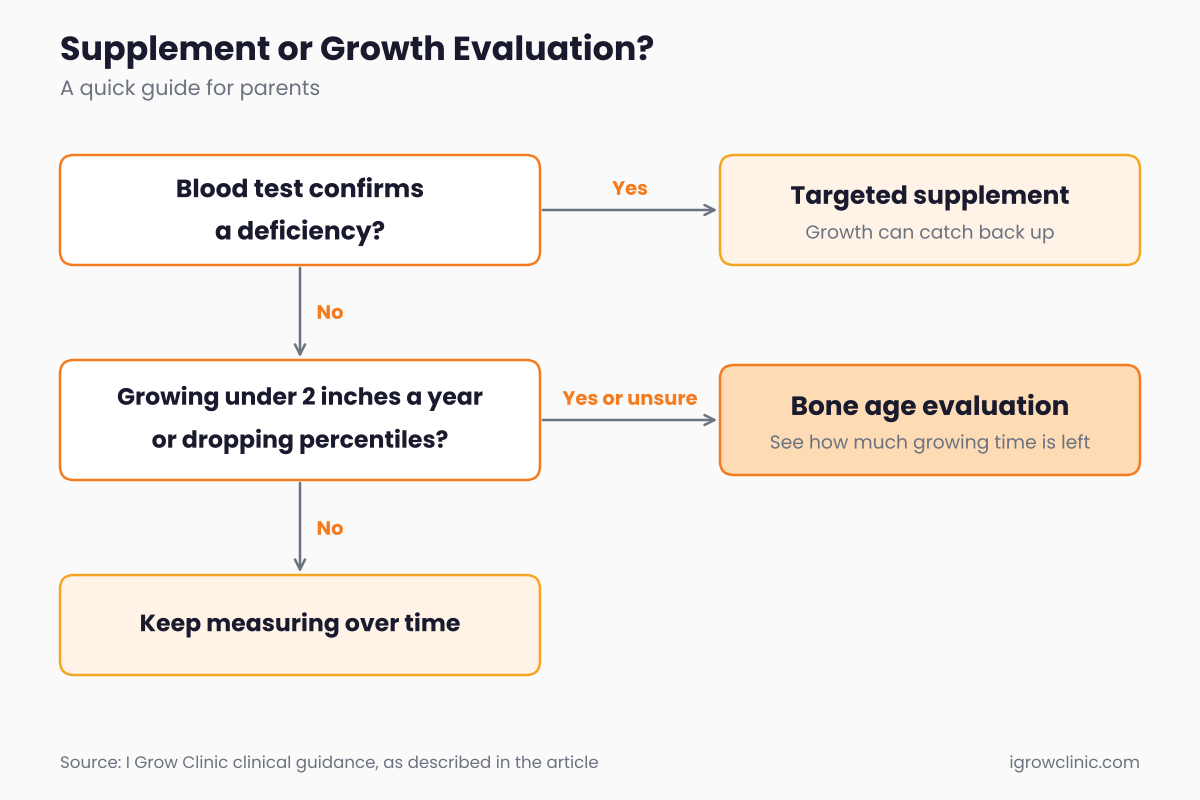
Two numbers tell you far more than any product review. A growth rate under about two inches a year is generally slow enough to warrant a closer look. This applies to children past toddlerhood who haven’t started puberty yet. The second signal is crossing more than one major line on the growth chart after around age three. Both require accurate height measurements tracked over time, not a guess based on how your child looks next to classmates.
For a teenager, the worry usually sounds different: is it too late to do anything at all. That question is answered by bone age, not by calendar age. A bone age X ray shows how much growing time is genuinely left in a child’s growth plates, regardless of whether they are twelve or sixteen, and it is the only way to know whether a growth conversation still has real runway or whether the window has already closed.
🔍 If your teenager has slowed down and you are wondering whether time has run out, start here. Read: My Son Is 15 and Barely Growing. Did We Miss the Window?
A birthday tells you almost nothing about how much growing is left. A bone age result tells you nearly everything, which is exactly why relying on the calendar leads so many families to either panic too early or wait too long.
🔍 For a fuller explanation of why these two numbers can tell very different stories, read: Bone Age vs. Chronological Age: Is Your Child’s Biological Clock Ticking Too Fast?
If a height supplement has been the plan for a while and your child’s growth still concerns you, that is the signal to trade the supplement aisle for a real look at how much growth potential remains, rather than adding another bottle to the shelf.
A Word From One Parent to Another
If you were searching for a height supplement, it’s because you noticed something and wanted to help right away. That instinct is exactly what makes you a good parent. But unless your child has a confirmed nutrient deficiency, research has not shown that supplements help children grow taller.
Getting Real Answers, Not Another Bottle

Every evaluation at I Grow Clinic is reviewed by our physician supervised clinical team. We use AI driven bone age analysis to compare your child’s growth plates against thousands of reference points, not just a growth chart. For children who qualify, growth hormone therapy is one of the few options with solid research behind it for improving height. You can see how some of our patients have grown over the course of treatment. Because every case gets one to one attention, new openings are limited each week. Families can work with us in person at our Fullerton clinic or through telehealth in California, New York, Washington, Florida, and Texas.
🔍 To understand why we built a clinic around giving families real answers instead of another product to try, read: Why I Started a Growth Hormone Clinic
FAQ: What Parents Ask About Height Gummies and Growth Supplements
1. Do height supplements work if my child does not have a deficiency?
Not for increasing height. If your child eats well and has no confirmed nutrient gap, research has not shown a height benefit from common gummy ingredients like vitamin B12 or probiotics. Studies on fortified milk, which has a nutrient mix similar to a typical gummy, found the same result. These products may add a little to general nutrition, but not to height.
2. What are the vitamins for growth height for teenager?
No vitamin has been shown to increase height in a teenager who already eats well. Vitamin D, calcium, zinc, and iron do support healthy bones and growth. Correcting a confirmed deficiency in any of them can help growth return to its normal pace. For teenagers, the bigger question is how much growing time is left, and a bone age X ray answers that.
3. Can supplements make up for my child being a picky eater?
Sometimes partially, but not reliably enough to replace an actual assessment. A picky eater can develop real gaps in specific nutrients, and in that case a targeted, confirmed correction can help. A daily gummy taken as a general precaution is a different situation, and it should not be treated as proof that nutrition is fully covered.
4. Is It Too Late for My Teenager to Grow Taller?
That depends entirely on bone age, not on your child’s birthday. Some teenagers still have meaningful growth potential remaining even at fifteen or sixteen, while others have already reached the end of their growth window earlier than expected. A bone age X ray is the only reliable way to know which situation applies to your child.
5. How do I know if my child needs a supplement or a full growth evaluation?
If a blood test confirms a specific deficiency, targeted supplementation makes sense. If your child’s growth rate has slowed, if they have crossed more than one major percentile line, or if you simply are not sure whether their pace is normal, that calls for a growth evaluation rather than a trial and error approach with over the counter products.