
“My pediatrician says he’s fine, but he hasn’t grown out of a single pair of pants in over a year.”
“I searched ‘growth clinic for kids’ and got a dozen hospital pages that all sound like they’re for children with rare syndromes. My daughter isn’t sick. She’s just small.”
“Do we need a referral to see a growth specialist, or can I just make an appointment directly?”
That mix of urgency and confusion is exactly what sends most parents searching for a child growth clinic in the first place. It rarely comes from a diagnosis. It comes from a feeling: pants that don’t need hemming twice a year anymore, a class photo where your child is suddenly on the end of the row, a pediatrician who says ‘let’s keep watching it’ for the third visit in a row.
I’m Yuri Kim, FNP, and I sit across from parents who feel exactly this way almost every week. What I want you to know before you book a consultation is what a real growth evaluation actually involves, and how to tell whether a clinic is genuinely built for a child like yours.
At I Grow Clinic, every evaluation is built around one question: is my child’s growth on track, and if not, what can actually be done about it.
| What Parents Ask About | I Grow Clinic |
|---|---|
| Experience | Over 3,000 children treated |
| Retention | 95% of families continue care after their first visit |
| Board certification | ABPMR board certified |
| Bone age accuracy | AI-driven bone age analysis |
| Reputation | 5-star Google rating across hundreds of reviews |
| Track record | 20+ years in pediatric growth and hormone care |
By the end of this article, you’ll know exactly what a child growth clinic evaluates, whether you need a referral to get in the door, and how telehealth and in-person visits actually differ so you can pick the right path for your family.
What does a child growth clinic actually evaluate?
Here’s something almost no hospital growth program page tells you directly: most children seen at a growth clinic do not have a rare genetic disorder or underlying medical condition. Cases tied to a specific diagnosis account for roughly 5% of short stature. The other 95% are healthy children who are simply growing more slowly than their peers, whether because of family genetics, a naturally later growth timeline, or no identifiable reason at all.
A real evaluation is built to sort out which of those categories your child actually falls into, and it does that with three pieces of information working together, not one number in isolation.
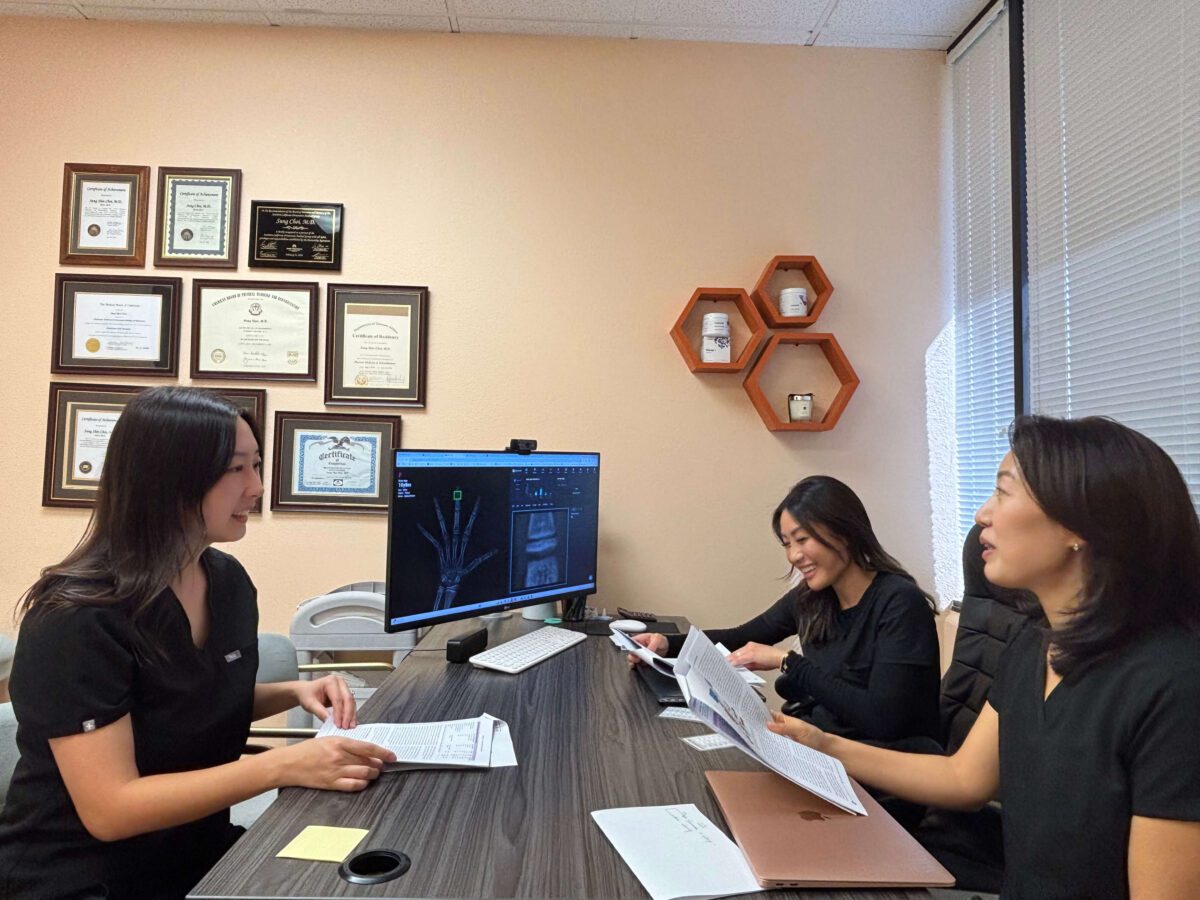
The first is growth velocity: not just where your child sits on the chart today, but how fast they’re moving along it. A child whose growth has clearly slowed compared to their own past pace is showing a pattern worth looking at more closely. The second is a bone age X-ray, a quick, low-dose image of the hand and wrist that shows how mature your child’s skeleton actually is compared to their birth-certificate age. The third is where your child stands in their pubertal development. Together with the bone age X-ray, the stage of puberty your child has reached gives us a much clearer picture of how much of the growth window is still open and how much has already closed.
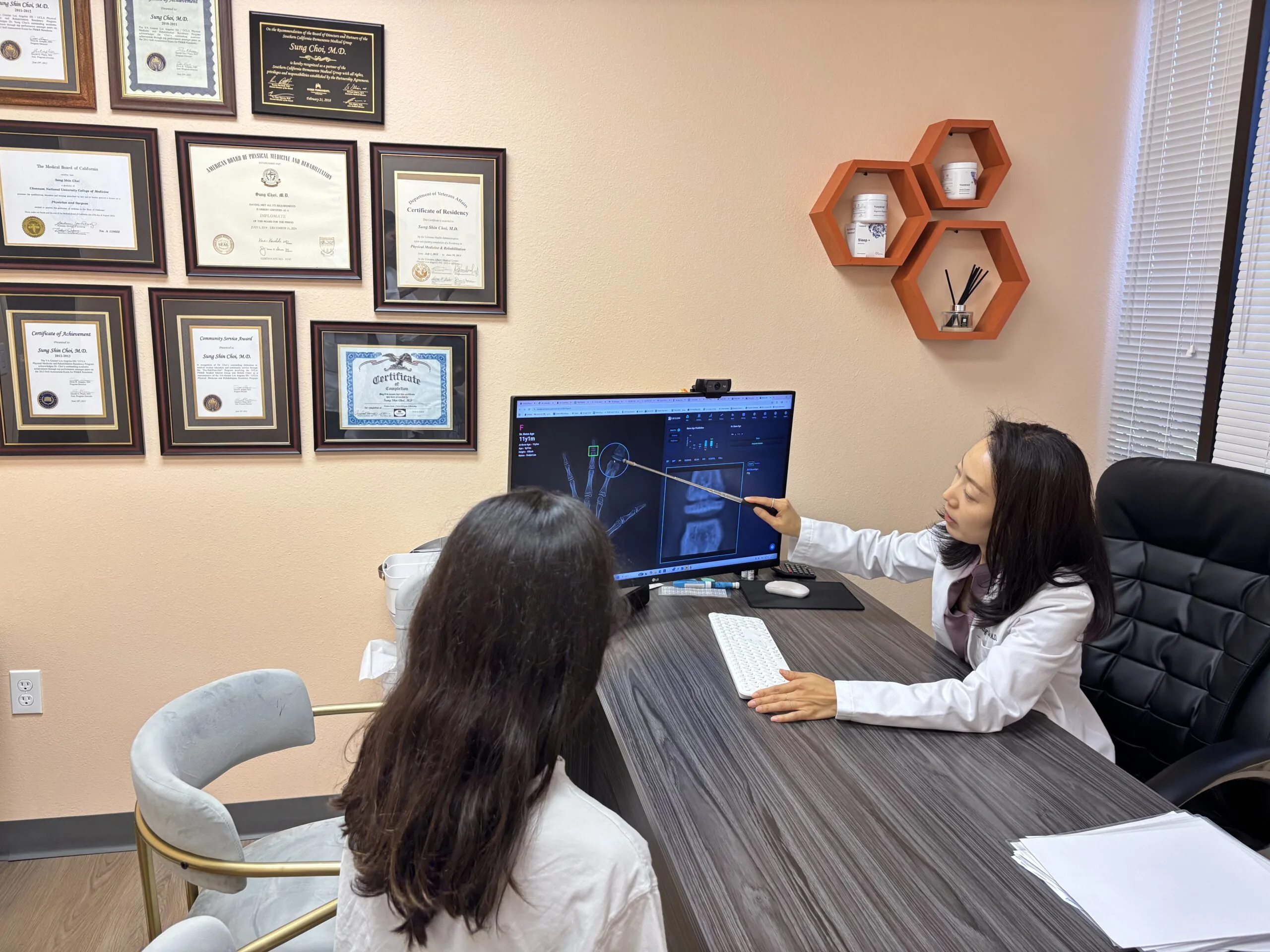
This is where a formal bone age evaluation does something a growth chart alone cannot: it tells you how much runway is actually left. A bone age reading that lags noticeably behind calendar age often points toward a late bloomer pattern, meaning your child’s body is simply maturing on a slower timeline than their peers. This is called constitutional delay. A bone age that is closer to or ahead of calendar age suggests the growth window is narrower than a late bloomer’s. Either way, this evaluation allows us to estimate your child’s predicted adult height and assess how much growth potential remains. That is the conversation we have with every family: what the numbers show, what they mean for your child specifically, and whether growth hormone therapy is worth considering.
🔍 If your child’s evaluation points toward idiopathic short stature, this post walks through the specific criteria we use to determine whether treatment could actually help. Growth Hormone for Height: Does My Child Actually Qualify?
Do you need a referral to see a pediatric growth specialist?
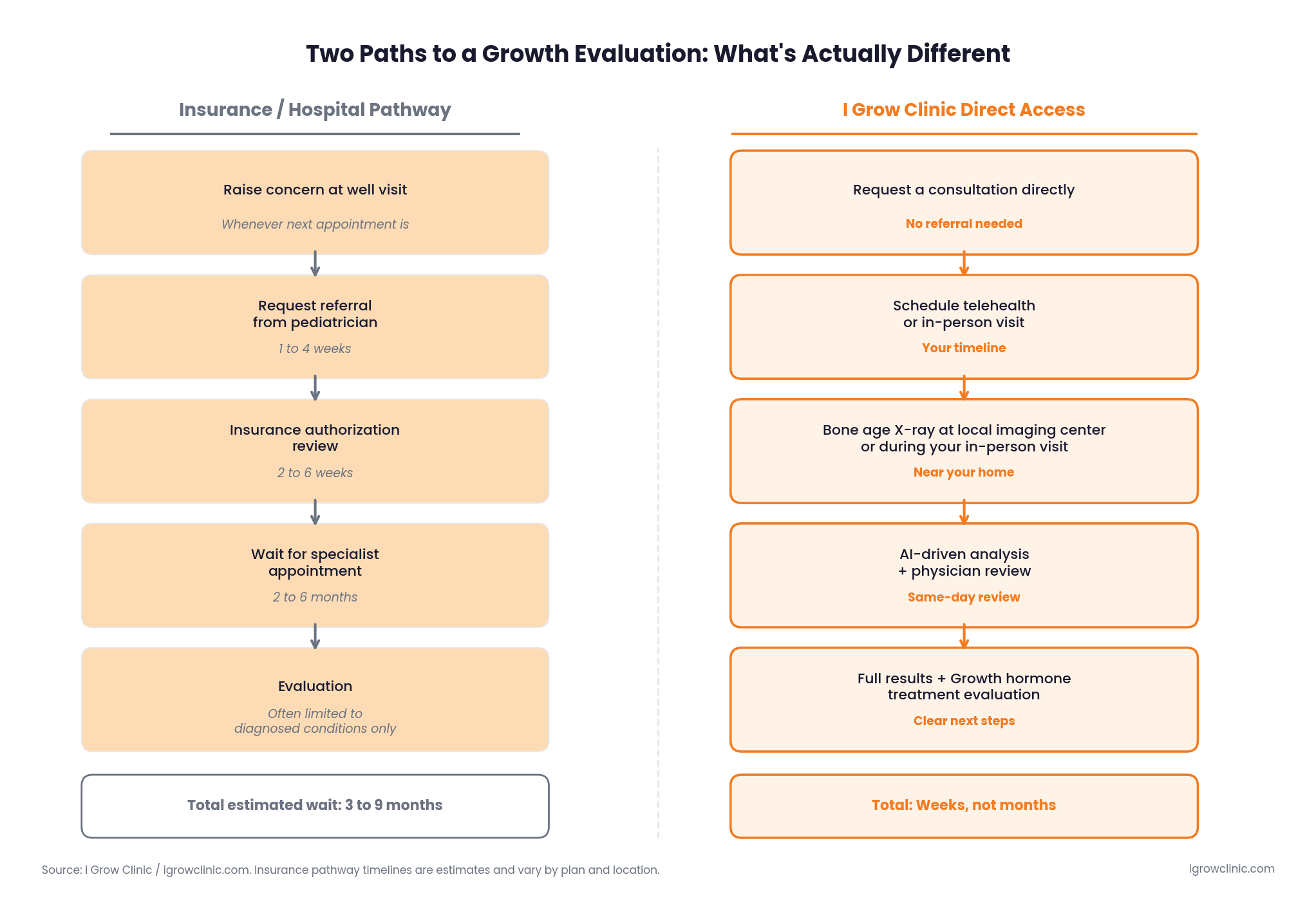
This is the question that stops more parents than any other. The honest answer depends on where you go. If you are pursuing growth evaluation through your insurance, a referral is often required, and the wait for an appointment can stretch for months. Even then, insurance coverage for growth hormone therapy is typically limited to children with a specific diagnosed condition. A healthy child who is simply shorter than their peers rarely qualifies. I Grow Clinic was built for exactly that situation. We work on a self-pay basis, which means no referral is needed and no insurance authorization stands between your family and an evaluation.
Hospital-based growth programs are built around insurance authorization and formal referral pathways. That structure makes sense for children with a confirmed diagnosis. But for a healthy child who is simply shorter than their peers, it often means months of waiting for an appointment that was never really designed for them.
At I Grow Clinic, families can request a consultation directly without a referral or insurance authorization. That doesn’t mean your pediatrician is left out of the picture. Bring their growth chart data, their notes on your child’s growth velocity, and any concerns they’ve flagged. It just means you are not required to have a referral in hand before you can get started.
Pediatricians do an excellent job monitoring overall health, but growth trajectory interpretation is a specialized area that often warrants a dedicated evaluation. When a concern gets flagged at a well visit, there often isn’t a structured next step built into that appointment. A dedicated growth evaluation fills that gap with the tools a routine visit doesn’t include: bone age imaging, lab work where indicated, AI-assisted analysis, and a predicted adult height conversation.
Our clinical team is built around exactly this kind of evaluation, with nurse practitioners who specialize in pediatric growth and hormone care, and every case supervised by Dr. Choi, MD.
🔍 If you want to understand what growth hormone therapy actually involves for a healthy child without a hormone deficiency, this post is a good place to start. Can Growth Hormone Therapy Help If My Child Does Not Have a Hormone Deficiency?
Telehealth vs. in-person: how does a child growth clinic work today?
Once you know an evaluation doesn’t require a referral, the next practical question is simply: where do you actually go?
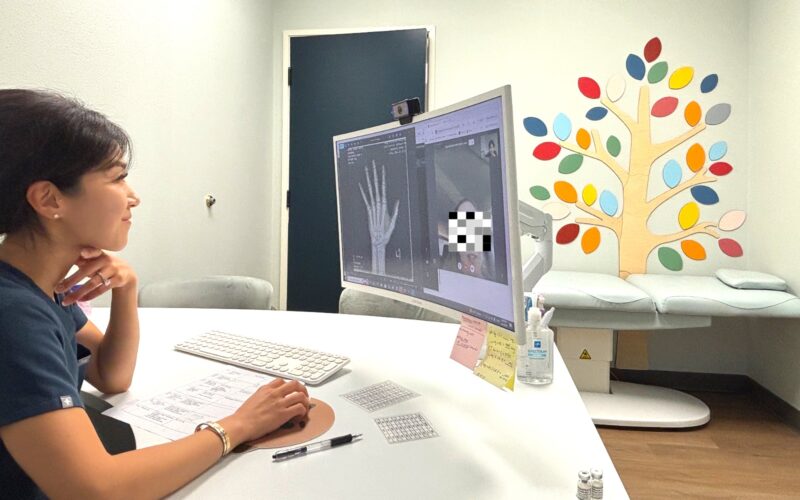
An in-person visit means coming to our Fullerton clinic for the imaging, exam, and consultation all in one place. A telehealth visit works differently: your child gets the bone age X-ray at a local imaging center near you, and the consultation happens over video from wherever you are. For families in California, New York, Washington, Florida, or Texas, our telehealth program brings the same evaluation and AI-driven bone age analysis to you, without needing to travel to a clinic. Neither path is more or less thorough. The imaging, the analysis, and the clinical questions being answered are identical. The real difference is logistics: whether you come to us in Fullerton or fit a video visit around your family’s schedule.
🔍 If you’re comparing what a telehealth-based growth evaluation actually involves step by step, this post breaks down exactly how each visit works from request to results. How Pediatric Growth Hormone Telehealth Works
One Parent to Another

If you’ve read this far, you’re probably the parent who has already been quietly tracking this for a while: the pants, the class photo, the “let’s just keep an eye on it” conversation that’s happened one too many times. You are not overreacting. Research shows that nearly 4 in 10 children are flagged for a height follow-up by age five, simply because their growth curve shifted at some point along the way. What matters is what happens next: whether your child’s growth gets a real look, or just another “let’s watch it.”
You don’t need a diagnosis in hand to ask for that look. You don’t need a referral. Bringing a healthy, otherwise thriving child in to find out where they stand isn’t jumping the gun. It’s exactly what this clinic is built for.
At I Grow Clinic, every case is supervised by Dr. Choi using AI-driven bone age analysis through a 1:1 concierge model. Because we see a limited number of families at a time, evaluation slots do fill up. Families can choose between an in-person evaluation at our Fullerton clinic or a telehealth evaluation for those in California, New York, Washington, Florida, or Texas.
🔍 If you want to understand why this clinic exists in the first place and the philosophy that shapes every evaluation we do, this is the place to start. Why I Started a Growth Hormone Clinic
FAQ: What Parents Ask Before Choosing a Growth Clinic
1. Do I need a doctor’s referral to book a growth evaluation for my child?
No. Most self-pay growth clinics, including ours, allow you to request a consultation directly without a referral. It’s still helpful to bring your pediatrician’s growth chart notes and any prior labs, but you don’t need to wait on a referral to get started.
2. Is a growth clinic only for children with a diagnosed condition or genetic syndrome?
No. True pathology accounts for a small share of short stature cases. Most children evaluated at a growth clinic are healthy kids with familial short stature, constitutional delay, or idiopathic short stature, not a diagnosed syndrome.
3. What actually happens during a child growth clinic evaluation?
The core of the visit is a bone age X-ray of the hand and wrist, AI-assisted analysis comparing that bone age to your child’s chronological age and growth history, and a consultation where the provider discusses predicted adult height, growth velocity, and whether treatment is worth considering.
4. How is a bone age X-ray different from just tracking my child’s growth chart at the pediatrician?
A growth chart shows where your child sits and how fast they’re moving over time. A bone age X-ray shows how mature their skeleton actually is, which tells you how much growing time is realistically left. The two together give a far clearer picture than either one alone.
5. Should we choose telehealth or an in-person visit for our first evaluation?
Both use the same physician oversight and the same AI bone age analysis. The difference is logistics. Telehealth works well for families in California, New York, Washington, Florida, or Texas who prefer to handle the consultation from home, while an in-person visit at our Fullerton clinic suits families who prefer a face-to-face first appointment.