
“His pediatrician measured him again and said, ‘Let’s keep watching it.’ That was the third time.”
“I looked up growth hormone deficiency symptoms in children online. I checked every box except one. His face still looks young for his age, and I wasn’t sure if that counted.”
“The growth hormone stimulation test came back borderline. What does that really mean?”
That word, borderline, is its own kind of stuck. It isn’t urgent enough to feel like an emergency. It isn’t clear enough to let go of. You’re left rereading the same lab page. You’re trying to decide how worried to be about a number nobody fully explained.
I’m Yuri Kim, a Nurse Practitioner at I Grow Clinic. Every week I review growth cases, and many of them aren’t simple. Some are children whose growth has clearly slowed but whose test results land in a gray area. Others haven’t been tested at all yet, and their parents are simply trying to make sense of what they’re seeing. Either way, I know how unsettling it is to not have a clear answer.
Why Parents Trust Our Read on a Borderline Result
| Credential | Detail |
|---|---|
| Children guided | Nearly 4,000 with precision growth strategies |
| Treatment retention | 95% rate, reflecting exceptional outcomes and family trust |
| Approach | Meticulous 1:1 personalized management using AI driven bone age analysis |
| Medical Director | Board certified by the American Board of Physical Medicine and Rehabilitation (ABPMR) |
| Experience | 20+ years of clinical experience |
| Reputation | 5 star Google rating with numerous testimonials |
| Telehealth | Available in CA, NY, WA, FL, and TX |
By the end of this article, you’ll know which growth hormone deficiency symptoms in children matter most, and why no single test confirms or rules it out. You’ll also understand what options exist if your child turns out to be healthy but simply short.

What Growth Hormone Deficiency Symptoms Should I Watch for in My Child?
Short height alone does not mean growth hormone deficiency. Plenty of healthy, short children simply come from shorter parents. The growth hormone deficiency symptoms in children that matter most are about pattern, not a single measurement.
Growth velocity is the number to watch. The main growth hormone function in children is to drive steady height gain year over year. When that function is impaired, the rate of growth slows. This often happens before total height looks unusual at all. Between ages two and four, a healthy child typically gains more than two inches a year. Between ages four and six, that drops slightly, to around two inches a year. From age six until puberty starts, a healthy pace is close to two inches per year. A child who consistently grows less than that is worth a closer look.
Percentile crossing is the second pattern. A child who was steady at the 50th percentile for years is one picture. A child who has drifted down across two or more percentile lines is a different one, and a real shift. That is not the same as a child who has simply always tracked a lower line on the chart.
Some children also show physical signs alongside slow growth. A face that looks noticeably younger than the child’s actual age. A rounder build, with more fat around the belly and less muscle. A forehead that looks prominent and a nose bridge that looks flat or underdeveloped. Baby teeth that fall out or adult teeth that come in later than expected. Thin, slow growing hair. Puberty that hasn’t started by the expected age. None of these alone confirms anything. Together with slow growth, though, they build a clearer picture.
Two honest caveats about those physical signs. First, they are most obvious in severe or congenital growth hormone deficiency. In the milder form we see most often in school age children, the exam can look completely ordinary apart from slow growth and a body that carries a bit more weight for its height. A child who looks “normal” can still have growth hormone deficiency. Second, many of these features also show up in other common causes of slow growth, such as delayed puberty and an underactive thyroid. That is why the growth pattern matters more than the face or body shape.
A few details in a child’s history raise the level of concern and are worth telling your doctor about. Low blood sugar as a newborn. Prolonged jaundice as a baby. A boy born with an unusually small penis. A past brain tumor, head injury, brain infection, or radiation to the head. And a child who grew normally for years, then suddenly slows down, gains weight around the middle, or complains of headaches or vision changes.
Delayed puberty deserves its own mention. Most commonly it is a normal late bloomer pattern, which is far more common than growth hormone deficiency. But no breast development by age 13 in a girl, or no signs of puberty by age 14 in a boy, is worth a proper look. Growth rate helps tell the two apart. Late bloomer boys in their early teens tend to keep growing at around two inches a year, while boys with true growth hormone deficiency tend to grow far less than that.
It’s worth saying plainly: growth hormone deficiency does not affect a child’s intelligence or development in any other way. It specifically affects height and growth rate, nothing more.
A complete short stature workup also checks for the other common reasons a child grows slowly. Growth hormone deficiency is only one possible cause. Thyroid problems, celiac disease, poor nutrition, chronic illness, and certain medications can all slow growth in ways that look similar on a chart. Ruling these out is an important part of the process.
🔍 If your child’s labs already came back normal but something still feels off, this companion post walks through that exact situation: My Child Is Short, But the Tests Come Back Normal
How Do Doctors Actually Test for Growth Hormone Deficiency, and Why Are the Results So Often Unclear?
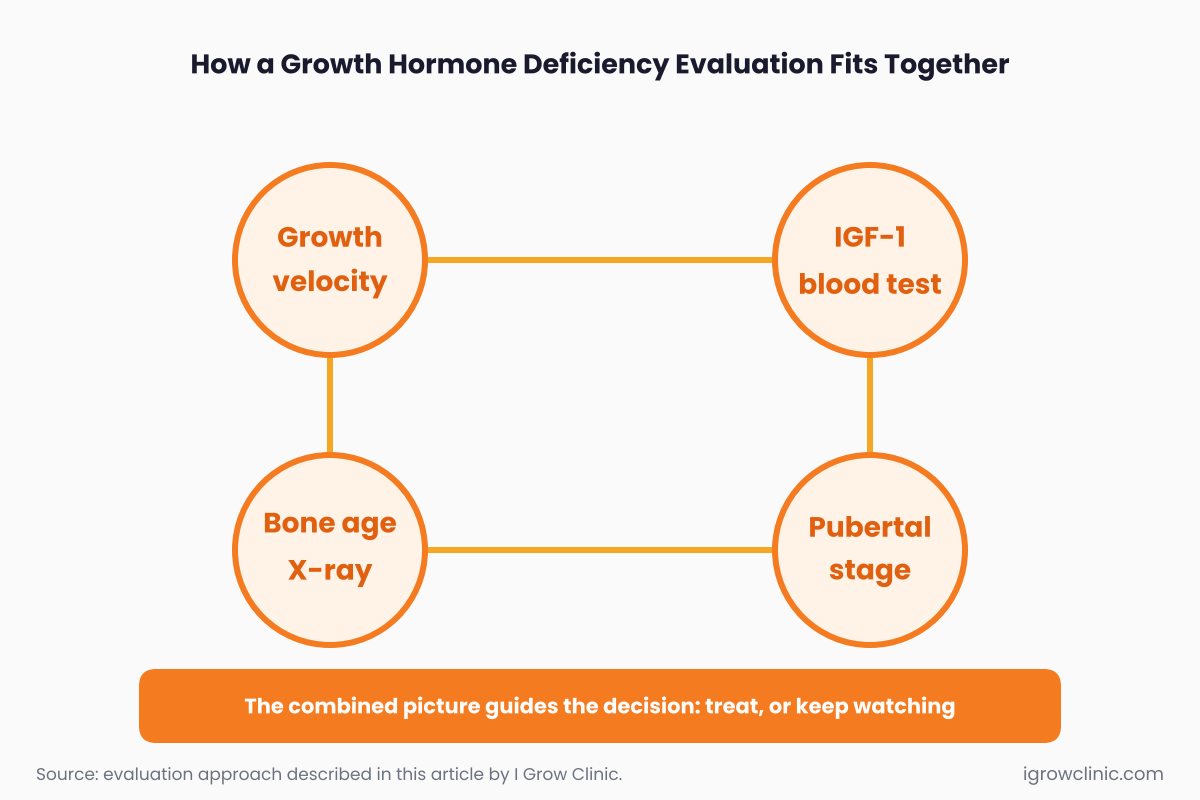
Testing for growth hormone deficiency isn’t a single yes or no test. It’s more like assembling a puzzle from several pieces. None of those pieces is decisive on its own.
The starting point is usually an IGF-1 blood test. Growth hormone itself rises and falls throughout the day in short pulses, so a single growth hormone blood draw is nearly useless on its own. IGF-1 is the hormone that growth hormone triggers the liver to produce. It stays far steadier in the blood. That steadiness is what makes the IGF-1 test a more useful screening tool. Low IGF-1 symptoms often show up simply as slow growth, with no other obvious complaint.
The problem is that normal growth hormone levels by age shift constantly. This is especially true around puberty, when the normal IGF-1 range changes a great deal. A child’s IGF-1 result has to be read against their bone age and pubertal stage. It can’t just be read against their calendar age.
When IGF-1 and growth velocity both point toward a problem, the next step is usually a stimulation test. A pediatric growth hormone stimulation test uses medication, often arginine or clonidine, to stimulate the pituitary gland. Doctors then measure how much growth hormone it releases in response. It sounds definitive. In practice, its accuracy and reproducibility are limited.
Here’s why. The cutoff used to call a result abnormal varies by lab and by the specific medication used. A healthy child can fail a single stimulation test and still have a perfectly normal pituitary gland. That’s why guidelines call for two abnormal tests before a result is treated as reliable. Excess body weight can also blunt the result. And a child close to puberty can test low simply because puberty hasn’t kicked the system into gear yet. The same test, repeated, can look different.
This is exactly why so many families end up with a result that reads as borderline rather than clearly positive or clearly normal. It’s a known limitation of the test itself.
🔍 For help with growth hormone test results interpretation for your child, read: IGF-1 Levels and Height Growth: What Your Child’s Blood Test Results Actually Mean
Bone age adds another layer of useful information. A simple, low dose X-ray of the left hand and wrist shows how mature your child’s growth plates are. That maturity gets compared to their calendar age. A child whose bone age is noticeably behind their actual age tells a story on its own. Combined with slow growth and a borderline stimulation test, it paints a far more complete picture than any single result could.
🔍 To understand exactly what a bone age X-ray shows and how it’s read, read: Growth Plate X-Ray Interpretation
The takeaway is this: a growth hormone deficiency diagnosis never rests on a single number, test, or scan. Growth velocity, IGF-1, bone age, and pubertal stage are read together. That combined picture is what guides the decision to treat or keep watching. One isolated result never should.
What If My Child Has No Clear Diagnosis, or Insurance Says No?
Most parents who search for growth hormone deficiency symptoms in children don’t have a diagnosis. They have a child who seems to be falling behind, and maybe one borderline lab result. Most articles skip this situation, but it’s often the one parents need help with most.
Here’s what’s worth knowing. Most short children who go through a full evaluation do not have growth hormone deficiency. Far more often, they are healthy children with idiopathic short stature, a family height pattern, or a late bloomer timeline. That doesn’t mean nothing can be done. It means the question shifts from “Is something wrong?” to “How much growing time does my child have left, and is it enough?”
Insurance adds another layer. Insurers tend to approve growth hormone therapy only for children who meet strict criteria. One or two clearly abnormal stimulation tests. Height below a specific percentile. A confirmed underlying medical condition. A healthy child who is simply short, or a child with one borderline result, usually doesn’t check every box. The insurance pathway isn’t the only pathway, though.
At I Grow Clinic, our focus is children who are healthy but short. Decisions about growth hormone treatment are built around the whole picture, not an insurance checklist. A child with slow growth velocity and a bone age running behind can be a reasonable candidate for therapy, whether or not a deficiency is ever confirmed on paper. If the workup points toward a true deficiency or another medical cause, we tell you plainly and help coordinate the right next step.
Families who choose this path use the same medication insured families receive as treatment for GHD, and you can see what that progress has looked like for real children in our before and after results. What differs is how they access it. A manufacturer self pay program can bring the monthly cost into a manageable range.
🔍 For the full breakdown of self pay pricing and why insurance so often says no, read: Growth Hormone Cost and Insurance Coverage
Families don’t need to live near Fullerton to start this process. Through our telehealth program, families in California, New York, Washington, Florida, and Texas can begin from home. The bone age X-ray happens at a local imaging center. The rest of the evaluation happens virtually, with the same physician supervised review as an in person visit.
From One Parent to Another

If you’ve been carrying around a lab result you don’t fully understand, that instinct to keep digging is not overreacting. the same instinct behind the same shoe size since last winter. Those details are data. You were right to pay attention to them.
A lot of parents arrive at our clinic already a little tired. Many have been told to wait and see more than once. You don’t need a confirmed diagnosis to ask for a real evaluation. You just need the questions you already have.
What Happens When You Reach Out to Us
Every case at I Grow Clinic is reviewed by our physician supervised clinical team. We analyze the growth velocity, bone age, and pubertal stage together. We use AI driven bone age analysis to estimate how much growing time your child has left. That combined picture is what shapes our recommendation, whether that’s starting therapy, monitoring for a few more months, or referring out for a different concern.
Because care here is concierge and one on one, we cap new patient onboarding to protect the quality of every review. Consultation openings are limited each week. Families can meet with us in person at our Fullerton, California clinic, or through telehealth in California, New York, Washington, Florida, and Texas.
🔍 To understand why we built the clinic around this kind of whole picture evaluation, read: Why I Started a Growth Hormone Clinic
FAQ: What Parents Ask About Growth Hormone Deficiency Testing and Treatment
1. What is a growth hormone stimulation test, and how reliable is it?
A growth hormone stimulation test gives a child medication to prompt the pituitary gland to release growth hormone. That release is then measured in the blood. The two most common versions are the arginine stim test and the clonidine growth hormone stimulation test. It’s useful information, but it’s known to produce false abnormal results in healthy children. Most clinicians want this test paired with growth velocity and IGF-1 results, often with a second test, before treating any single result as final.
2. What causes growth hormone deficiency in children, and is it genetic?
Most of the time, no cause is found. This is called idiopathic growth hormone deficiency, and it is the most common form in school age children. A genetic cause is identified in a minority of cases, and more often when several pituitary hormones are low rather than growth hormone alone. Growth hormone deficiency can also be acquired, for example after a brain tumor, radiation to the head, a head injury, or an infection. It is uncommon, roughly two to four new cases per 100,000 children a year. Many idiopathic cases are retested once growth is finished, because some children turn out to make normal amounts of growth hormone as young adults.
3. At what age should a child start growth hormone treatment?
There is no fixed starting age, and a confirmed deficiency isn’t required to begin at our clinic. For healthy children who are shorter than their peers, treatment can start once an evaluation shows that growth is falling behind and the growth plates are still open. Starting earlier tends to give a better growth response, because a younger child has more growing time left. That’s why bone age matters as much as calendar age.
4. Can I raise my child’s growth hormone naturally?
Sleep, exercise, and good nutrition all support the body’s normal growth hormone release, and they are worth getting right. Growth hormone is released mostly during deep sleep, and a child who is chronically undernourished or has untreated sleep apnea can grow more slowly. But there is no good evidence that extra sleep, workouts, or foods raise growth hormone or height beyond what a healthy child already makes, and they do not replace treatment in a child who truly has a deficiency. Supplements marketed as growth hormone boosters have no supporting pediatric evidence. For more on this, see Does Sleep Affect Height in Children? and Do Height Gummies Work?
5. How much does growth hormone deficiency treatment cost?
Without insurance coverage, growth hormone therapy at retail pharmacy pricing can run from roughly 2,500 to 10,000 dollars a month. The exact amount depends on the brand and your child’s weight. Families using a manufacturer self pay program, available for certain brands, often pay a small fraction of that amount. Starting treatment earlier, at a lower weight based dose, also tends to cost less.