
“My son has been doing daily injections for months. Someone in our parent group mentioned weekly shots. Should we be asking about switching?”
“I just heard about once-weekly growth hormone. Is it better?
“Are the weekly injections newer and more effective, or is daily still the standard?”
As growth hormone therapy becomes more visible online and in parent communities, more families are hearing about once-weekly long-acting formulations and wondering whether their child is on the right track.
The honest answer is that both daily and weekly growth hormone injections are legitimate, FDA-approved options, and neither is universally superior. The decision depends on your child’s specific diagnosis, their response to treatment, your family’s lifestyle, and what is practically accessible to you. This article will walk you through the real differences so you can have a more informed conversation with your child’s physician.
Meet Yuri Kim, FNP
Hi, I am Yuri Kim, a Nurse Practitioner at I Grow Clinic. Our clinic specializes in growth plate evaluation and growth hormone therapy for children with short stature. Under the supervision of Dr. Choi, our board-certified Medical Director with over 20 years of experience, we have guided nearly 4,000 children through their unique growth journeys. I see the questions parents bring about long acting growth hormone injection every week, and I want to give you a clear, balanced answer grounded in what the research actually shows.
Why Families Trust I Grow Clinic
| Credential | Detail |
|---|---|
| Children guided | Nearly 4,000 with precision growth strategies |
| Treatment retention | 95 percent rate, reflecting exceptional outcomes and family trust |
| Approach | Meticulous 1:1 personalized management using AI driven bone age analysis |
| Medical Director | Board Certified by the American Board of Physical Medicine and Rehabilitation (ABPMR) |
| Experience | 20+ years specializing in Pediatric Growth and Developmental PM&R |
| Reputation | 5 Star Google Rating with numerous testimonials |
| Telehealth | Available in CA, NY, WA, FL, and TX |
By the end of this article, you will understand exactly how daily and weekly growth hormone injections differ, what the clinical evidence says about outcomes, and what questions to ask your physician when deciding which approach is right for your child.
How Do Daily and Weekly Growth Hormone Injections Work Differently in the Body?
Growth hormone is not meant to sit at a constant level in the bloodstream. The body naturally releases it in pulses, with the largest surge occurring during deep sleep in the early hours of the night. This rhythm drives the production of IGF-1, which is the hormone that actually does the work at the bone and tissue level, stimulating the growth plates to produce new bone and increase height.
Daily injections are designed to work with this natural rhythm. A small dose is given each evening, which raises GH levels for several hours before gradually clearing from the body. This keeps IGF-1 levels relatively stable throughout the week, closely approximating what a child’s own pituitary gland would ideally produce.
Weekly long-acting formulations work through a fundamentally different mechanism. They use modified GH molecules that are engineered to release slowly over seven days. Instead of a daily pulse, the child receives one injection per week that produces a peak in IGF-1 levels within the first day or two, followed by a gradual decline before the next dose. This creates what clinicians refer to as a peak-trough IGF-1 curve.
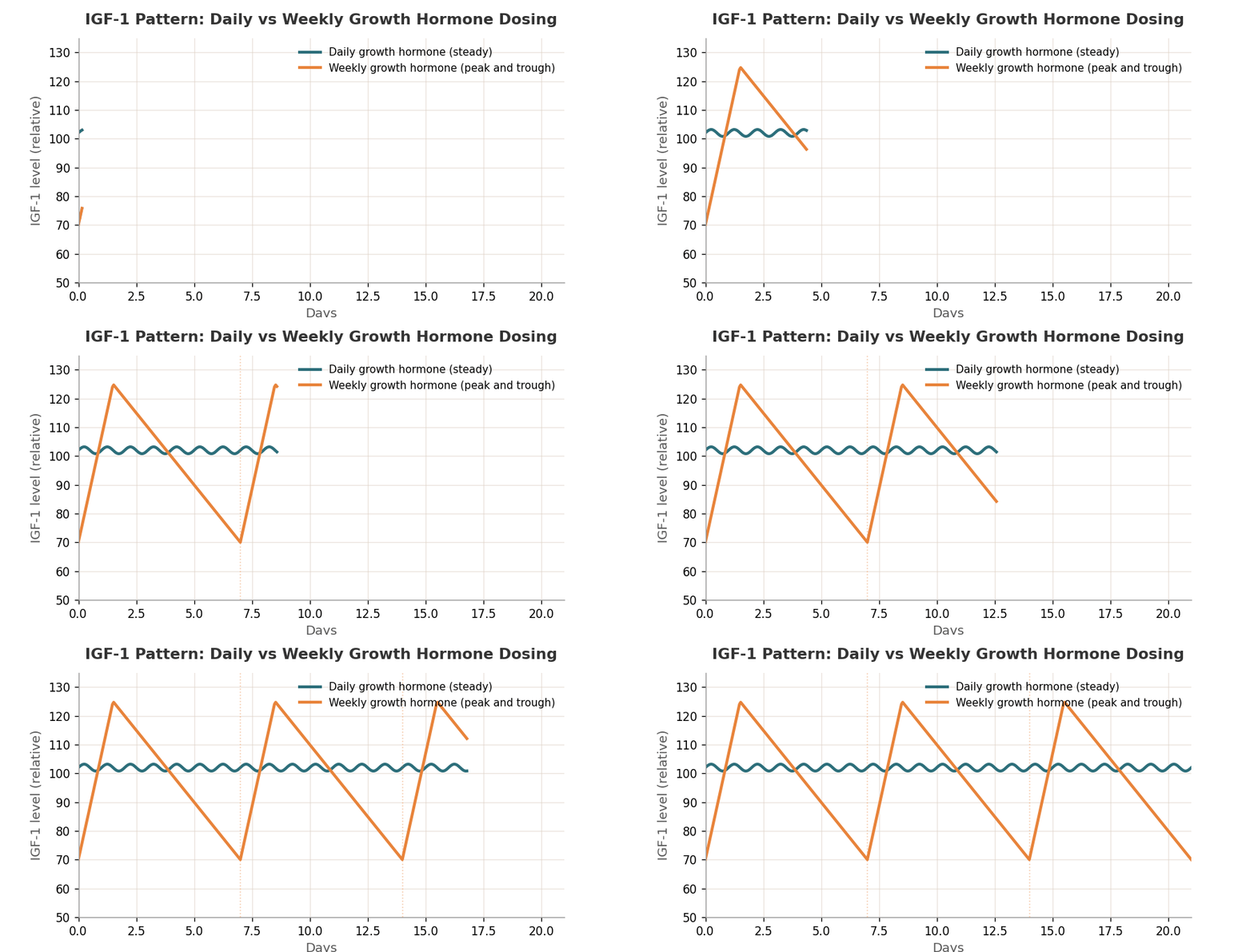
Neither pattern is inherently wrong. Both successfully stimulate the growth plates. But they are genuinely different in how they interact with the body’s hormone system, and that difference matters when it comes to monitoring, dosing adjustments, and individual response.
What Does the Research Actually Show About Height Results?
This is the question most parents want answered first. The straightforward answer is that both approaches produce meaningful height gains, and the differences between them are more modest than the marketing around weekly formulations might suggest.
The Clinical Trial Data
There are currently three FDA approved weekly growth hormone formulations. Lonapegsomatropin, sold as Skytrofa. Somatrogon, sold as Ngenla. And somapacitan, sold as Sogroya. Each has been studied against daily somatropin in randomized trials, and the results genuinely differ by condition.
Several phase 3 trials have compared once-weekly long-acting formulations to daily growth hormone in children with growth hormone deficiency. The consistent finding across these trials is that weekly formulations are noninferior to daily GH, meaning they produce comparable results within an acceptable margin.
In one 12-month trial, lonapegsomatropin achieved an annualized height velocity of 11.2 cm per year compared to 10.3 cm per year for daily somatropin. In another, somatrogon achieved 10.1 cm per year versus 9.78 cm per year for daily. A third trial with somapacitan actually showed a slightly higher velocity in the daily group at 11.7 cm per year versus 11.2 cm per year for the weekly formulation.
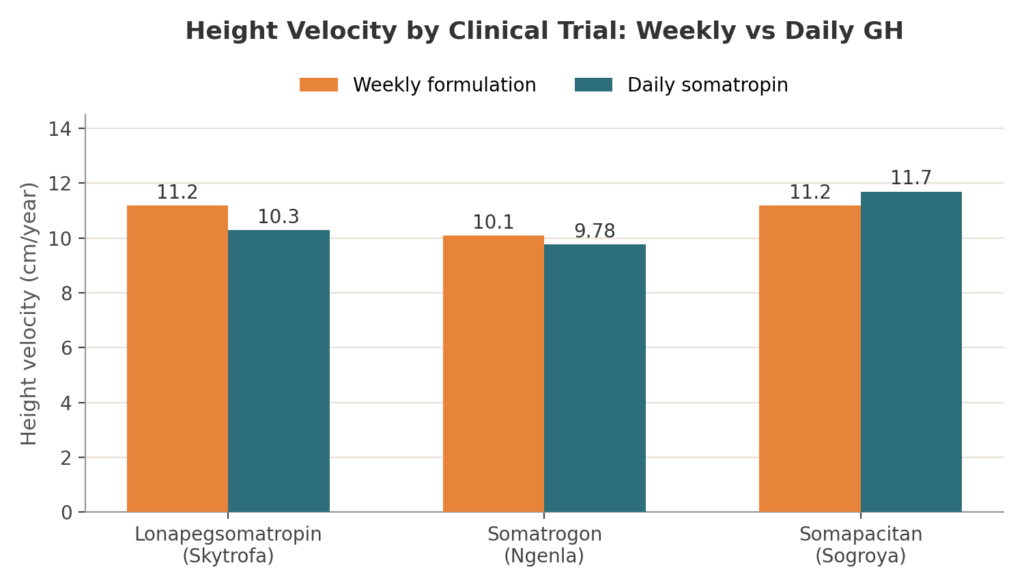
At the 24-month mark, a meta-analysis of 2,549 children found weekly PEG-rhGH showed a modest statistical advantage in height velocity of approximately 0.74 cm per year over daily GH. This is real but small, roughly a quarter of an inch per year difference.
An Important Caveat About the Research
Parents reviewing this data should know that the majority of head-to-head trials comparing weekly to daily growth hormone were conducted or funded by the manufacturers of the weekly formulations. This does not make the data invalid, but it is a meaningful context. Independent meta-analyses, which pool data across multiple studies, paint a more measured picture: the two approaches are largely comparable, with weekly showing a modest advantage in some analyses that should be interpreted alongside that funding context.
The independent evidence does not show that weekly GH dramatically outperforms daily GH. It shows that weekly GH is a viable alternative with a different delivery profile. That is an honest summary of where the science currently stands.
What About Children With Idiopathic Short Stature?
Here is the part that matters most for the families we see. I Grow Clinic focuses specifically on children with idiopathic short stature, meaning healthy children who are simply shorter than their peers without an identifiable hormonal deficiency. That is a meaningfully different population than growth hormone deficiency, and the research reflects that difference clearly.
Most of the strongest clinical trial data for weekly formulations comes from children with confirmed growth hormone deficiency. For children with idiopathic short stature, the evidence base for weekly formulations is smaller. A two-year real-world study in children with idiopathic short stature showed that weekly PEG-rhGH produced greater height velocity than daily GH in both year one and year two, but this is a single study and long-term real-world data on weekly formulations in the ISS population specifically remains limited compared to the decades of data available for daily GH.
🔍 To understand how idiopathic short stature is diagnosed and why it qualifies for treatment, read: Growth Hormone for Height: Does My Child Actually Qualify?
The Real Pros and Cons of Each Approach
Beyond the efficacy numbers, the practical differences between daily and weekly injections matter significantly for real families living with this treatment every day.
The Case for Weekly Injections
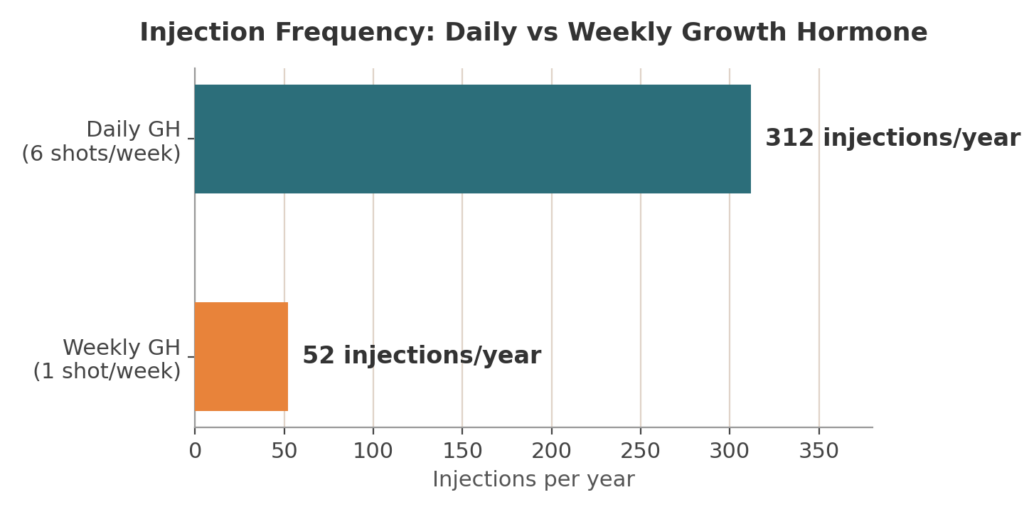
The most compelling argument for weekly formulations is injection burden. Daily GH requires injections 6-7 days a week. Weekly GH requires injection once a week. For children who struggle with needle anxiety, or for families with complex schedules, this reduction is genuinely meaningful.
Some weekly formulations also offer advantages for travel. Certain products are stable at room temperature, which removes the logistical challenge of maintaining refrigeration during vacations, camp, or sports travel.
The Case for Daily Injections
Daily GH has a nearly 50-year safety record in children. The long-term data on its effects on growth plates, puberty timing, metabolic health, and adult outcomes is extensive and well characterized. For weekly formulations, the longest available follow-up data covers only a few years, which means certain long-term questions simply cannot be answered yet.
Daily dosing also allows for finer dose adjustments. Because the child receives a small amount each day, a physician can make precise changes to the protocol based on growth response, lab results, and the child’s changing weight. Weekly formulations involve larger single doses that are harder to titrate with the same granularity.
Injection Site Reactions
Not all weekly formulations behave the same way at the injection site. In clinical trials, one weekly brand showed injection site pain in approximately 39 percent of patients compared to 25 percent for daily somatropin, along with higher rates of injection site swelling and redness. Other weekly formulations showed injection site reaction rates comparable to daily GH. This variability between weekly brands is something families and physicians should discuss specifically, rather than assuming all weekly options carry the same local tolerability profile.
Which Children Qualify for Weekly Formulations?
This is a critical practical point that is often missing from online discussions. Not all weekly formulations are FDA-approved for the same conditions. As of 2026, only one weekly long-acting formulation carries FDA approval for idiopathic short stature in children, while the other weekly options are approved only for confirmed growth hormone deficiency. Children with ISS who are considering weekly formulations have a narrower set of approved options than children with GHD.
Second, accessibility is a practical factor many families do not learn about until they are already deep into treatment. Skytrofa now offers a manufacturer self pay program, but only for growth hormone deficiency, not idiopathic short stature. Ngenla and Sogroya currently have no self pay option at all. Since Sogroya is the only weekly brand approved for ISS, and it is not self pay accessible, families navigating ISS without insurance coverage for growth hormone, which is the situation for the majority of ISS families in the United States, face full retail pharmacy pricing across every weekly formulation available to them. Omnitrope, by contrast, is available through a manufacturer self pay program specifically because it is an established, off patent somatropin molecule, and that accessibility gap can be the difference between starting treatment and not being able to start at all.
🔍 To understand the cost and insurance realities of growth hormone therapy, read: Growth Hormone Cost and Insurance Coverage
Daily vs Weekly Growth Hormone: Side-by-Side Comparison
| Daily GH Injections | Weekly (Long-Acting) GH Injections | |
| Injection frequency | 6-7 days/week injection | 1 day/week injection |
| IGF-1 pattern | Stable, consistent levels throughout the week | Peak shortly after injection, gradual decline before next dose |
| FDA approval for ISS | Yes, multiple brands approved | Only one brand (somapacitan) currently approved for ISS |
| Evidence base | Nearly 50 years of pediatric safety and efficacy data | Approved since 2021 to 2023, long-term data still accumulating |
| Self-pay access | Some brands have self-pay program through manufacturer | No manufacturer self-pay programs currently available |
| Insurance requirement | Covered for GHD; ISS often denied | Covered for GHD; ISS coverage very limited |
| Injection site reactions | Generally mild and well tolerated | Varies by brand; some brands show higher reaction rates |
How Families and Physicians Decide Together
After reviewing the evidence, the honest takeaway is that there is no single right answer for every child. Both approaches can support meaningful height gains. Both have legitimate advantages and real limitations.
The families who make the best decisions are the ones who go into the conversation with their physician knowing what questions to ask. Is my child’s diagnosis GHD or ISS, and does that affect which weekly options are even approved for them? What is our family’s realistic tolerance for daily injections over several years? Does our insurance cover weekly formulations, or would we need a self-pay option?
These are answerable questions. And a good physician will walk through each one with you before any protocol is decided. Treatment for short stature is a multi-year commitment, and the injection schedule your family can actually sustain consistently matters as much as which option looks better on paper.
A Personalized Assessment Makes the Difference
At I Grow Clinic, every treatment decision begins with a thorough evaluation of your child’s bone age, growth plate activity, diagnosis, and growth history. We do not apply a one-size-fits-all approach to injection frequency any more than we do to dosing. Whether daily or weekly therapy is discussed, the protocol is built around what is clinically appropriate, practically sustainable, and genuinely aligned with your child’s remaining growth potential.
We offer in-person consultations at our Fullerton, California clinic and telehealth evaluations for families in California, New York, Texas, Florida, and Washington. If you are trying to understand your child’s options and want a data-driven, honest assessment, we would be glad to help.
🔍 To understand why we built this clinic, read: Why I Started a Growth Hormone Clinic
Frequently Asked Questions
1. Is weekly growth hormone better than daily for children?
Neither is universally better. Clinical trials show that weekly long-acting formulations produce comparable height outcomes to daily GH, with some studies showing a modest advantage for weekly at 12 to 24 months. However, most of those trials were sponsored by the manufacturers of weekly products. Independent analyses suggest the two approaches are largely equivalent, with weekly offering a meaningful adherence advantage due to fewer injections.
2. Can my child switch from daily to weekly growth hormone?
In some cases, yes. Switching is a clinical decision that depends on your child’s diagnosis, their current response to daily therapy, insurance coverage, and which weekly formulations are approved for their specific condition. It is not a straightforward swap and should be evaluated with your supervising physician based on your child’s complete clinical picture.
3. Do weekly growth hormone injections hurt more?
It varies by brand. Some weekly formulations have shown higher rates of injection site pain, swelling, and redness in clinical trials compared to daily somatropin. Others have shown tolerability comparable to daily GH. The injection volume with weekly formulations is typically larger, which can affect comfort. Discussing specific brands and their local tolerability profiles with your physician is worthwhile.
4. Why does my child’s IGF-1 result look different after switching to weekly GH?
With weekly long-acting formulations, IGF-1 levels peak shortly after the injection and gradually decline before the next dose. This means the timing of your blood draw significantly affects the result. For accurate monitoring, IGF-1 should be drawn approximately four days after the last injection. Drawing it sooner may give a falsely elevated reading, and drawing it later may give a falsely low one.
🔍 To understand how IGF-1 monitoring works more broadly, read: IGF-1 Levels and Height Growth: What Your Child’s Blood Test Results Actually Mean
5. Is weekly growth hormone available without insurance?
Currently, weekly long acting growth hormone formulations do not have manufacturer self pay programs available for kids with idiopathic short stature. Skytrofa now has a self pay program, but only for growth hormone deficiency, not idiopathic short stature. Ngenla and Sogroya have no self pay option at all. Since Sogroya is the only weekly brand approved for ISS, and it isn’t self pay accessible, ISS families without insurance coverage, which describes the majority in the United States, face full retail pricing across every weekly formulation. Omnitrope, a daily formulation, is the exception, with a manufacturer self pay program that makes treatment accessible for these same families. For families managing treatment costs out of pocket, this is an important practical consideration when evaluating options with your physician.