

“Is Norditropin better than Omnitrope?
“Does Genotropin work faster than other brands?”
“Will switching brands mid treatment hurt my child’s progress?”
Parents ask us these questions almost every week at I Grow Clinic.
If your child has just started growth hormone therapy, or you are still weighing the decision, you have probably noticed something. There is more than one brand of growth hormone on the market, and every pharmacy, insurance plan, and online forum seems to have a different opinion about which one is “best.” These questions come up constantly when families are comparing growth hormone treatment for kids and trying to choose among the available hgh brands.
Here is the evidence based answer, drawn from FDA data and the clinical trials behind each brand.
Since growth hormone for height is the reason most families start treatment in the first place, it helps to know upfront that the molecule matters far more than the label on the box.
Are All Growth Hormone Brands the Same? Yes, and Here Is the Proof.
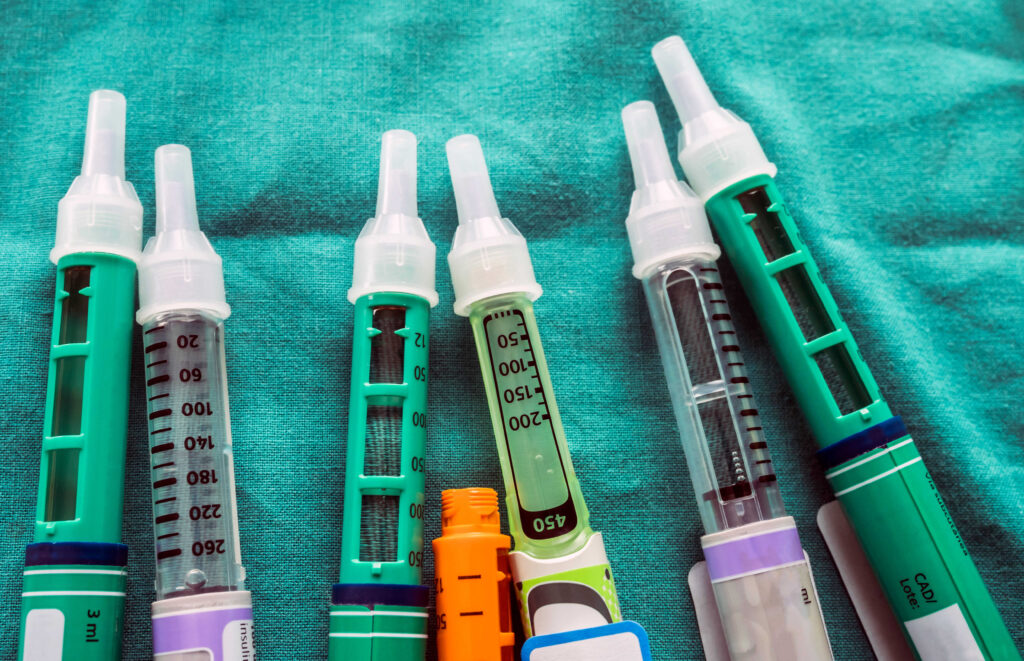
Every FDA approved somatropin product, whether Genotropin, Norditropin, Humatrope, Omnitrope, or Zomacton, delivers the exact same 191 amino acid recombinant human growth hormone molecule. This is not a marketing simplification. It is a pharmacological fact confirmed across decades of comparative research.
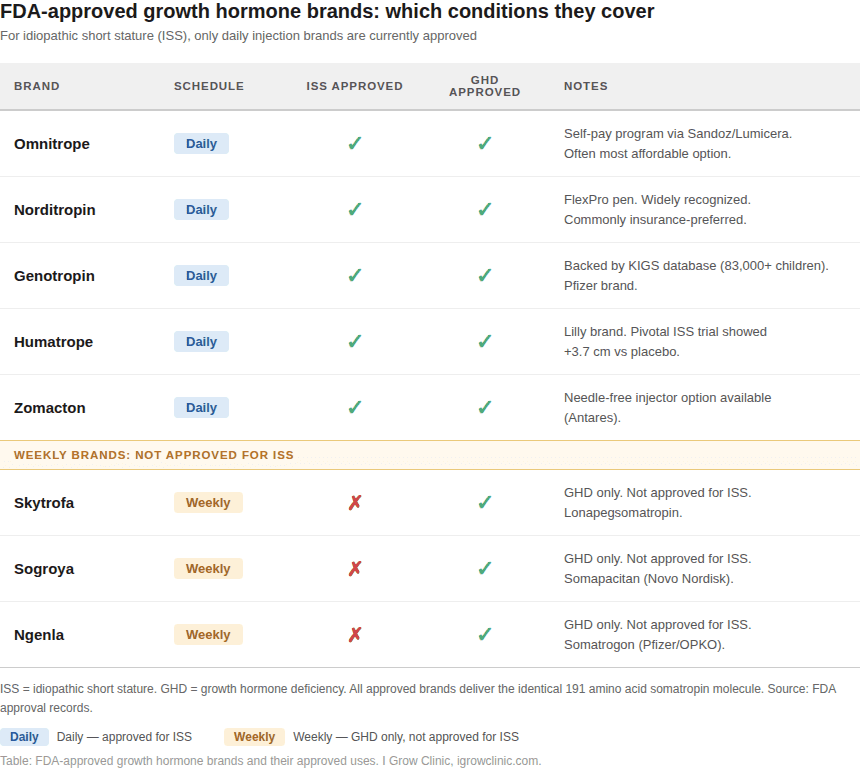
For idiopathic short stature specifically, which is the diagnosis for most of the healthy short children we treat at I Grow Clinic, five brands carry an FDA approved indication: Humatrope, Norditropin, Genotropin, Omnitrope, and Zomacton. There are no head to head trials pitting these daily brands directly against each other in ISS, because each brand’s approval was built on its own independent trial. But the results tell a consistent story. If you are wondering whether your child qualifies, our growth plate evaluation is where every assessment begins. (https://igrowclinic.com/services/growth-plate-evaluation/)
🔍 If you are wondering whether your own child would even qualify for treatment, our guide on Growth Hormone for Height: Does My Child Actually Qualify? walks through the criteria in detail.
Humatrope’s pivotal trial showed a height gain of roughly 3.7 cm above placebo. Norditropin’s dose response study in prepubertal children confirmed a clear dose dependent improvement in height. Genotropin’s 4 year trial, and the massive KIGS database of over 83,000 children, showed comparable height gains regardless of dosing approach. Omnitrope demonstrated matching growth effects in its own clinical development program. Different trials, different populations, same underlying conclusion: children respond to the hormone itself, not to the label.
What Studies Show When Children Switch Growth Hormone Brands
Omnitrope went through some of the most rigorous comparative testing of any growth hormone brand on the market. Two Phase 1 randomized studies confirmed its pharmacokinetic profile matched Genotropin’s within standard equivalence ranges. A follow up study confirmed the same equivalence for the ready to use liquid formulation.
A ten year review of Omnitrope’s real world use, published in Drug Design, Development and Therapy, reaffirmed its efficacy across every approved indication and found no clinically meaningful differences in children who switched to it from other growth hormone brands. Separately, a clinical trial of children switching from Genotropin to another growth hormone brand found no drop in efficacy, safety, or immune response over six months. This is the kind of evidence that matters most to parents worried about switching brands mid treatment: it has been studied directly, and the outcomes hold steady.
This evidence base is also why the American Academy of Pediatrics, in its 2026 policy statement on prescribing in children, supports pediatricians confidently substituting an equivalent product of the same formulation and dose when appropriate.
Daily vs. Weekly Growth Hormone: Which Brands Are Approved for Short Stature?
One detail parents often miss when comparing brands online is that not every growth hormone product is approved for the same use. The newer once weekly formulations, Skytrofa, Sogroya, and Ngenla, are currently FDA approved only for growth hormone deficiency. They do not carry an approval for idiopathic short stature, which is the diagnosis for most healthy short children.
🔍 We break down how the daily and weekly options actually compare, in Weekly vs Daily Growth Hormone Injections: Which Is Right for Your Child?.
This means that if your child is being treated for ISS rather than a diagnosed hormone deficiency, the conversation is really about which daily brand fits your family, not whether to choose a daily or weekly option. Research on weekly, longer acting formulations in ISS is still emerging outside the US, and while some data suggests comparable or slightly better height outcomes with better adherence, this has not yet translated into FDA approval for ISS in daily practice here.
What Predicts How Much My Child Will Grow on Treatment
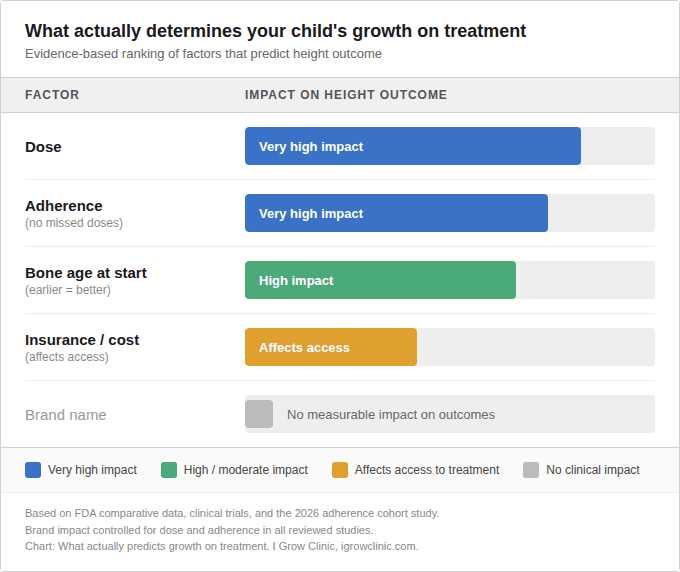
If brand is not the deciding factor, what is? The clinical literature is consistent on this point.
Dose matters more than brand. Higher doses within the approved range tend to produce a greater growth response, which is why your treatment plan should be individualized and reassessed regularly rather than fixed at a standard number.
Adherence matters more than brand. A 2026 cohort study found that missed injections were the single strongest predictor of a suboptimal growth response. A child who takes their prescribed brand every night will consistently outgrow a child on any other brand who skips doses. This is exactly why we spend so much time with families on device comfort and nightly routine, not brand loyalty.
Age at initiation matters more than brand. Earlier treatment is consistently associated with better height outcomes, since more growing years remain before the growth plates close.
If your child is still in an active growth window, every month matters. See how our telehealth consultations work for families in California, Texas, Washington, Florida, and New York.
Cost and insurance coverage often decide the brand for you. Annual growth hormone therapy can exceed $25,000, and reimbursement varies significantly by payer. In practice, formulary preference is frequently the real reason one brand is chosen over another, which is precisely why a lower cost, clinically equivalent option like Omnitrope is often the right choice rather than a compromise.
Why Insurance Coverage Affects Which Brand Your Child Receives
Coverage for growth hormone treatment for kids varies significantly by insurer, diagnosis, and which brand a plan classifies as preferred. Many parents come to us asking a simpler question first: if their child is noticeably short, won’t insurance just cover it? In reality, insurers look at far more than how short a child is. Before authorizing a specific brand, they require an extensive workup by a pediatric endocrinologist, including growth velocity tracked over time, bone age imaging, lab work, and the exact diagnostic code on the claim. Every part of that workup exists to prove medical necessity, and the burden of proof falls on the family and the physician, not the insurer. For children with idiopathic short stature specifically, denial is common even when every clinical box is checked, since most insurers reserve approval for confirmed growth hormone deficiency or a short list of qualifying syndromes. This is exactly the gap I Grow Clinic was built to close. We work every day with families whose healthy but shorter child does not meet an insurer’s narrow definition of medical necessity. When that happens, we help them access our growth hormone treatment program through a self pay path instead.
🔍 For a full breakdown of what insurance typically approves, what it typically denies, and what self pay options look like in practice, see Growth Hormone Cost and Insurance Coverage: What U.S. Parents Need to Know.
Can You Switch Brands Mid Treatment?
In most cases, yes. Since the active hormone is the same and switching studies have shown no meaningful impact on growth outcomes, safety, or immune response, moving from one somatropin brand to another does not reset your child’s progress. Your prescribing physician should always confirm the dose translates correctly and walk your family through the new device. If you are curious what consistent treatment looks like over time, you can browse before and after results from real families we have worked with at I Grow Clinic.
The Bottom Line
The strongest evidence available, from FDA approval data, comparative trials, switching studies, and the American Academy of Pediatrics itself, points to the same conclusion. Brand name is not what drives your child’s growth. Dose, consistency, and how early treatment begins are what matter, and a more affordable brand is very often the smartest clinical choice rather than a lesser one.
If you still have questions about your child’s growth, or what a realistic treatment path might look like for your family, our team at I Grow Clinic is happy to talk it through. Reach out for a personalized evaluation, whether in person in Fullerton or by telehealth if you are in California, Texas, Washington, Florida, or New York.
🔍 You can also read the story of why our clinic exists in Why I Started a Growth Hormone Clinic.
FAQ: Frequently Asked Questions: Growth Hormone Brands for Children
Does insurance ever cover growth hormone therapy for idiopathic short stature?
It can, but coverage for ISS is far less consistent than for confirmed growth hormone deficiency. Many plans deny ISS claims outright or require extensive documentation, appeals, and specific diagnostic codes before approving a brand.
Does a more expensive growth hormone brand work better than an affordable one?
No. Every FDA approved somatropin brand delivers the same 191 amino acid molecule, so a higher price does not mean a stronger growth effect. Price differences usually come down to the delivery device, packaging, or manufacturer, not the hormone itself.
Does the injection device differ between growth hormone brands?
Yes. Each brand uses its own pen or cartridge system, with differences in size, dosing dial, and ease of use.
Is a self pay program the same as paying full retail price?
No. Self pay programs are typically arranged directly through the manufacturer at a reduced rate through a contracted specialty pharmacy, which is very different from paying the standard retail price at a pharmacy counter.
Does choosing a self pay brand affect treatment quality?
No. Every FDA approved somatropin brand delivers the same 191 amino acid molecule. Choosing a brand based on cost or self pay access does not change the hormone your child receives or the growth response it can produce.