

“I found a small hard lump under her nipple while helping her change. She just turned eight. Is that even puberty?”
“My daughter is twelve and hasn’t started developing at all, what should I look for?”
“Her friends keep getting taller and she’s still the shortest in her class. Will puberty help her catch up?”
Behind each of these is the same uncertainty. It is not knowing which change comes first, which one matters, and whether the timing is normal for your own daughter and her height.
I am Dr. Choi, founder of I Grow Clinic. I hear versions of these questions almost every week, often from parents whose daughters are already among the shortest in their class. For those girls, when puberty starts shapes how much growing time is left. The order and pace of these changes differ from girl to girl, and that is exactly why the start date matters.
Why Families Trust I Grow Clinic
| Credential | Detail |
|---|---|
| Children guided | Over 4,000 with precision growth strategies |
| Treatment retention | 95% rate, reflecting strong family trust |
| Approach | Personalized bone age analysis supported by artificial intelligence |
| Medical Director | Board certified by the American Board of Physical Medicine and Rehabilitation |
| Experience | Clinical team with over 20 years of experience in Pediatric Growth and Developmental PM&R |
| Reputation | 5 star Google rating with many family testimonials |
| Telehealth | Available in California, New York, Washington, Florida, and Texas |
For most girls, breast budding comes first, and when it starts tells you more than the sign itself. Below is what is typical, what counts as early or late, and what to track at home once it begins.
The First Sign of Puberty in a Female Is Usually Breast Development
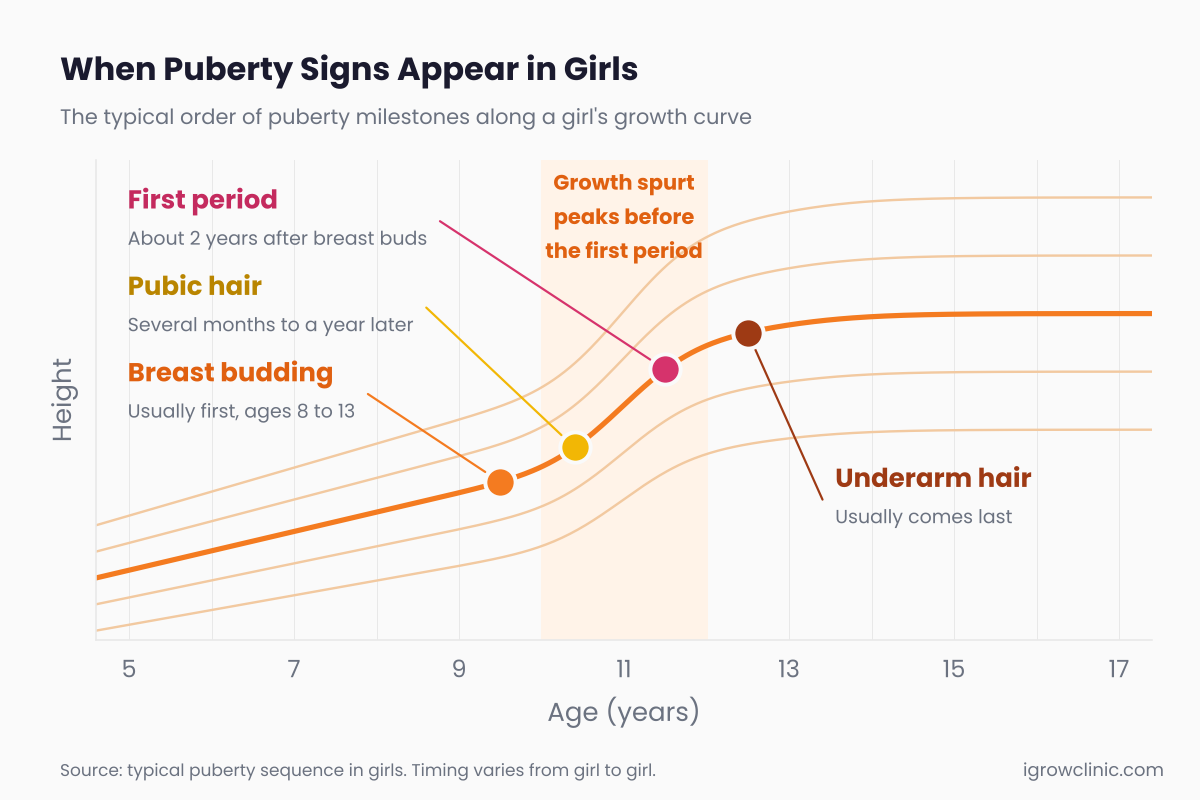
For most girls, the first sign of puberty is breast budding, called thelarche in clinical terms. It usually appears several months to a year before pubic hair. In the United States, it most often starts between ages 8 and 13, with an average of around 9 to 10.
Breast budding shows up as a small, firm lump just under one or both nipples. It can appear on one side weeks before the other. Tenderness under the nipple is common when the bud first appears. It usually eases as the bud grows larger.
The typical order looks like this. Breast buds come first, and pubic hair follows within several months to a year. Next, the growth spurt picks up. The first period usually arrives about a year after that, roughly two years after the first breast bud appeared. Underarm hair typically comes last, after the first period.
Not every girl follows that order exactly. Some show pubic hair before a breast bud, and some notice underarm hair or body odor early on. A small difference in which sign appears first is not, by itself, a reason for concern. What matters more is when the changes begin and how her height responds once they do.
🔍 For the full breakdown of the Tanner stages girls move through, including breast Tanner staging, read: Tanner Stages of Puberty
How Can I Track My Daughter’s Growth Once Puberty Starts?

Once you notice a breast bud, you have a rare piece of information most parents never get: a start date. That single data point lets you track something a yearly checkup usually misses, which is how fast your daughter is growing in the months that follow.
Measure her height once a month. Use the same spot against the wall, and the same time of day if you can. Mornings tend to be most consistent, since children settle slightly by evening. Write down the number and the date every time, even if the change looks small.
The growth spurt that follows breast budding usually does not announce itself. It builds over several months before it shows up in clothes or shoe size. A monthly height log is often the only way to catch the moment it starts, rather than noticing it after several inches have already come and gone.
🔍 To learn how to tell a real growth spurt from a pattern that needs a closer look, read: Is My Daughter Having a Growth Spurt? 5 Signs, and the One That Means Something Else
This is a small habit. But it gives you, and later her doctor, real numbers to look at instead of a guess about how fast things are moving.
Is My Daughter’s Puberty Starting Too Early or Too Late?
Doctors consider puberty early, called precocious puberty, when breast changes begin before age 8. Most parents who notice this are already worried, and that instinct deserves attention. A girl who starts early often grows faster than her classmates at first, so she can look like she is ahead. But her growth plates also mature and close sooner. Girls whose puberty starts early often end up shorter as adults than they otherwise would have. Early breast development is not an emergency, but it is a reason to have her growth checked now rather than waiting to see how things unfold.
On the other end, doctors generally consider puberty delayed if there is no breast budding by age 13, or no first period by age 15. A late start usually means her growth window opens later, not that it is smaller. It is still worth a growth check, to confirm that nothing else is slowing things down.
🔍 To understand what happens to height in the years after her first period, read: When Do Girls Stop Growing?
When Should My Daughter Get a Growth Check?
A growth check is worth scheduling if any of these describe your daughter:
- Breast budding or pubic hair starts before age 8
- No breast budding at all by age 13
- No first period by age 15
- She grows less than about 2 inches a year before puberty begins
- Her height is dropping across percentile lines, or she is much shorter than her classmates and than your family pattern
A growth plate evaluation, including a bone age X-ray, can show how much of her growth window is still open and how that compares to a typical timeline for her age. Our team reads that X-ray alongside her growth pattern, rather than guessing from age alone.
🔍 To understand exactly how early timing affects final height, read: Does Early Puberty Affect Height?
Whether your daughter’s puberty looks early, late, or right on schedule, you do not have to work it out from a single lump or a guess. If her timing does call for more than watching, our growth hormone treatment program is built around the growing time she still has, and these answers to common questions about growth hormone explain how it works.
FAQ: What Parents Ask About the First Signs of Puberty in Girls
1. How do I know if my daughter has started puberty?
Look for a small, firm lump under one or both nipples. That is breast budding, the usual first sign of puberty in a girl. Pubic hair and a faster growth rate typically follow. Body odor or oily skin can appear early too, but on their own they are less often the true starting point.
2. What age does puberty end for girls?
Most girls reach their final height and complete the main stages of puberty by around 14 to 16, once periods have been regular for a year or more. A smaller number continue slow, minor changes into their late teens, which is still within a normal range.
3. How long after breast buds does a period start?
On average, a first period arrives about two years after breast budding begins. This varies by several months in either direction from girl to girl. The growth spurt usually peaks before the first period, not after.
4. Is a breast bud in a 7 year old normal?
Breast budding before age 8 is considered early puberty. A breast bud in a 7 year old is not an emergency, but it is a reason for a growth check that includes a bone age X-ray. Bone age shows whether her skeleton is maturing faster than her calendar age.
5. Will my daughter still grow taller if her puberty starts late?
She can. A later start usually shifts the whole timeline back rather than shrinking it. Growth after menarche typically adds another 1 to 3 inches over the following 1 to 1.5 years.