

“I typed our two heights into one of those online calculators, and it gave me a range that was almost eight inches wide. That’s not an answer. That’s a shrug.”
“My daughter is in the 15th percentile and my husband is six foot two. The calculator told me she would land somewhere around average. I genuinely don’t know what to do with that.”
“Nobody ever explains what actually decides it, or why my son’s number keeps changing every time I plug it in again.”
I’m Jenny Diep, a board-certified family nurse practitioner at I Grow Clinic. Parents bring me screenshots of these calculators several times a week. This post walks through what that calculator can actually tell you, why it drifts off course for a specific child more often than most parents realize, and what a real height prediction requires when you want something more solid to stand on than an app.
Why Families Trust I Grow Clinic
| Credential | Detail |
|---|---|
| Children guided | Nearly 4,000 with precision growth strategies |
| Treatment retention | 95% rate, reflecting exceptional outcomes and family trust |
| Approach | Meticulous 1:1 personalized management using AI-driven bone age analysis |
| Board certification | ABPMR board certified |
| Clinical experience | Over 20 years of clinical experience |
| Reputation | 5-Star Google rating with numerous testimonials |
| Telehealth | Available in California, New York, Washington, Florida, and Texas |
By the end of this article, you will understand exactly what an online height calculator can and cannot tell you, which situations make that number unreliable for a specific child, and what a bone age based evaluation actually adds when a family wants a prediction they can trust more than a guess.
What Does an Online Heights Calculator Actually Tell You?
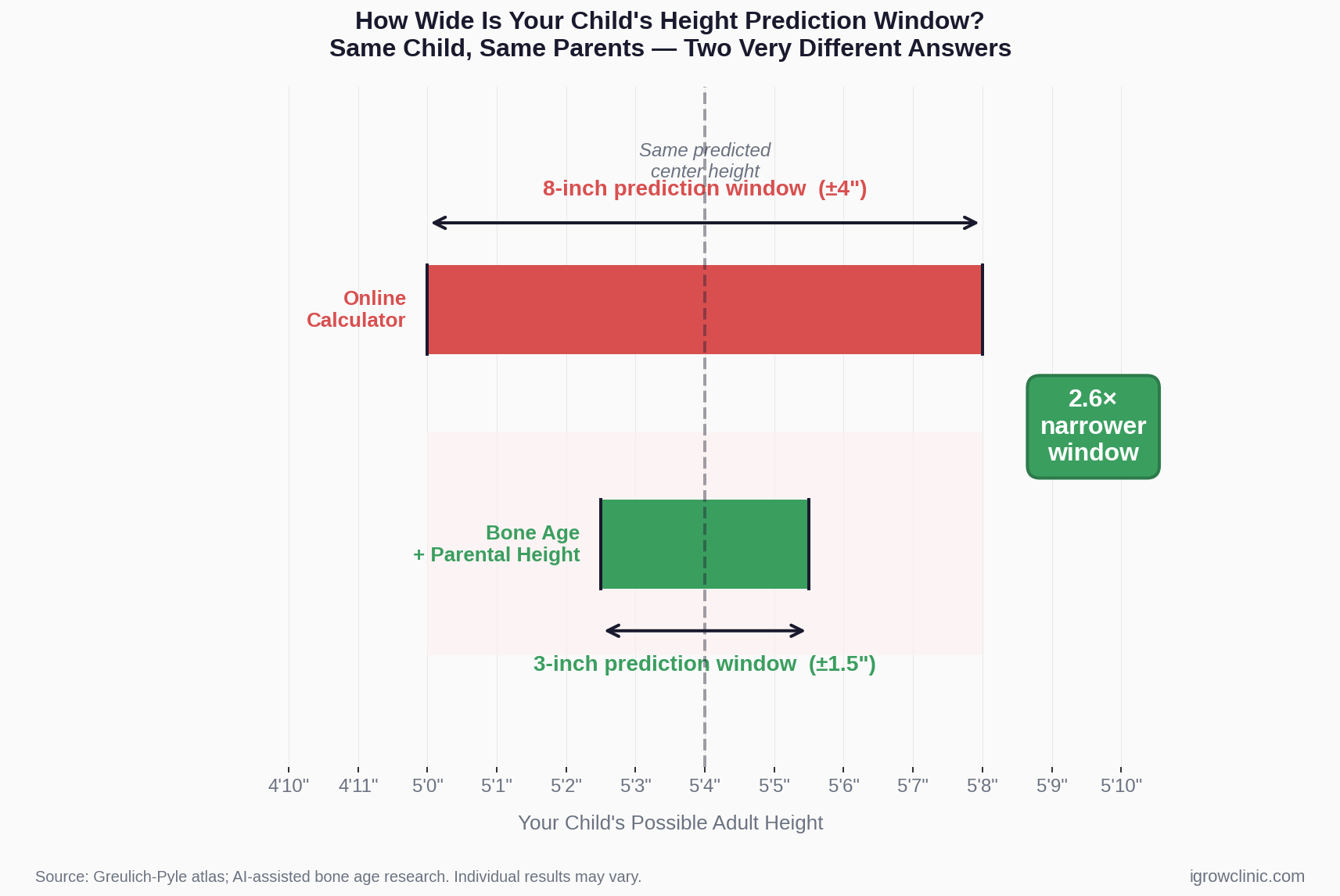
The formula behind nearly every child height predictor and height calculator child app online is the same one pediatricians have used for decades. Add the mother’s and father’s heights, adjust for the child’s sex, and divide. It produces what is technically called mid-parental or target height, and it is a genuinely useful number for one specific purpose. It estimates a child’s genetic potential based on their parents’ heights.
What it cannot do is tell you where your specific child will land. In large tracking studies, about 90 percent of children landed within 4 inches of their mid-parental estimate, meaning one in ten fell outside even that wide a range. The formula also breaks down at the extremes. If you or your partner is unusually tall or short, your child’s actual height tends to drift back toward average, a pattern called regression to the mean.
How to Calculate Mid-Parental Height
Here is the standard formula, in inches.
- Boys: (father’s height + mother’s height + 5) ÷ 2
- Girls: (father’s height + mother’s height − 5) ÷ 2
For example, take a father who is 70 inches and a mother who is 64 inches. A son’s target is (70 + 64 + 5) ÷ 2 = 69.5 inches. A daughter’s target is (70 + 64 − 5) ÷ 2 = 64.5 inches.
In centimeters, add or subtract 13 instead of 5.
This is a target, not a prediction. Most children land within about 4 inches of it. A bone age X-ray is what narrows that range.
Why Is That Number Often Wrong for Your Specific Child?
The calculator makes a quiet assumption it never states out loud: that your child will go through puberty at an average age with a skeleton maturing at an average pace. When that holds, the estimate lands close. When it doesn’t, the number can be off in a specific, predictable direction.
A child with constitutional delay has a skeleton maturing more slowly than their calendar age suggests. Their growth plates stay open longer, giving them more time to grow even when their current height looks worrying on paper. The calculator cannot see this, so it tends to undersell a late bloomer’s eventual height.
The opposite happens with early puberty. A child whose bone age is running ahead of their calendar age will reach growth plate closure sooner than the calculator assumes, which can overestimate their eventual height by a meaningful margin. Children carrying extra weight often follow a similar pattern, since higher body fat can accelerate bone maturation and pull puberty earlier.
🔍 If your child’s puberty seems to be arriving earlier than you expected, this companion post walks through how that specifically affects final height: Does Early Puberty Affect Height?
This is really the answer to how tall will my son be or how tall will my daughter be as a genuinely individual question rather than a household math problem. The calculator treats every child in a family the same way. Puberty timing and bone maturity do not.
How Tall Will My Daughter Be? Why Her First Period Changes the Math
Girls are usually further along than parents expect by the time a first period arrives. The fastest part of the growth spurt tends to come before it, which is why a daughter who gets her period early and one who gets it late can have very different amounts of height left to gain. The online calculator ignores all of this. It treats a girl who has not started puberty and a girl who is already well past her first period as the same child, as long as they share an age and a pair of parents.
A bone age X-ray is what shows how much growing is actually left for your daughter, which is why it answers the question the calculator can only guess at. If she has already had her period, we walk through what that means for her remaining growth in When Do Girls Stop Growing?
How Tall Will My Son Be? Why Predictions Move the Most During the Teen Years
Boys usually start puberty later than girls, and their growth spurt arrives later and runs bigger. That means a prediction made for a son before his spurt has begun, or while he is in the middle of it, is the least stable one a family can get. The number can shift noticeably from one year to the next, which is exactly what it feels like to plug his height into a calculator and see a different answer every time.
Bone age tells you whether your son’s skeleton is running ahead, behind, or on schedule compared with his calendar age, and that is what decides how much time he has left. If your son is already in his mid-teens, see How Much Do Boys Grow After 16? for what his growth plates can reveal.
What Does a Real Height Prediction Require?

A real prediction starts with the one piece of information the calculator never has: how mature your child’s skeleton is. That comes from a bone age X-ray, a quick, low-dose image of the left hand and wrist that shows how far along the growth plates are compared to a reference standard.
When bone age is combined with current height and parental height, the resulting prediction narrows considerably. AI-assisted bone age reading paired with parental height brings the typical error down to roughly 1 to 1.5 inches. That is a meaningfully tighter number, though still a range, not a guaranteed inch mark. A prediction within an inch or two is far more useful to plan around than a wide, open-ended estimate with variation of up to 4 inches in either direction.
🔍 To understand exactly what a bone age reading shows and how it compares to your child’s calendar age, read: Bone Age vs. Chronological Age: Is Your Child’s Biological Clock Ticking Too Fast?
This is also why a single visit, even a very thorough one, is never quite as informative as tracking over time. One bone age reading tells you where your child stands today. A second reading six to twelve months later tells you how fast they are moving through that window, which is often the more useful piece of information. At I Grow Clinic, our AI-driven bone age analysis compares each film against thousands of reference data points, and we pair that with a formal bone age evaluation and follow-up tracking rather than a single number handed over once and never revisited.
🔍 If you want to see exactly how a bone age report is read and what the terminology on it actually means, read: Growth Plate X-Ray Interpretation: What Your Child’s Bone Age Report Actually Means
Families outside Southern California can go through this same evaluation through our telehealth program, which serves families in California, New York, Washington, Florida, and Texas, with the bone age film taken at a local imaging center and reviewed by our team remotely.
Wanting a Real Answer Is Not Overthinking It
A bone age X-ray does not require assuming something is wrong. It just adds the one piece of information a calculator was never designed to have.
Every case at I Grow Clinic is reviewed by our physician-supervised clinical team using AI-driven bone age analysis, personalized to each child rather than applied as a single formula across all patients. Because our care is concierge and personally supervised, new patient openings are limited each week. Families can work with us in person at our Fullerton clinic or through telehealth in California, New York, Washington, Florida, and Texas.
🔍 To read more about why we built our clinic around exactly this kind of clarity, read: Why I Started a Growth Hormone Clinic
FAQ: What Parents Ask About Predicting Their Child’s Adult Height
1. Is the online height calculator for children ever actually right?
It can be a reasonable starting estimate of your child’s genetic potential, since about 90 percent of children land within roughly 4 inches of their calculated mid-parental height. It is not a precise prediction for one specific child, and it gets less reliable the taller or shorter the parents are.
2. How tall will my daughter be if she’s small for her age right now?
It depends heavily on why she’s small. A child with a delayed bone age often still has plenty of growing left despite a low current height, while a child with an advanced bone age may have less time left than her current height suggests. A bone age X-ray is the only way to tell which situation applies to your daughter specifically.
3. Does a bone age X-ray actually give a more accurate prediction than the parent height formula?
Yes, particularly when the bone age reading is combined with parental height rather than used alone. Studies combining AI-assisted bone age reading with parental height have shown meaningfully tighter accuracy than either the parent-height formula or older manual bone age methods used by themselves.
4. What does “how tall will my child be based on percentile” actually mean?
A percentile tells you where your child stands compared to peers today, but it says nothing about where they will end up. A child who was small throughout childhood can grow into a tall adult, and the tallest kid in 4th grade can walk into their 20-year reunion shorter than average. Percentile is a snapshot, not a forecast. Bone age is what actually lets us look forward, which is why we read the two together. You can check where your child stands today with our free Child Height Percentile Calculator.
5. How tall will my daughter be if she got her period early?
It depends on how much growing she still has ahead, and her first period alone cannot tell you that. A girl whose period came early often has less time left than her current height suggests, but how much less depends on her bone age and how far into puberty she already is. A bone age X-ray is the way to see where she actually stands, and our guide on when girls stop growing covers what her period does and does not mean.
6. How tall will my son be if he is the shortest in his class?
Being the shortest in the class right now does not tell you where he will finish. Some boys are simply early in the timeline of puberty and have a lot of growing ahead of them, while others are on a slower track for other reasons. Bone age is the piece that separates those two situations, which is why we start there instead of relying on his current height or a calculator.