

“I let my son have a boba drink three times a week. Am I doing something wrong?”
“I searched does sugar stunt growth and the answers all said the same vague thing: cut back on sweets. Nobody told me what sugar really does to my child’s growth.”
“My daughter started developing early, and she has always loved sweets. Could that be the reason?”
That particular kind of guilt sits differently than ordinary food worry. It is the fear that a daily habit already changed a number you cannot get back.
I’m Dr. Choi, Medical Director at I Grow Clinic. The sugar question is rarely just about sugar. It is about a parent wondering whether an everyday choice quietly shaped their child’s future. Most of what you find online sounds certain but skips the real mechanism, so let me walk you through both the short answer and the fuller story.
Why Our Answer on Sugar and Growth Carries Weight
| Credential | Detail |
|---|---|
| Children guided | Over 4,000 with precision growth strategies |
| Treatment retention | 95% rate, reflecting exceptional outcomes and family trust |
| Approach | Meticulous 1:1 personalized management using AI driven bone age analysis |
| Medical Director | Board Certified by the American Board of Physical Medicine and Rehabilitation (ABPMR) |
| Experience | Over 20 years of clinical experience |
| Reputation | 5 Star Google Rating with numerous testimonials |
| Telehealth | Available in CA, NY, WA, FL, and TX |
Here is what you will know by the end. Why soda, juice, and boba matter more than sugar itself. And what that shift means for your child’s growth window.
Does Sugar Really Stunt My Child’s Growth?
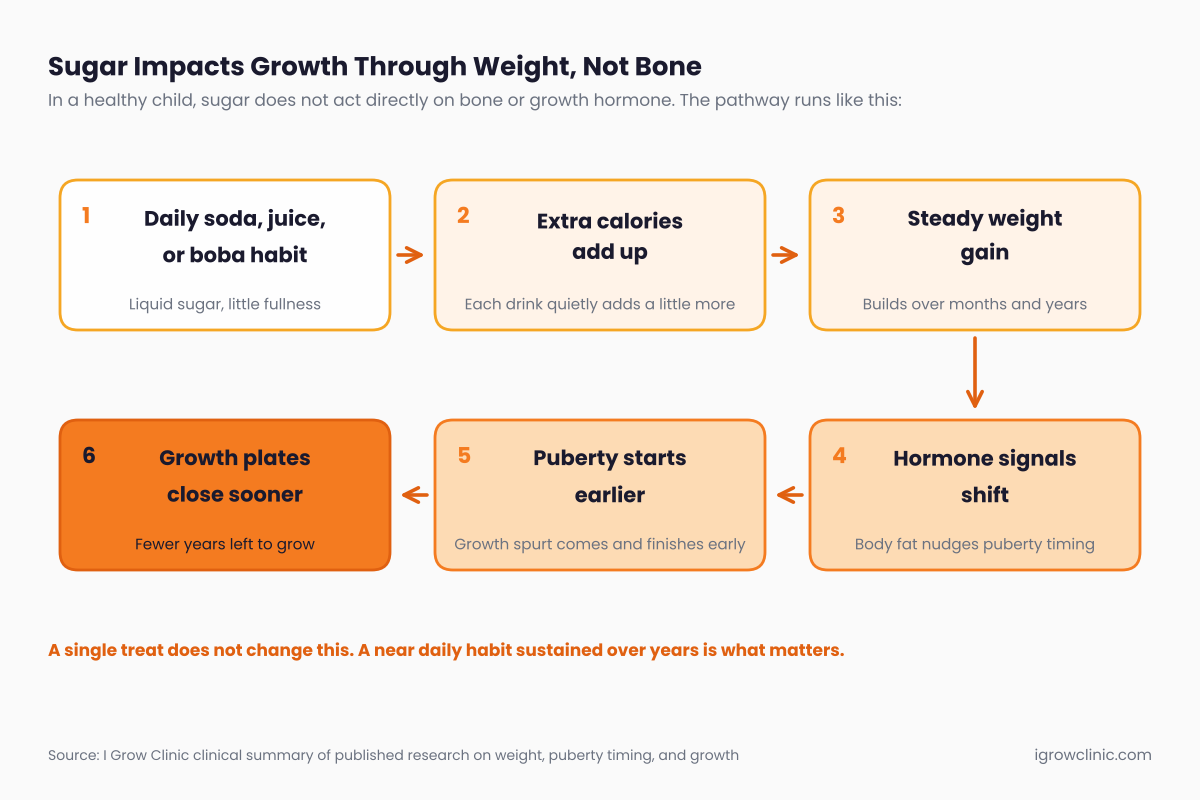
Does sugar stunt growth in a healthy child? Not directly, and not on its own. Sugar often shows up on lists of foods that stunt growth, right next to caffeine. But a direct link only shows up in one specific group: children with diabetes, where very high blood sugar has a documented effect on growth. For a healthy child, that mechanism does not apply. So does sugar make your child shorter? Not by itself. The real pathway runs through weight, not through sugar acting directly on bone.
Growth hormone works through a chain of signals that runs from the brain to the growth plates in the bones. In a healthy child, sugar does not interrupt that chain. What can change the picture is extra body fat. Body fat shifts hormone signals well before puberty visibly starts, and that can nudge the body toward an earlier timeline. An earlier start means fewer years left for height growth later. This is why a pattern of steady weight gain matters more than any single sugary snack.
🔍 If you are noticing early signs of puberty and wondering whether that is tied to your child’s weight or diet, this post walks through what counts as early and what does not. Is My Child Going Through Puberty Too Early?
Are Sugary Drinks Worse for My Child Than Sweets?
Sugar in an apple and sugar in apple juice do not act the same way inside the body. Whole fruit comes packaged with fiber, and it takes time to chew. That slows digestion and helps a child feel full. Juice keeps the sugar but loses most of that fiber. The sugar hits the bloodstream fast, and the body does not register the same fullness signal it would get from eating the fruit itself.
Soda and boba follow the same pattern, only with no fruit in the picture at all. They are liquid sugar from the first sip. So does soda stunt growth? Not directly. But a daily soda, juice, or boba habit adds a steady stream of extra calories that a child’s body never quite notices. Over months and years, those uncounted calories add up to real weight gain.
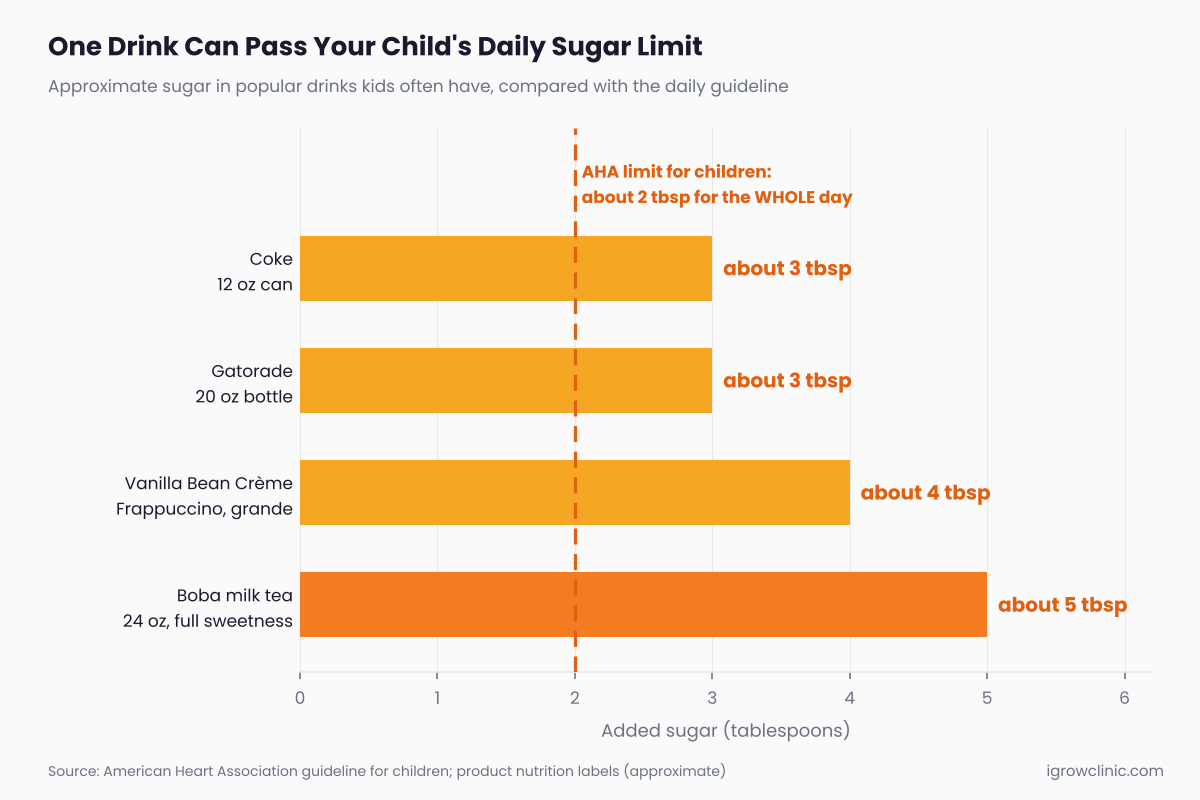
It helps to picture what is actually in the cup. A single 12 ounce can of Coke holds about 3 tablespoons of sugar. A 20 ounce bottle of Gatorade holds close to 3 tablespoons. A grande Vanilla Bean Crème Frappuccino from Starbucks, a favorite with kids because it has no coffee, holds about 4 tablespoons. A large 24 ounce boba milk tea at full sweetness can reach about 5 tablespoons. The American Heart Association recommends that children keep added sugar to about 2 tablespoons for the entire day. One drink can cross that line before dinner.
Sports drinks deserve a special mention. In many youth leagues, a bottle of Gatorade after every game has become part of the routine, often handed out by the team snack parent. It feels harmless because everyone does it. But for a child playing an hour of soccer or baseball, water usually does the job. Sports drinks were designed for long, intense exercise, and two or three games a week can quietly add up to several extra bottles.
A large analysis of studies covering more than 90,000 children found that each daily sugary drink was linked to a small, steady rise in body mass index over time. One drink a day will not change a child’s growth overnight. A daily habit sustained over years is a different story.
When parents search stunted growth causes, sugar rarely appears high on any medical list. Chronic illness, inherited short stature, and hormone problems are the common causes. When sugar plays a role at all, it is through the slow, cumulative route of weight gain.
None of this means a boba treat on the weekend is a problem. An occasional sweet drink is part of a normal childhood. The concern is a near daily habit that quietly becomes one more steady source of liquid sugar.
What Are the Real Signs My Child’s Growth Window Has Shifted?
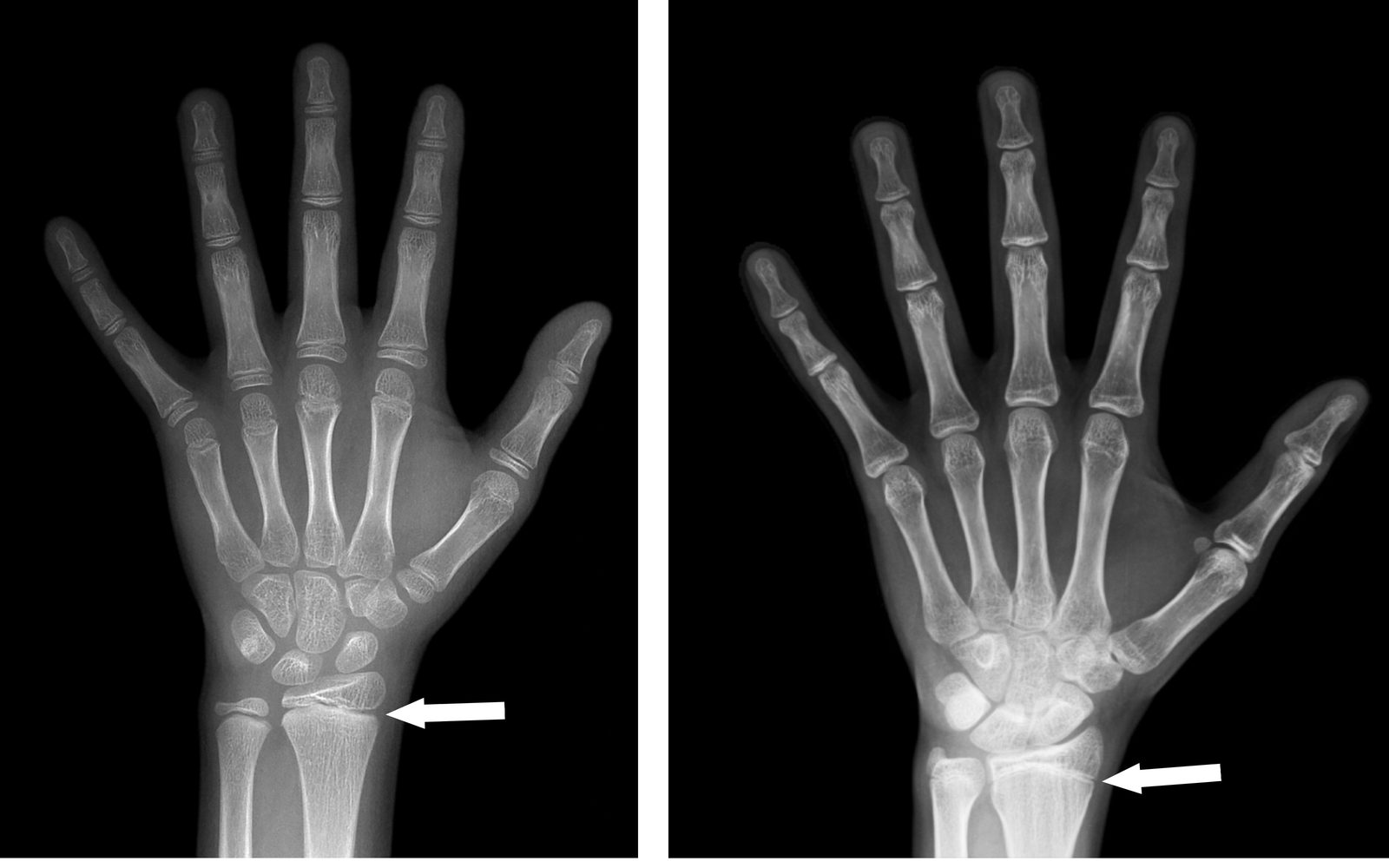
Among the things that stunt growth during puberty, an early start driven by weight gain is one of the most overlooked. Research on children with extra weight shows a pattern some clinicians call “tall early, short spurt.” These children often grow faster than their classmates before puberty. Then their growth spurt arrives early, ends early, and is smaller than expected, because the growth plates mature and close sooner.
🔍 If you want to understand the age range when growth plates typically close and how that timeline can shift, this guide breaks down what to expect for both boys and girls. What Age Do Growth Plates Close? A Parent’s Guide to the Timeline
This is why it goes unnoticed. A child who is tall for their age looks like they are doing well. The effect on final adult height is usually modest, often a few centimeters, but it is real, and it is easiest to catch while there is still growing time left. That makes the signs below worth knowing.
Here are signs you can actually see and track at home:
- Breast budding before age 8 in a girl, or testicular enlargement before age 9 in a boy
- A growth spurt that starts earlier than classmates, followed by growth that slows down faster than expected
- Weight climbing steadily on the growth chart while height does not keep pace with it
- A family history of early puberty or early weight gain alongside your child’s own pattern
If any of these sound familiar, a growth chart alone cannot tell you how much time is left. A growth plate evaluation combines a bone age X ray with growth velocity and pubertal stage. The result is grounded in your child’s own biology, not a guess based on averages.
🔍 If you have noticed any of the signs above and want a clearer sense of what a closing growth window looks like in practice, this is the place to start. How Do You Know If Growth Plates Are Closed? 3 Key Signs Parents Often Miss
If You Are Second Guessing Every Snack

Most parents who read a post like this are not careless. They are paying close attention. That is exactly why one comment from another parent, or one headline about sugar, can land so hard.
Watching your child stand at the end of the line in class photos is heavy in a quiet way. You notice it at birthday parties, at checkups, at the start of every school year. And when you are already worried, every boba run and every juice box starts to feel like evidence against you.
It is not. A drink your child enjoyed last week did not decide their adult height. What matters is what you do with the information you have today. Small, steady changes, like making water the default after practice or saving boba for the weekend, can shift a habit without taking the joy out of treats.
And if something still feels off about your child’s growth, that instinct deserves a real answer. Not a guess or a rule of thumb, but a clear look at how much growing time your child actually has left.
Get a Clear Answer for Your Own Child
Every child’s growth story is different, and that is how we approach every evaluation. Bone age analysis powered by AI reads each child’s growth plates with a level of precision that general growth charts were never built to offer. Because care here is concierge and 1:1, we keep new patient openings limited each week to protect that level of attention. Families can work with us in person at our Fullerton clinic, or through telehealth in California, New York, Washington, Florida, and Texas. The same clinical team reviews every case either way.
🔍 To understand why we built I Grow Clinic around exactly this kind of clarity, read: Why I Started a Growth Hormone Clinic
FAQ: What Parents Ask About Sugar and Their Child’s Growth
1. Does soda stunt growth?
Not directly. The sugar in soda does not act on bone or growth hormone by itself. A daily soda habit is different. It adds extra calories a child’s body barely registers. Over time, that steady extra intake can drive weight gain, and weight gain can shift puberty earlier, which shortens the growth window.
2. Does sugar affect growth hormone?
Not in the way many parents picture it. A sugar spike can briefly lower growth hormone levels, but the body recovers quickly. That short dip does not slow a healthy child’s growth. The more meaningful link runs through long term weight gain, which can shift puberty earlier.
3. Does junk food stunt growth?
Not directly, in most cases. The bigger concern is what junk food pushes off the plate. A growing body needs steady protein, calcium, vitamin D, and zinc to build bone and support height. When chips, fast food, and sugary snacks fill a child up, there is less room for the foods that actually fuel growth. An occasional treat is fine. A diet built mostly around processed snacks can leave a growing body running short.
4. Is boba bad for kids?
An occasional boba drink is not something to worry about. A single large one can carry a surprising amount of sugar, often more than a parent expects from a drink marketed as a treat. The concern grows when boba becomes a near daily habit rather than an occasional one. At that point, it turns into a steady source of liquid sugar calories.
5. What stunts growth in children?
Genuine growth stunting is rare in the United States. It usually comes from a hormone problem, a chronic illness, poor nutrition overall, or inherited short stature. If your child is consistently shorter than peers or has dropped across percentile lines on the growth chart, an evaluation can help sort out which of these, if any, is playing a role.