

“Six months into Adderall, dinner is three bites. His last checkup showed no height gain at all.”
“My daughter has been on Vyvanse for two years now. Would taking a break this summer help her catch up on height?”
“We were told the height slowdown is temporary. Temporary for how long? Nobody could answer that.”
That last question is the actual problem. It is not that no information exists about ADHD medication and growth. It is that most of what exists is written for an average child in a study, not for the specific child sitting across from you at dinner. I’m Jenny Diep, a nurse practitioner at I Grow Clinic. I talk with parents about this exact tension every week: two real medical priorities, ADHD treatment and healthy growth, pulling in opposite directions, with no clear answer for your own child.
Why Families Trust I Grow Clinic
| Credential | Detail |
|---|---|
| Children guided | Nearly 4,000 through personalized growth evaluation and treatment |
| Treatment retention | 95% of families who start treatment continue with our care |
| Approach | 1:1 concierge management using AI-driven bone age analysis |
| Board certification | ABPMR board certified |
| Experience | 20+ years of clinical experience |
| Reputation | 5-star Google rating across hundreds of reviews |
By the end of this article, you will understand what the current research shows about ADHD medication and height, whether a summer medication break does anything measurable for growth, and how a bone age evaluation can tell you whether your child’s slower growth is the expected pattern or something worth a closer look.
Does ADHD Medication (Adderall, Vyvanse, Ritalin, Concerta, Focalin) Really Slow My Child’s Growth?

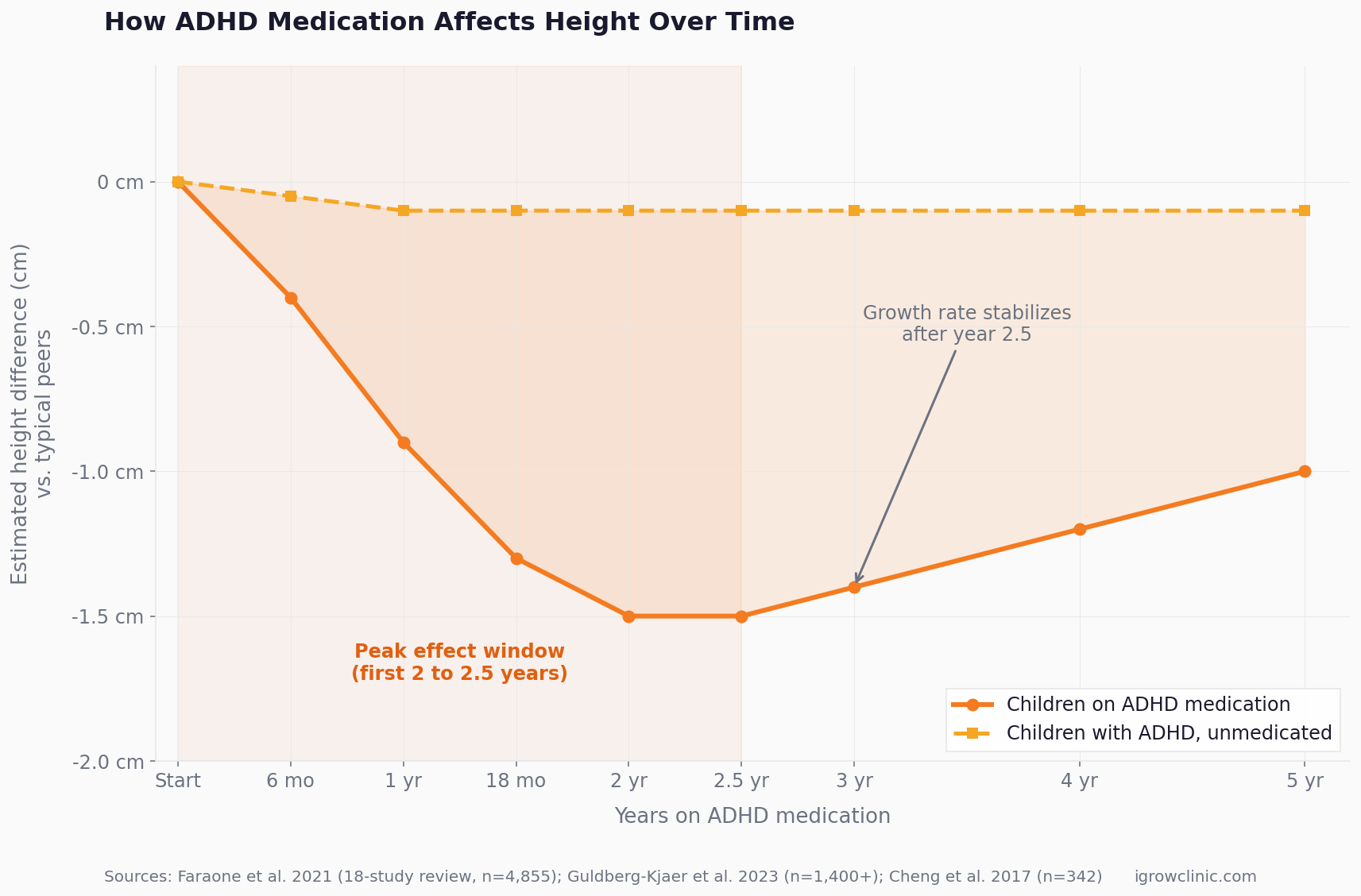
The honest answer is more specific than either extreme you have probably already read online. It is not “no effect at all,” and it is not “your child will end up permanently shorter.” A 2021 review pooling 18 studies and nearly 5,000 children found a real but small reduction in height, and the effect was concentrated almost entirely in the first two to two and a half years of treatment. Dose, formulation, and age did not change the size of that early effect much. What changes the picture is what happens after those first couple of years.
A large 2023 study following more than 1,400 children for two years, comparing kids on methylphenidate to kids with ADHD who were not medicated, found no meaningful difference in height velocity between the two groups once the severity of their ADHD was factored in. That is a genuinely useful finding, because it suggests a large share of the growth slowdown parents worry about is not a fixed, permanent drag. It is front-loaded, and it often evens out.
There is also a distinction worth making that almost no parent-facing source draws clearly: is it the ADHD medication doing this, or is it something about having ADHD in the first place? A 2026 study following nearly 35,000 children found that ADHD alone, without medication, was not associated with any meaningful difference in adult height. Children who were treated with methylphenidate had modestly higher odds of shorter adult stature, a small but real effect, distinct from ADHD itself. That reframes the question in a useful way. It is not about whether to treat ADHD at all. It is about whether your child’s growth pattern, specifically, needs closer monitoring while treatment continues.
Age when treatment started also matters. A 2017 study of 342 patients found a measurable height reduction only in children who started stimulant medication between ages 6 and 12. Children who started during adolescence showed no significant height effect at all. If your son started Concerta at age 7, his growth is worth watching more closely than a teenager who just started the same medication at 15.
🔍 If your child’s growth has slowed and you’re wondering whether growth hormone therapy could be relevant, this post walks through the qualification criteria. Growth Hormone for Height: Does My Child Actually Qualify?
Is a “Medication Break” the Right Way to Protect My Child’s Height?
The honest answer is going to disappoint a lot of families. Drug holidays are a real, guideline-supported strategy, but the evidence behind them is about weight, not height.
The best-designed trial on this question put children into three groups: weekend breaks, added daily calories, or continued monitoring. Both breaks and extra calories improved weight. Neither improved height. It took two consecutive summers off medication before any height difference showed up at all, and even then it was about half an inch.
What actually moves the needle on height is the lowest effective dose over time, not a planned pause built around the school calendar. If height is the specific concern, that is the conversation worth having with your child’s prescribing provider.
Medication breaks still make sense for appetite and dose reassessment. Just don’t rely on them as a height-protection plan. The research doesn’t support that use.
🔍 If you want to understand what a bone age evaluation actually shows about your child’s remaining growth window, this post explains how to read the results. Growth Plate X-Ray Interpretation: What Your Child’s Bone Age Results Actually Mean
How Do I Know If My Child’s Slower Growth Is Just the Medication, or Something a Specialist Should Check?
Slower growth on ADHD medication and a shortened growth window are two different things. Knowing which one you are dealing with changes everything.
A study that followed 40 children on ADHD medication against their unmedicated siblings found exactly this. The medicated children grew more slowly, but their bone age, the actual maturity of their growth plates, progressed at a completely normal rate. Slower growth velocity did not mean the plates were closing early. It meant growth was temporarily paced more slowly on a timeline that was still on track underneath.
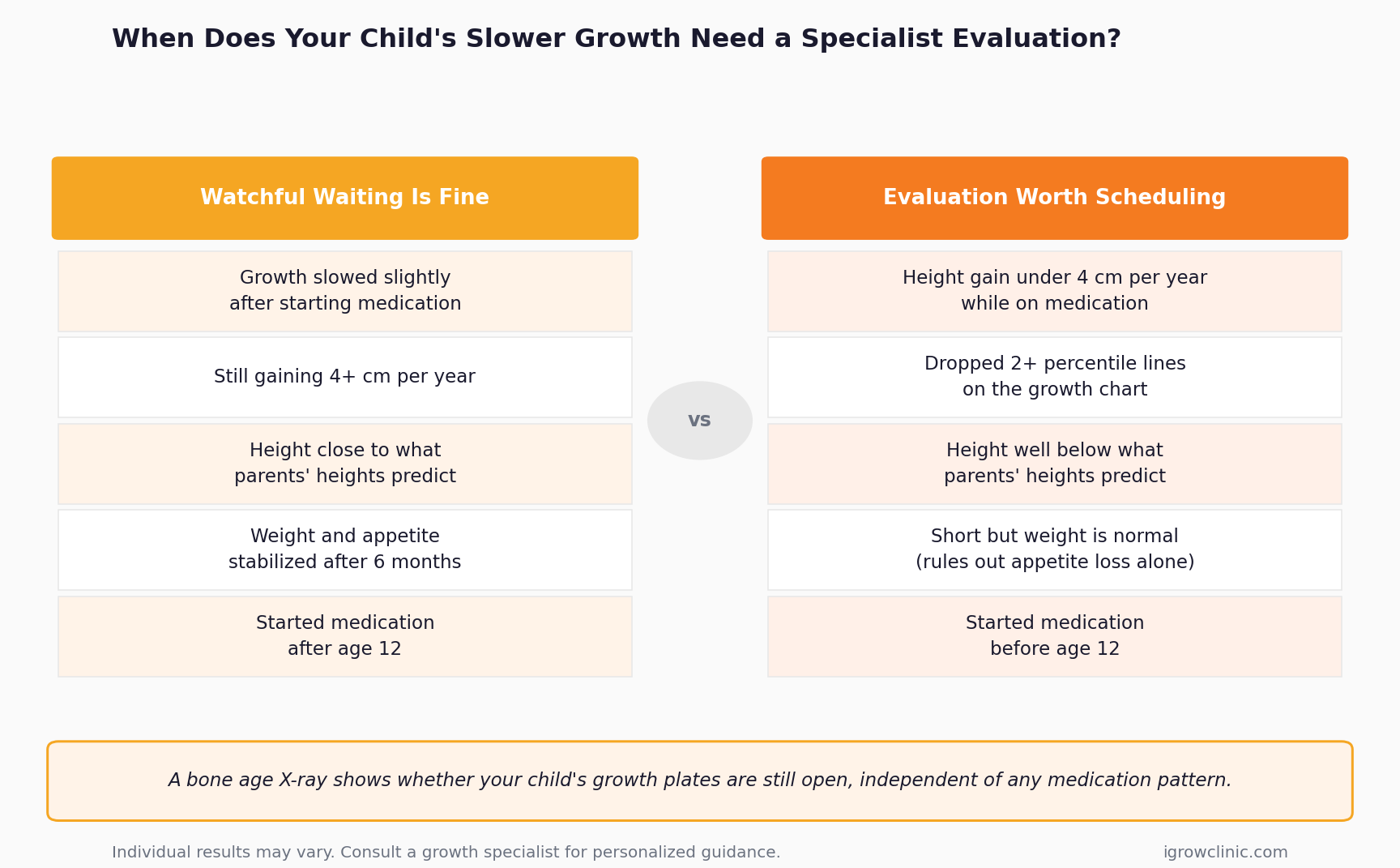
That is what a growth chart alone cannot show you. A chart tells you your child grew less this year. A bone age X-ray tells you whether his skeleton is still maturing on schedule, or whether something beyond the medication is affecting his growth window.
A few patterns suggest it is worth going beyond watchful waiting. Height velocity under 4 centimeters a year. A drop across two or more major percentile lines, especially if your child tracked one line consistently before starting medication. Height well below what both parents’ heights would predict.
One more distinction matters. A child who is short but at a normal or higher weight for his height is a different clinical picture than a child who is short and thin. Appetite suppression affects weight first. If weight is holding but height is not, that points toward something separate from the medication, and that is exactly the kind of detail a full evaluation is built to catch.
🔍 If you want the fuller list of signs that a child’s growth window may be closing faster than expected, independent of any medication, this covers it directly: How Do You Know If Growth Plates Are Closed? 3 Key Signs Parents Often Miss
Many parents land on this question after one specific number on a printed growth chart, a percentile that moved between two well visits with little explanation attached to it. That single number cannot tell you on its own whether the shift traces back to the medication, to ordinary variation, or to something unrelated that happens to be showing up at the same time.
🔍 And if a percentile drop is the specific thing that triggered your concern in the first place, this walks through what that number can and cannot tell you on its own: Your Child’s Height Percentile Dropped This Year: Should You Worry?
At I Grow Clinic, we check whether his growth plates are keeping pace using AI-enhanced bone age analysis rather than a single measurement compared to a population average, which is what answers the question a growth chart alone cannot.
You Are Not Choosing Between Your Child’s Focus and His Height
You do not have to choose between treating ADHD and protecting your child’s growth. In the overwhelming majority of cases, both are possible at the same time, with the right monitoring in place. The families who feel most at ease are not the ones who stopped medication out of fear. They are the ones who got a clear, individual answer about where their child’s growth stands, instead of guessing from a population statistic that may or may not describe their own kid.
For children whose growth has fallen meaningfully behind despite good monitoring, that answer sometimes opens a different conversation. Growth hormone therapy has been studied in children with growth suppression from long-term stimulant use, and for some of them it has made a real difference. If you want to see what that looks like in practice, our before and after results show how children at I Grow Clinic have responded to treatment. It is not the right path for every child, but it is worth knowing the option exists, and that knowing requires an evaluation, not a guess.
What Comes Next for Families Weighing This Decision
Our clinical team reviews every growth case with the combination of tools: a detailed history including medication timeline and dose, a physical exam, and AI-driven bone age analysis that compares your child against thousands of reference data points rather than a single average. For a child on stimulant medication showing a growth slowdown, that evaluation is what separates the expected, temporary pattern from something that genuinely needs a different plan, whether that means adjusting the ADHD treatment itself or addressing a separate growth concern entirely.
New patient openings are limited each week to protect the quality of that 1:1 attention. Families can work with us in person at our Fullerton clinic or through our telehealth program for families in California, New York, Washington, Florida, and Texas, and either way, the same clinical team reviews the results.
🔍 To understand why we built our clinic around exactly this kind of individualized answer, read: Why I Started a Growth Hormone Clinic
FAQ: What Parents Ask About ADHD Medication and Their Child’s Growth
1. Does ADHD medication stunt growth permanently?
Not typically. Research shows a small reduction in height that is concentrated mostly in the first two to two and a half years of treatment. Many children’s growth trajectories even out after that period, especially when the medication was started during adolescence rather than early childhood.
2. Does Adderall stunt growth more than Ritalin or Vyvanse?
No strong evidence points to one stimulant brand causing more height effect than another. The research consistently ties the effect to duration of treatment and the age a child started medication, not to which specific stimulant was used.
3. Do stimulants stunt growth because of appetite loss, or something else?
Appetite suppression is the main driver. Less food intake, especially at growth-critical meals, is the mechanism behind most of the height and weight effects seen in the research, which is also why the effect tends to lessen once a child’s eating pattern stabilizes.
4. Should we do a medication break every summer to protect his height?
Medication breaks can help with weight recovery and are a reasonable way to periodically reassess dosing, but the best available research found they did not meaningfully improve height on their own. If height is the specific goal, a supervised evaluation of dosing over time matters more than a fixed summer schedule.
5. How do I know if my child’s slower growth needs more than watching and waiting?
Signs worth a closer look include height gain under about 4 centimeters a year, crossing two or more major lines on the growth chart, or height that has fallen well below what your child’s family height would predict. A bone age evaluation is the most direct way to find out whether these signs reflect the expected medication-related pattern or something else.